Kimmitt Genealogical Research

Showing posts with label Memorial Day. Show all posts

28 May 2012

Our Loved One Sleeps For His Country's Flag: Pvt. Hosea Orcutt Barnes (1842-1864)

by Fearing Burr and George Lincoln, 1876

Today is Memorial Day. Somehow Memorial Day and Veterans Day have morphed into similar holidays and many people don't know the difference. Memorial Day is in danger of being swallowed up by Veterans Day. It's not a huge deal, really, and I'm glad that people pause to remember servicemen at all on this weekend that is most commonly associated with barbecues, the start of summer, being granted permission to wear white shoes, and the Indianapolis 500.

On both holidays we make a point to let our servicemen know we are grateful to them for keeping us safe. We salute the flag, hear veterans' memories and pause to pray. After all, the vets are still among us, and we need to make it clear to them how precious they are to us. And of course, we take a minute in our incredibly self-obsessed lives to be grateful for what we have. But there is actually a difference in these two holidays, and a place for both.

The tradition of decorating the graves of fallen soldiers with flowers is surely timeless. But after the Civil War, the sheer numbers of lives lost caused people to gather and pause, and eventually the practice was formalized into Decoration Day. By the early 20th century, decorating graves extended beyond soldier's graves to all family members, and it has become a sort of Day of the Dead. But Decoration Day was already well established when we declared Armistice Day, a day to remember all those who had fallen in World War I. In Great Britain, Armistice Day was also called Remembrance Day because they didn't have the equivalent of our Decoration Day. In the US, Armistice Day was renamed Veterans Day in 1954, and on that day we celebrate and remember the horrors, thank the veterans, acknowledge that peace is much nicer than war, etc.

But just for today let's talk about remembering and memorializing those who actually died in battle or in service to our country. Not to minimize the suffering of returning veterans or their families. My own brother was a veteran and died prematurely because of exposure to Agent Orange in Vietnam.

My work on Army repatriation cases makes this a sore spot for me. Most of the servicemen whose families I trace were just about 20 years old and not married when they disappeared or perished. Many have no one left who even remembers them--no one even interested in claiming the remains, or being honored by a stately military funeral. The serviceman's sacrifices have disappeared into a file somewhere in St. Louis. He is invisible. And I'm not talking about the Civil War. I'm working on Korea and World War II. Poof. It's like these kids never lived, fought, suffered or died. I sit with the file and wonder if I'm the only person alive who knows and cares, and is grateful.

So I went through my own files to find a family member who died young and unmarried. I don't have too many, thankfully. But this one actually did fight in the Civil War. He got plenty of accolades, perhaps more than usual for a private. But I want to thank my first cousin three times removed, Private Hosea Orcutt Barnes. Hosea was mustered into the Massachusetts 10th Battery, Light Artillery on September 9, 1862, just after turning 20.

Pvt. Hosea Orcutt Barnes,
photo from Barnes family album
Fearing Burr and George Lincoln's 1876 book, The Town of Hingham in the Civil War... (available on Google Books) tells us on pp 324-25:

Hosea Orcutt Barnes, whose name is upon the Soldiers' and Sallors' Monument, son of Elisha J. and Harriet A. (Peakes) Barnes of Boston, was born in Scituate, Mass., June 13, 1842. He joined the Tenth Light Battery, under Capt. J. Henry Sleeper, and was mustered as private, Sept. 9, 1862.

During the time young Barnes was connected with the battery, it was engaged at Kelley's Ford, Mine Run, Po River, Spottsylvania, and North Ana.

May 30, 1864, the battery went into position on the south side of Pamukey River, at a place called Jones' Farm, and was about to engage the enemy, when a detachment of four men was sent to cut down a tree which stood in a position that 'prevented accurate firing.[no end quote] The men returned and reported that it could not be accomplished by reason of exposure to the enemy's sharpshooters. Private Barnes then *volunteered* to perform the duty, and had removed the obstruction when he received his death-wound.

He was a promising young man, and a favorite with all who knew him.

A marble tablet, erected over his remains in the Hingham cemetery, bears the inscription:––
HOSEA O. BARNES
member of 10th Batt., Mass. Vols.
killed at Jones' Farm, Va.
May 30, 1864
Aged 21 years, 11 months.
-------
Our Loved One Sleeps
For His Country's Flag
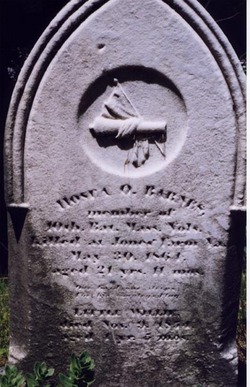

Tombstone of Hosea O. Barnes and Little Willie,
Hingham Cemetery, Hingham, Massachusetts,
FindAGrave.com, memorial n. 2012533, added by MP, 27 Jun 2007;
(www.findagrave.com : accessed 28 May 2012).
I located a History of the 10th Battery, Mass Light Artillery, 1862-1865 online and it has a description of Hosea's death, but it is not as detailed as the one I found on a website dedicated to Hosea back in 2001. You can reach it via the Wayback Machine at:
http://web.archive.org/web/20080217210820/http://home.earthlink.net/~mmp2000/index.htm. The author was Mary Powers. She said:

It was high noon when three Union soldiers scrambled over the works to clear away brush that obstructed the view of the gunners. A single shot rang out from a rebel sniper's gun and found its mark. Private Hosea Orcutt Barnes lay mortally wounded from a Minie ball. He was just one month shy of his 22nd birthday...As reported in the battery's history written in 1909: "It was Hosea O. Barnes, Number Three man on the Third piece. One of his companions lifted him up and bore him into the breastworks, but he was rapidly entering the valley of shadows. ‘I am about gone,' were the last words that passed his lips. Shrouded in his shelter tent he was laid in a grave dug near by, and the spot marked by a hastily carved board placed at his head. His death cast a deep gloom over the Company, for his many good qualities as a soldier, notably his genial temperament and good humor, had made him a general favorite."

01 June 2010

Flag-Waving

Memorial Day used to have a different feel to it and I'm not sure if that's because I have grown up or times have changed. I remember teachers in school using it as a springboard to discuss a plethora of subjects––patriotism, geography, war, loyalty, compromise, religion, history, tolerance and medical curiosities. We sang patriotic songs in music class. We read proclamations aloud at solemn school ceremonies. Widows and mothers wept. But the parades were big and loud, and men were proud of the part they had played in protecting the country and fighting for freedom. And we were proud of them. It was easy to confuse the bass drum's reverberations in your chest with your excited heartbeat. Two of my greatest life passions were forged at those Memorial Day parades: music and history. We were all on the same team and it felt good. It all boiled down to the flag in my young mind: the bigger the flag the happier and safer we must be. We gathered together underneath it, one people, one goal, one pledged allegiance, secure and calm.

I was born in 1955, ten years after World War II ended. Our life was comfortable, my world safe, and most of what I knew about the outside world was brought to me courtesy of whitewashed images on television and in the movies. My parents presented the rest in an optimistic, dumbed down, yet stiff-upper lip fashion. People were kind to me and I learned to be kind to others. There was nothing we couldn't "rise above."

Early imprinting: Grandma Barnes with two equally patriotic pals by her huge flag!

From that vantage point the nastiness of war seemed more unfortunate than horrific, yet we knew there was more. When kids are curious, uneasy or scared they are likely to play their way to some resolution. Consequently, both boys and girls played games of war, swooping around making bomber noises, diving into makeshift kid-bunkers, attacking the enemy on their weak right flank (Mrs. Welch's iris garden). We re-enacted grade B "cowboys & Indians" films, and the younger you were, the more likely it was you'd get the role of the scalping, whooping wild Indian. We used to don pretend gas masks before attacking a stockade fort, mixing Indian massacres together indiscriminately with the Civil War and World War One battles. It was all about fighting, death and mourning, and always culminated in a jubilant ceremony in which the winner slowly raised the American flag over his or her conquered territory. The flag was the resolution of the problem, symbol that all was once again right with the world. No need to fear.

Jared FitzGerald in Vietnam 1965

My oldest brother went to Viet Nam when I was in elementary school. I still didn't have much use for history or wars and much preferred playing house or dolls, and school. I couldn't figure out why men fought all the time instead of just working things out. But of course, Viet Nam changed the perspective of the entire country, not just baby boomers, and nothing was clear any more. The war seemed unwise to my immature mind, but it was scary, and I mostly turned away. I wrote goofy letters to my brother, listened to the occasional reel-to-reel tape he would send, and boasted about him being in the Air Force to anyone who would listen. All I knew was that my brother was in danger and many civilians were dying right along with soldiers. Oh dear. Hard to raise a flag over slaughtered women and children. Still, the flag was a comforting reminder of the freedom we were able to enjoy. It represented our ideals, not stark reality. You don't only wave it when times are clear and solutions easy. You wave it to show that as long as we continue to be a team, with common goals and compromise, we'll be proved right and all will work out–the founding fathers will be vindicated. I waved the flag, supported the veterans and was very, very grateful when my brother returned home. My other brother came of age later in the war, when things were not going well and it was apparent to many that it was an unwise war. He managed to avoid the draft. I understood how he felt, as well, but never stopped waving that flag. 

Today Memorial Day today seems rife with anger and accusation, one political party constantly accusing the other of sowing seeds of revolution. The memories are fresh and raw, and it's the veterans themselves who weep while recounting their experiences and mourning their fallen comrades. Waving the flag can seem filled with vengeance and hatred for the enemy, rather than a common rallying cry. People carry on banale conversations during the services, completely oblivious to why they have even joined together this day. This year, as a prayer was being offered, a man behind me said, "So, how's the potty training going?" 

Memorial Day 2010, "Family Planting"

While planting flowers at the cemetery this weekend it occurred to me that my strong positive feelings toward my country and my flag are ignored by many in the country. Half of the country believes that because I am a Democrat I must hate the flag, hate America, love communism, want the downfall of the United States. How can this be? I thought we were on the same team? I wave my flag more frantically. "I'm with you! We're on the same team!"

OK, yes, I have a thing about flags. I like big ones, and I'm going to continue to wave mine as long and hard as I can. After 911 I got a gigantic one that had flown over the US Capitol and donated it to my DAR Chapter when my term as Regent was up. I have little ones that I like to put in my garden on appropriate holidays. But I have grown up and now see that the flag is not a wand: waving it does not banish problems: that will take some growing up for all of us. It's time to stop the name calling, put on our thinking caps and come up with some positive solutions. Wave a flag to show your solidarity with the basic values of American culture. E Pluribus Unum!

With my brother Tim, by Jed's grave, two flag-waving Democrats.


Gravestone of my Irish grandparents, Patrick J. and Annie J. (Sullivan) FitzGerald, and two of their children, Mary and Frank. Daughter Theresa and her husband Hugh Bradshaw are listed on the back of the stone. Mt. Pleasant Cemetery, corner of Chestnut and Mystic Streets, 70 Medford St., Arlington, Massachusetts.