Kimmitt Genealogical Research

Showing posts with label England. Show all posts

03 May 2016

Elsie's Receipt Book--The Heart of the Home

Good cooks have always collected recipes, or receipts as they were sometimes called. My mother-in-law's mother, Elizabeth Mary Stephens (Drapes) Churton, aka Elsie, was no exception. We recently uncovered a little journal, begun on 16 June 1918, eight months after she married, and about the time her husband was to return home from World War I, minus an arm and in need of much nurturing.

Elsie was born 12 July 1885 in Enniscorthy, Co. Wexford, Ireland. She met her future husband Harry Leslie Churton when he was working at the Asylum there as an electrician.


Cooking being at the heart of what we consider home and family life, this little book gives us insight into Elsie's world. Maybe because Elsie was born and raised in Ireland she didn't know some of the recipes that the English ladies already had ingrained in them, but for whatever reason we find some classic English foods, along with little hints. The page below has a very simple recipe for that most cherished dish, Yorkshire Pudding.

Beneath that is a key to which sauces must be served with which meats. Critical that the sauce changes depending on cooking method, so a roast chicken demands bread sauce, while boiled chicken wants a parsley or egg sauce. I remember my mother-in-law still holding to these hard and fast rules and wish I had known at the time that she had it all written down! Entertaining the in-laws might have been a little less stressful had I been able to anticipate the proper sauces!


Initially I thought it would be fun to work through each recipe in order, as an homage to ancestors, cooking and love, but mayonnaise sauce and many of the other treats don't really fit into our current dietary regime. What else, what else might Elsie have a receipe for?

We learn that Elsie was an orderly sort, for she created an index at the back of her little book. Oh, I like this lady!


Now this would all be quite wondrous enough, but upon further examination I found that Elsie and I have a few other things in common. First, she was a singer! While techniques may have changed a bit, I love that she recorded these warm-up exercises.


As if that weren't enough to put me into a swoon, I then discovered we have a pastime in common--knitting! Here are directions for making socks for her new husband. Now there's something I could try. You can see that she has squeezed in a receipt at the bottom, sideways, just as my mother-in-law Rosemary used to do on aerogrammes when she wrote to us and had one last message!


Finally, in anticipation of having children, Elsie also had some instructions for knitting baby garments.


Did mother-in-law Rosemary and Auntie Tealy (Sheelagh) end up wearing these woolly pants? Probably!

If we are lucky our genealogical research turns up documents, and many of those are dry--full of facts, and lacking in warmth, but helping us link together the generations with proof. Most are transactions between men concerning war, purchases, migration, and death and probate, in sum, the harsher side of life. This pleasing little journal, on the other hand, gives us a peek into the softer side of our family history and we will cherish it always.

10 February 2015

Week #6 of 52 Ancestors: Samuel Cox of Beaminster, Dorset, England

I'm working in Salt Lake City at the Family History Library for ten days. In recent years, the way we research has changed considerably, and it will continue to change. Today when I search the library catalog I'm just as likely to find the records I seek on the FamilySearch website as in the microfilm. It speeds up my research tremendously to have it online, but also makes me think I shouldn't do what I'm doing because I could do it later at home. However, I must strike while the iron is hot!


Beaminster Church Tower from the Northwest,
Hine, History of Beaminster
Though the Kimmitts take great pride in their Irish blood, they have married into several English lines, and the Cox family is one of them. I wrote about Robert Fitzgerald Meredith in my previous post. Robert was not the eldest son and therefore did not inherit property because of the law of primogeniture.

As a young vicar he got a posting in Dorsetshire and there met his wife, Mary Russell Cox, thus introducing the English Cox line into the family. Mary was baptized in Beaminster on 22 September 1826, the daughter of our subject, Samuel Cox, and his wife Virtue/Vertue Russell. (1)

By bouncing between the Dorset parish record extracts on FindMyPast.com, and images on Ancestry.com, and FamilySearch.org I'm able to add quite a few names to the old tree, with pretty solid evidence to back it all.

Samuel Cox was born on 9 September 1790 in Beaminster and baptized on 16 December of the same year, the son of Samuel Cox and Ann, image below. (2)


We know Samuel's mother Ann's surname was Symes from their Beaminster marriage record: "1790, Samuel Cox Jun.r and Ann Symes both of this Parish were married in this Church by Banns this 23rd Day of March by Hugh Pugh Curate." I wonder if the local kids mocked poor Hugh Pugh for his name? You may have noticed that Baby Samuel was born only five and a half months after his parents' marriage. They may have been brought up for punishment, or at least a good scolding.

It's a very nice record because it has witness signatures. The last one is young John Cox Russell, aged 6 years, making his mark. Isn't that cute? I've never seen a minor listed like that. I can just see him all dressed up and excited to be playing a part in the wedding. (3) I  do not yet know how, if at all, he is related to the groom, but find in the parish registers that he is the son of John and Mary Cox–which John Cox will have to be determined at a later date. (4)


The History of Beaminster has an entire sketch on the Beaminster Manor House, "home of the old Beaminster family of Cox for many generations... The name is [first] mentioned in a transcript of the parish Register for the year 1585 when Robert, a son of Robert Cox, was baptized." (5) The author, Richard Hine, refers frequently to the work of historian John Banger Russell, a meticulous historian and collector who just happened to be Vertue Russell's father. The book is very carefully researched and assembled and refers frequently to original records--a gold mine for Beaminster researchers! I'm thinking he probably also assembled a good deal of genealogical information as well, tee hee.

The banns of marriage were announced for Samuel Cox the younger and Vertue Russell three times in Beaminster before they married on 9 September 1816, Samuel's 26th birthday. (6)


Hine describes renovations Samuel made to the manor house around 1822: "In the drawing room he placed a handsomely carved white marble mantelpiece of Italian workmanship, the sculpture of which vividly depicts scenes connected with the siege of Troy. This apartment was further enriched by a painted canvas ceiling representing the "Feast of the Gods" by Andrew Casali, an Italian artist born at Civita Vecchia, in 1720." (7)


Fireplace at Beaminster Manor House (8)
It's not often we get to see how our ancestors' homes were decorated. I wonder if young Mary frolicked around this fireplace and was motivated to studied her history lessons because of the scenes of the Trojan War carved into it.

Nine also relates that: "When Princess Victoria, in 1833, passed through Beaminster, Samuel Cox, then a Cornet in the Dorset Yeomanry Calvary, had the honor of commanding the escort of Her Royal Highness from this town to Lyme Regis. Samuel Cox, Deputy Lieutenant and a Justice of the Peace for Dorset, was for more than [a] quarter of a century Chairman of the Beaminster Union Board of Guardians. On his death in 1860 the family estates passed into the possession of his eldest son, Samuel Symes Cox." (9)

Samuel and Virtue had (at least) the following children, which I find in census and parish records, but have not yet thoroughly documented (10):
Samuel Symes, b. 4 September 1817
John Russell, b. ca 1820, twin
Charles, b. ca 1820, twin
Ellen, b. ca 1822
Henry, b. ca 1824
Ann M., b. ca 1826
Mary Russell, b. ca 1826 (line carrier)
Georgina, b. ca 1828

Samuel died in Beaminster on 22 October 1860. He is buried at Holy Trinity, Beaminster. (11)


We have a nice will extract here, naming Samuel's widow Vertue, brother Peter, and son Samuel Symes Cox. As stated above, Samuel's son Samuel Symes Cox inherited the property.

-------------------------------------------------------------
Notes

1. “Dorset, England, Births and Baptisms” (online database), baptisms, p. 166, Mary Cox, n. 1828, 22 September 1826, Beaminster daughter of Samuel and Virtue Cox; Ancestry (http://www.ancestry.com : accessed 9 February 2015); citing Dorset History Centre; Dorset Parish Registers; Reference: PE/BE.

2. "Dorset, England, Baptisms, Marriages and Burials, 1538-1812, " (online database), baptisms, no p. n., Samuel Cox, baptized 16 December 1790 (born 9 September 1790, Beaminster; Ancestry (http://www.ancestry.com : 9 February 2015); citing Dorset History Centre; Dorset Parish Registers; Reference: PE/BE: RE2/3.

3. “Dorset, England, Baptisms, Marriages and Burials, 1538-1812," marriages, Samuel Cox Junior and Ann Symes, 23 March 1790,  Beaminster; citing Dorset History Centre; Dorset Parish Registers; Reference: PE/BE: RE 4/2

4. "Dorset, England, Baptisms, Marriages and Burials, 1538-1812," baptisms, John Cox, 24 December 1783, Beaminster;; citing Dorset History Centre; Dorset Parish Registers; Reference: PE/BE: RE2/2.

5. Richard Hine, The History of Beaminster (Taunton, England: Barnicott and Pearce, 1914), 350-353.

6. “Dorset, England, Marriages and Banns, 1813-1921” (online database) Banns, n. 45, Samuel Cox and Vertue Russell, 11, 18 and 25 August 1816, Beaminster; citing Dorset History Centre; Dorset Parish Registers; Reference: PE/BE: RE 4/2 - 4/6. And “Dorset, England, Marriages and Banns, 1813-1921,” marriage, Samuel Cox and Vertue Russell, 9 September 1816, Beaminster, p. 20; Ancestry (http://www.ancestry.com : accessed 9 February 2015); citing Dorset History Centre; Dorset Parish Registers; Reference: PE/BE: RE 4/2 - 4/6.

7. Hine, The History of Beaminster, 351.


9. Hine, The History of Beaminster, 352.

10.1841 England Census, Beaminster, Dorset, piece 280, bk. 1, folio 58, p. 26, household of Samuel Cox; Ancestry (http://www.ancestry.com : accessed 10 February 2015); citing Class: HO107; Piece: 280; Book: 1; Civil Parish: Beaminster; County: Dorset; Enumeration District: 3; Folio: 58; Page: 36; Line: 6; GSU roll: 241337. Also, 1851 England census, Beaminster, ED 1b, piece 1860, folio 389, p. 18, household n. 91, household of Samuel Cox; Ancestry (http://www.ancestry.com : accessed 10 February 2015); citing Class: HO107; Piece: 1860; Folio: 389; Page: 18; GSU roll: 221008. Also Dorset Parish Registers on Ancestry.

11. "England and Wales, FreeBMD Death Index, 1837-1915" (online database), Samuel Cox, Beaminster, Dorset, 22 October 1860, 5a:225; Ancestry (www.ancestry.com : 27 Mar 2011). Also, "England and Wales, National Probate Calendar (Index of Wills and Administrations), 1861-1941" (online database) Wills, 1861, p. 38, 7 May, Samuel Cox, died 22 October 1860; Ancestry (http://www.ancestry.com : accessed 9 February 2015); citing Principal Probate Registry, Calendar of the Grants of Probate and Letters of Administration made in the Probate Registries of the High Court of Justice in England. Also, "Dorset, England, Deaths and Burials, 1813-2010" (online database), Samuel Cox, 26 October 1860, Holy Trinity, Beaminster;   Ancestry (http://www.ancestry.com : accessed 9 February 2015); citing Dorst History Centre; Dorset Parish Registers; Reference: PE/BE.


28 January 2015

Week #4 of 52 Ancestors: Emily (Churton) Churton (1847-1918)


Emily Churton was the granddaughter of William Churton, daughter of William Churton, wife of William Churton, sister of William Churton, and mother of William Churton.

She was born 21 November 1847 in Whitchurch, Shropshire, England, the daughter of William Parker Churton and Jane Weaver. (1) She was my husband Myles's great-grandmother: his mother's father's mother. So he will not have inherited any Y-DNA (male), or mitochondrial DNA (straight female line)--just autosomal, and not too much of it at that distance. This is his only English line, the other three grandparents being of Irish descent.

Little is known about Emily. On 25 August 1868, she married her first cousin William Henry Churton in Whitchurch.  Their fathers were brothers, sons of William Churton and Anne Parker. (2)

"Births, Marriages, and Deaths," Churton-Churton, 25 August 1868, Whitchurch, Shropshire, England
Solicitors' Journal and Reporter, 5 September 1868, 915; Google Books (http://www.books.google.com).
This was really not a great idea, especially since the family lore depicts Emily as already being high-strung. At least that's the story my mother-in-law used to tell. (3) And it will mess up the DNA measurements, giving undue weight to Churton ancestor relationships.

When our youngest son was christened he was presented with Emily's Bible. It does not contain any genealogical information, just two inscriptions on the inside cover as shown below. William Henry, aka Harry, originally gave this Bible to Emily on 21 November 1869.


Apparently they had consulted the Table of Kindred and Affinity and found nothing to discourage them from marrying, though I will say that number 6 comes pretty close: "Wherein whosoever are related are forbidden in scripture and our laws to marry together: Father's Brother's Wife." Just one more step and it would have been forbidden. I really can't believe there are no cousins on there.


Margaret's work tells this story: "According to a diary kept by Emily, the wedding was at 11 o'clock in the morning (Rev. W. H. Egerton and Rev. John Gorman officiating) and after the wedding breakfast they left for London. The next day they crossed the channel from Folkestone to Boulogne and spent their honeymoon touring on the continent -- for four weeks." (4)

Emily and William Henry Churton went on to have four children, all born in Chester, Cheshire:
  • Ida Helen, 18 September 1869–23 May 1937
  • Jessie Lillian, 3 March 1873–28 August 1946
  • William Arthur Vere, 16 December 1876–26 July 1949
  • Harry Leslie, 4 August 1879–17 February 1964 (5)
Because I've known Margaret Churton is researching Churtons I haven't delved into them. But when reading through Margaret's great summary of the family documents she inherited I realize hers is not a traditional genealogical study--many record groups were omitted. With 2015's ease of internet searching it will be a much simpler chore than it would have been in 1983 when her work was created. And it gives me a goal for next trips to the UK.

I have only dabbled, but Emily appears in the UK censuses consistent with where family stories and documents say she should be. Most of these Churtons are listed in the Birth, Marriage, and Death indices on Ancestry. I have plenty of work ahead documenting the facts, that's for sure.

Emily died on 21 August 1918, after "deterioration of her mental health necessitated a move into a 'home' of some sort... at Gan-y-Don, Colwyn Bay. She is buried in Chester. (6) This cries out for investigation!

A quick visit to the website of The National Archives (http://discovery.nationalarchives.gov.uk) brings up reference to "Deeds and papers relating to the estates of the Churton family, auctioneers and solicitors, in Cheshire, Shropshire, Wales etc", deposited in the Cheshire Archives (not NA) by none other than Margaret!

Reference: DBC 3233
Date: [1635]-1947
Held by: Cheshire Archives and Local Studies, not available at The National Archives
Language: English
Extent: 44 docs., 18 bdls.
Custodial history: Acc. 3233
Immediate Source Of Acquisition:  Summary list of records deposited by Mr H T V Churton in Apr. 1983.

I can't wait to really dig in to those Churtons. They have a noble and interesting history.


-----------------------
Notes

1. A. M. G. ["Margaret"] Churton,  "A Churton Story from Heirlooms and Archives," (hereinafter called "A Churton Story"), typescript, "mostly written in 1983, with some later revisions," photocopy sent to author in 2011, pedigree chart. Margaret is the keeper of the Churton family papers and has inherited much original documentation, along with very old pedigree charts, photographs, and business papers. She is thorough but does not use many of the more common genealogical records groups like census and vital records, nor does she cite her sources. Also, “England and Wales, Free BMD Birth Marriage and Death Indexes, 1837-1915, and 1916-2005” (hereinafter called Free BMD) digital image of index register pages, birth of Emily Churton, 21 November 1847, Wem Registration District; Ancestry.com (www.ancestry.com : ), 18:179. Wem was originally called Wem and Whitchurch, and after 1935 known only as Whitchurch.

2. Free BMD, marriage of Emily Churton and William Henry Churton, 25 August 1868, Wem; 6a:1192. Also Margaret Churton, "A Churton Story," pedigree chart.

3. Ida R. (Churton) Kimmitt, conversation relating family history to author, 10 September 1988. Also Margaret Churton, "A Churton Story," 14.

4. Margaret Churton, "A Churton Story," 14.

5. Margaret Churton, "A Churton Story," pedigree chart, and throughout.

6. Margaret Churton, "A Churton Story," 14 and pedigree chart. Also, Free BMD, deaths, 1918, 11b:542.

13 January 2015

Week #2 of 52 Ancestors: Robert Robertson Kimmitt, 1871-1951, Man of Many Titles

Robert Robertson Kimmitt, O.B.E (Mil.), T.D., D.L

This is my second post in the "52 Ancestors in 52 Weeks" blogger challenge. So far, so good!

This week I'm switching to the Kimmitt side. I get many inquiries from Kimmitt cousins around the world and I'm afraid I've been telling them all the same thing since 1993: when I retire I hope to tie together all those loose cousin threads and produce a family history. In the meantime I'm gathering evidence here and there, and always happy to hear from members of all branches, from New Zealand to Canada. Part of the reason I don't like to write is because it feels endless. There is so much to say about some people, and Robert Robertson Kimmitt is one of them. So I will present some of the odds and ends I have assembled on him to date.

Robert Robertson (RR) Kimmitt was my husband's great-grandfather. He was the second youngest of the ten known children of the Reverend Edward Kimmitt and his wife Margaret Unwin, born 4 December 1871 in the little village of Benturb, County Tyrone, Ireland, near Moy (1). Guide books say that Moy is one of the most beautiful towns in Ireland, especially in summer when it is "filled with flowers from top to bottom" Yet I could NOT convince his descendants to visit his place of birth when we were on vacation in Northern Ireland this past summer! I can't imagine why, but they were afraid I'd get sidetracked.


The Rev. Edward Kimmitt was minister of the Prebysterian Church in nearby Loughgall, "Cloveneden," when son Robert was born, and he baptized him there on 3 March 1872 (2). Edward Kimmitt appears in Griffith's Valuation in 1864 in Ballygassey. (3) I haven't researched the Kimmitts on the ground in Ireland yet but I believe a research trip to Belfast is in order!

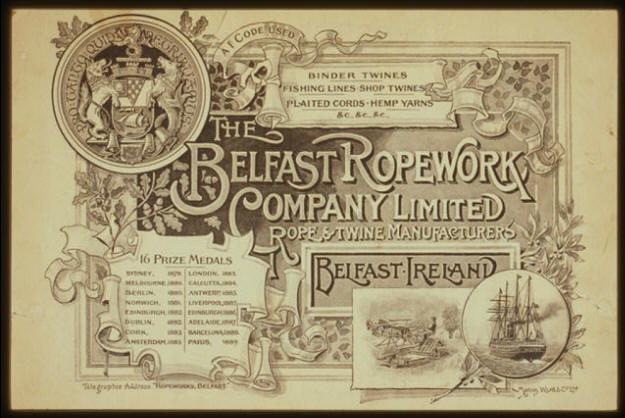
Robert married Elizabeth Marie Rowand Loudon in Belfast on 2 August 1899. Robert's occupation was "agent" (4). Though I can't put my finger on the source, I know that he was an agent for the Belfast Rope and Twine company. They moved to London by 1900 when son Gordon (my husband's grandfather) was born, and in 1901 the family is in Ealing, a borough of London, at 38 Egerton Gardens. (5) 


Photo courtesy of  The Man and Other Families website.
In 1911 Robert and Elizabeth and their two oldest children, Gordon, 11, and Vivian Robertson, 7 (male) were living at 33 Loveday Road, West Ealing when the census taker came to call. He noted their birthplaces: Robert was born in Moy, Elizabeth in Cork, Gordon in Shepard's Bush, London; and Vivian in Ealing, London. At that time Robert was still an agent for [Belfast] Rope and Twine Makers (6). According to a display in the Titanic Museum in Belfast we visited last summer, in 1900 it was the largest rope works in the world.

Detail of Rope Bridge at Carrick-a-Rede, Co. Antrim, No. Ireland, taken July 2014 by author.
Robert and Elizabeth went on to have their third child, Rowand Everil R. Kimmitt (female), in the third quarter of 1912. (7) RR (and his father before him) moved around frequently, so a timeline is definitely in order here. That will help me define the jurisdiction of various records I need to pull to fill in the gaps.

He seems to have been a natural leader. He is pictured below in 1915, the commanding officer of this group of Non-Commissioned Officers of the 3/18 London Regiment (the London Irish Rifles) --he is fourth from the left in the second row from the bottom. (8)


Here is a detail showing remarkable similarity to my father-in-law:


Robert Robertson Kimmitt served as Mayor of Ealing from 1924-25, and details of his election to the position, and the high regard in which he was held by the community appear in a newspaper article kindly sent to me by the Ealing Historical Society. (9) They look so... Downton Abbey-ish.


In 1947, was appointed High Sheriff of Middlesex. A glowing article about him says: "His first commission was with the 5th Royal Munster Fusilliers in 1899. He served in the First World War with the 18th Battalion London Regiment (London Irish Rifles) of which he was promoted Lieutenant Colonel in 1916; he was Hon. Colonel of the 44th (Home Counties) Division Signals 1928-1933, a military member of the County of Londonderry T.A. and Air Force Association from 1917-1936, and of the Middlesex Association from 1925 until the beginning of this year. In 1937 he became County Controller V.A.D. Middlesex, was appointed an Officer of the Venerable Order of St. John of Jerusalem in 1928 and Commander in 1939; he was awarded the O.B.E. (Military Division) in 1919, and the Territorial Decoration 1932, and has served as Army Welfare Officer for the County Middlesex since 1941. (10) I wonder what ever became of those medals, ribbons and pins?

He went on to head up or serve on many local committees such as the Ealing Public Health Committee from 1923-38 and many others, taking a special interest in the local hospital, King Edward Memorial. He was also a mason, according to his grandson, Brian Robert Rowland Kimmitt.

He "collapsed while attending the hospital he served,"  and "died with almost startling suddenness” there in Ealing Broadway, London on 24 January 1951 at 79 years old. Wife Elizabeth had died in 1944. His funeral was held at St. Andrews Church, Mount Park Road and he is buried in the family grave at Westminster Cemetery, Hanwell. (11)


Notes
____________________________________________
1. Brian Knox, "The Kimmitts of Armagh" September 2001, 4;  typescript report, in author's files. Brian's report is carefully researched, well written, and though not strictly documented he does make reference to where is obtaining information. He hired local researchers to pull parish and civil records. Also, "Ireland Births and Baptisms, 1620-1881," transcription from unknown source; FamilySearch.org (https://familysearch.org/pal:/MM9.1.1/FG4Z-XD4 : accessed 12 January 2015), Kimmett, 04 Dec 1871; citing Tyrone, Ireland, reference v 16-2 p 546; FHL microfilm 255,832.

2. Knox, "The Kimmitts of Armagh and Tyrone," 4.

3. Richard Griffith, General Valuation of Rateable Property in Ireland, Loughgall Parish, townland of Ballygassey, Co. Armagh, p. 25, taken in 1864, Rev. Edward Kimmitt; FindMyPast.com (http://www.findmypast.com : accessed 13 January 2015).

4. Marriage of Robert Robertson Kimmitt and Elizabeth Marie Loudon, 2 August 1899, Macrory Memorial Presbyterian Church, Belfast, Antrim, Ireland; online subscription database, transcription Irish Family History Foundation (http"//ifhf.brsgenealogy.com: accessed 14 Apr 2010, now http://www.rootsireland.ie).

5.  1901 England, Wales and Scotland census, Ealing, Middlesex, England, Castlebar Municipal Ward, St. Stephen's Parish, Brentford Reg. Dist., folio 164, p. 43, 38 Egerton Gardens, sched. n. 265, household of Robert R. Kimmitt; digital image, FindMyPast.com (http://www.findmypast.com : accessed 12 January 2015).

6. 1911 England, Wales and Scotland Census, Ealing, Middlesex, England, ED 28, Brentford Reg. Dist., Reg. Dist. n. 128, sched. 297, 33 Loveday Road, household of Robert Robertson Kimmitt; FindMyPast.com (http://www.findmypast.com : accessed 13 January 2015).

7. "England and Wales Births 1837-2006," index, birth of Rowand E R Kimmitt, 3rd quarter, 1912, Brentford Dist., Middlesex, England, 3A:264; FindMyPast.com (http://www.findmypast.com : accessed 13 January 2015).

8. NCOs of the 3/18 London Regiment (London Irish Rifles), photograph, Illustrated War News, 6 October 1915; Northwest Family History Society  (http://northwestfamilyhistorysociety.blogspot.com : accessed 18 August 2013). This link no longer works and I cannot find the site today.

9. "Mayor and Mayoress Designate for 1924-5," Middlesex County Times, Ealing, London, England, 26 July 1924, no p. n.; photocopy sent to author by Borough of Ealing Local History Centre, London, England.

10. "High Sheriff of Middlesex: Alderman R. R. Kimmitt appointed", Middlesex County Times, Ealing, London, England, 15 Mar 1947, no p. n.; photocopy sent to author by Borough of Ealing Local History Centre, London, England.

11. "Alderman Colonel Kimmitt Dies," West Middlesex County Times, Ealing, London, England, 27 January 1951, p. 1photocopy sent to author by Borough of Ealing Local History Centre, London, England.


02 April 2011

He's not American. Is he Kenyan, English or Irish?


How can one man be eligible for citizenship in four countries? Birthright, permanent residence, having a grandparent born in another country, or changes in governmental jurisdiction over the place you were born can all qualify you for citizenship. But proving that you qualify and applying can sometimes be a long and confusing process.

My husband is an English citizen with a UK passport and permanent US Resident Alien status. I am American, and our children were all born in the US and are also American citizens. Because children of British citizens are eligible to apply for a British passport, one of our sons asked me to help him complete a UK passport application. A US citizen may obtain a foreign passport without putting his American citizenship into jeopardy. It is not against US law to do so, as long as taking on the foreign citizenship does not require you to renounce the United States in any way (and it rarely does). A UK passport will allow him to travel and work freely anywhere in the European Community (EC) without first having to obtain a visa. This will be a great asset to him when he wants to visit his English relatives for a long period, or even work abroad.

In Ireland, Italy and elsewhere, obtaining a foreign passport is a two-pronged process. First you must prove your right to citizenship in the foreign country (and register the birth), then you apply for the passport. In the case of the United Kingdom, however, it can all be rolled into one step. There are usually a few ways in which you can qualify for citizenship. Most of the foreign passports I have obtained for clients are done by proving that they had a grandparent born in the foreign land. As long as that grandparent was not naturalized in America before the applicant's father was born, the applicant is qualified "by descent."

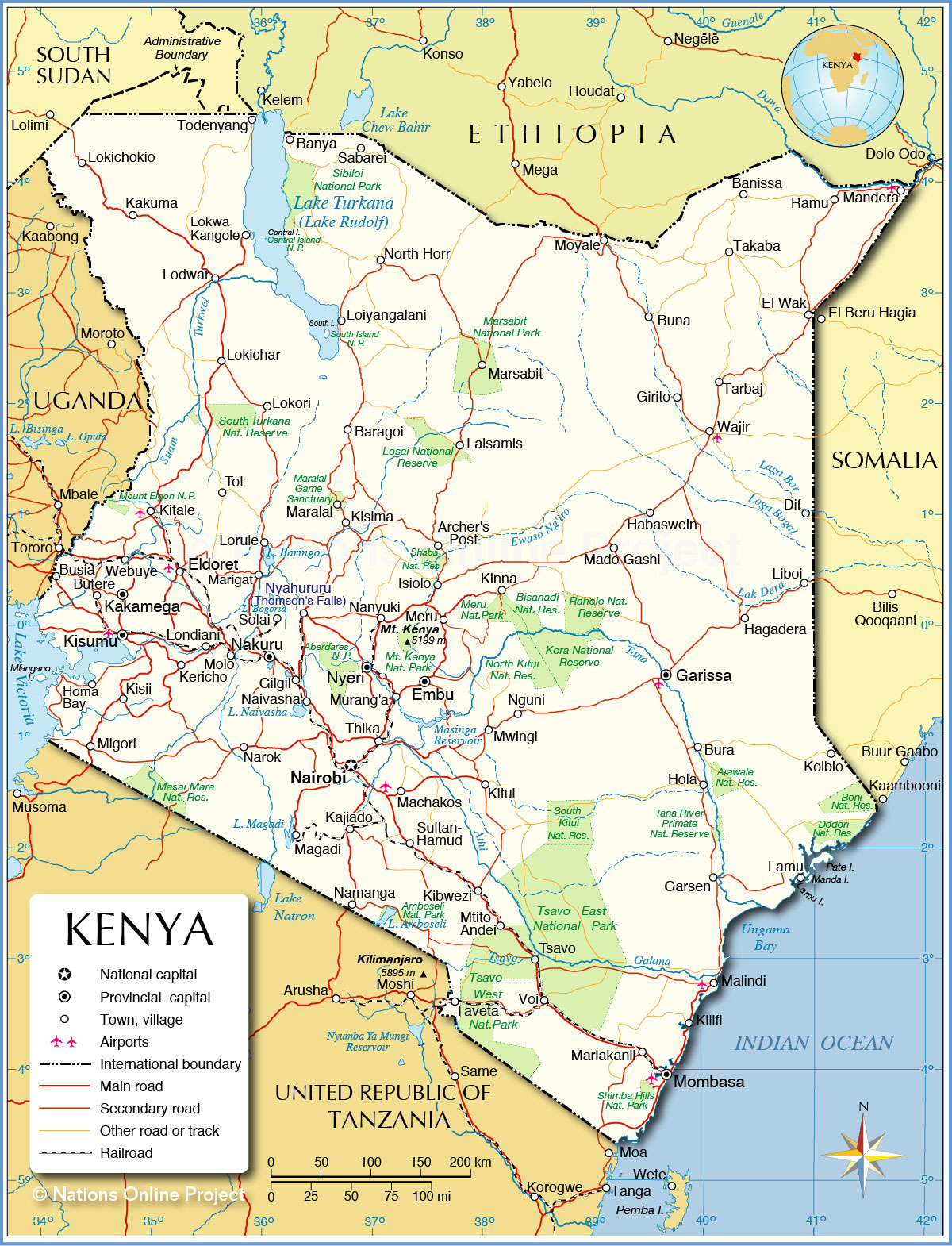
When our eldest son was born, I tried to have his birth registered in England. If I had been successful he could have just applied for the passport today as any English citizen would. Although my husband is English, he wasn't born in England: he was born in Kenya! At the time of his birth in 1960, Kenya was a Protectorate of the UK, which is why he was granted UK citizenship. All children born in Kenya at that time are eligible for UK citizenship themselves, but not all are able to pass eligibility down to their children.  The only way he could pass down his UK citizenship status to our children was if he were a UK citizen "otherwise than by descent," and that pretty much means either a natural-born citizen or someone allowed to qualify as such because of some special exceptions written into the law. The UK did not accept the application to register our son's birth because my husband was not born on UK soil, and thus they concluded he was a citizen "by descent."

But we got lucky and qualified under one of the exceptions. My father-in-law was sent to Kenya by the UK government to work in schools there, so my husband's birth is treated as though he were born in the UK, therefore he actually can pass down his citizenship status. When I originally tried to register our son's birth, I had not known this, but we now have a letter issued by the UK government which states that at the time of my husband's birth his father was in Kenya working for the UK government, so all I need to do is send that letter plus the original birth certificate.

The next obstacle is that I don't have an original birth certificate: all I have is a photocopy. I wanted to see how difficult it is to obtain a Kenyan birth certificate so I went to the central website for civil registration in Kenya. It looked promising –– under the proper district I got a name and email address (info@births.go.ke) and sent a request off to them. Sadly, my email was returned as "unsendable" a few days later. I  also checked the catalog of the Family History Library in SLC, and not surprisingly, they had no civil registration or church records for Kenya. 

Yet I knew that the British have been diligent about registering overseas births for many years, and on the Kenyan Consulate's website I found a very clear explanation of how the whole process works. I was then able to order two copies of his birth certificate (Certificate of Overseas Birth) from the UK General Records Office (GRO). I'm fairly sure they will not look at all like the photocopy of the one issued in Kenya. Once those arrive I can attach them to the forms, send photos, son's birth certificate, my birth certificate, our marriage certificate, and a big fat check to the British Embassy in Washington DC, and he should be good to go!

The funny thing is, my husband is English, but could have applied to become a Kenyan since he was born there. He could become an American too, and may yet. And in addition, since he has a grandparent (three out of four, actually) born in Ireland, he could also apply for Irish citizenship! So he could have four passports if he wanted! He's a simple kind of guy, though, and I suspect he'll stick with just the one.


Enhanced by Zemanta

06 October 2009

Tombstone Tuesday - A Rabbit-Proof Fence at Shocklach


My father-in-law, Brian R. R. Kimmitt ("Grandad") lives in Malpas, Cheshire, England. It's a beautiful place – low, rolling hills dotted with great trees who, never having been obliged to share the sunlight with their brethren, spread majestically across the misty backdrop, daring you to don your Wellies and wander among them.


My mother-in-law, Rosemary Kimmitt ("Granny"), née Ida Rosemary Churton, passed away in 2001. She is buried in an isolated church yard called St. Edith's in Shocklach, Cheshire. Some say the church belonged to a village which was burned after one of the many bouts of plague which swept England, but others say this is a myth and there is no evidence of other buildings on the site. In any case, there is no longer a Shocklach village – only the tiny Norman church remains.


St. Edith's lies hidden behind hedgerows off the main road, about half a mile from the River Dee. It was built in about 1150 by the Lord of the Manor, Thomas de Shocklach. It is constructed of irregularly shaped red sandstone blocks held together with mortar. The nave is almost entirely 12th century and the chancel is 14th century. Against the west wall are two large buttresses. The south door archway dates from about 1150 and is a good example of Norman work. The baptismal font is unusual in that it is seven-sided. The church registers date from 1538 and the churchwardens' accounts from 1725. ["Photographs of Shocklach, Cheshire," webpage; (http://www.thornber.net/cheshire/htmlfiles/shocklach.html : accessed 6 Oct. 2009); citing Raymond Richard, Old Cheshire Churches, with a supplementary survey of the lesser old chapels of Cheshire, completely revised and enlarged,  (Didsbury: E. J. Morten, 1973, first published in 1947.]


I was utterly charmed by this place when I was first taken there in 1986. Approached via tiny lanes through pasture land tastefully decorated with grazing animals, the spot remains hidden until the road turns abruptly just before you arrive, revealing this unexpected relic. You feel as if you are intruding and the gravel crunches loudly underfoot as you walk from the carpark to the church yard gate. Conkers (horse chestnuts) litter the ground and become playthings for any Brit under 75. They can't help themselves. The ancient gravestones tilt at awkward angles and evoke black and white visions of Scrooge on his knees begging for a last chance at redemption. Birds twitter, cows low, wind lifts the grasses, gravestones lean darkly. It's just beautiful.


My father-in-law has served as a lay minister at St. Edith's for many years, so when it was time to christen our first son, we chose to take him to England and have the ceremony performed at St. Edith's. We took advantage of the unusual seven-sided font, and Grandad assisted. And when my mother-in-law passed away, she was of course buried at St. Edith's.


Herein lies my trauma. Along with the grief of losing Rosemary, I felt sad at the realization that her final resting place was not going to be romantically set amongst the leaning stones, but rather at the other end of the yard. Today's gravestones are straight and polished, with (gasp) san serif type! Still, I thought at the time that she was lucky to have such a glorious spot in which to rest her bones for all of eternity.


However, that wasn't the end of it. Granny was a fantastic gardener. She loved flowers, was a master flower arranger and spent much of her free time in the garden. Yet the charm of the pastoral setting interferes with the rite of leaving flowers at the grave. The bunnies eat them! Grandad vowed he would prevent the bunnies from running amok, so he built a chicken wire fence around Granny's stone. I don't like the fence. It feels contradictory that in such a peaceful and natural setting, she should be caged. It is as if she's in a detention camp or something. I think he saw it as his final way to protect her. His grief softened visibly after that ugly fence went up, so I decided I could cope. Nevertheless, just for the record, I don't want a rabbit-proof fence around my gravestone! RIP rabbit-free, Rosemary.

05 September 2009

Thomas and Elizabeth Frances "Lizzie" (Preston) Drapes


My husband, Myles, is English. Kind of. It's complicated. First of all, he was born in Kenya. His English parents were working for the British government in Kenya which was a British colony in 1960. So he is a British citizen. But there's another reason I say sort of. He's got lots of Irish blood in him!

This photo was given to me by Myles' Aunt Sheelagh, aka Aunty Tealy. Sheelagh is the daughter of the young woman on the left, Elsie Drapes. Elsie was Myles' grandmother. The elderly gentleman is Sheelagh's grandfather, Dr. Thomas Drapes. I hadn't done much research on this family, but I did know that Dr. Thomas was born 17 January 1847 in Lakeview, County Cavan, Ireland. His father, also Dr. Thomas, died when young Thomas was only 5 months old "On the 17th instant [July], at Lakeview, in this county, Thomas Drapes, Esq., M.D., in the 32nd year of his age, of malignant typhus fever, contracted in his attendance of the Fever Hospital in his district." [http:// www.irelandoldnews.com/Cavan/1847/AUG.html : accessed 4 March 2007].

Aunty Tealy was visiting us from England recently and after asking me all about my genealogy work, told me that at 84 years old, she is suddenly aware of how very little she knows about her own ancestors. So we did some googling and found a beautiful obituary for her grandfather Thomas. He was a very distinguished psychologist and the Resident Medical Superintendent at the District Asylum in Enniscorthy, County Wexford, for years. He published many articles in which it is evident that he was intelligent and thoughtful.

"In the Journal of Mental Science in October 1894 Thomas Drapes, Resident Medical Superintendent of the District Asylum, Enniscorthy, delivered a paper ‘On the Alleged Increase of Insanity in Ireland’. Ireland, he pointed out, ‘possesses the unique and unenviable distinction of a continuously increasing amount of insanity with a continuously decreasing population’ and he then went on to a thoroughgoing analysis of what statistics were available to him and to comparisons between the Irish and English scenes. ...In summary, Drapes claimed: ‘The net result, then, of this examination is to show that, while there is an undoubted increase in occurring insanity, as indicated by the records of first admissions, by far the larger part of the apparent increase in insanity generally is due to accumulation, and that the seeming preponderance of insanity in Ireland, as compared to England, is fictitious, and depends entirely on the greater amount of accumulation in Ireland, occasioned by the lower death-rate in that country, and (possibly) the lower rate of discharge of the unrecovered." [MENTAL ILLNESS IS IRELAND 1750-1922 , http://www.hrb.ie/storage/publications/hrbpublications/mentalhealth/Mental%20Illness%20in%20Ireland.pdf : accessed 10 May 2009].

Thomas and Lizzie moved to a lovely house, "Milleen", on a bluff overlooking the Irish Sea in Dalkey shortly before Thomas died in 1919. Dalkey was in County Dublin, just south of Dublin. Lizzie remained there for the rest of her life, living comfortably with plenty of servants to help her out. Aunty Tealy has fond memories of spending summers with her Granny there. She and Rosemary, Myles' mother, would travel with their mother via ferry from Holyhead in North Wales from their home in Chester, England. For the rest of her life, Rosemary would get a charge out of passing the Kish Light in Dublin Bay, a signal that they were close to Dun Laoghaire harbor and their beloved Granny. Tealy remembers that they used to be met by a horse and "cab" at the boat – there were no taxis at that time. The driver was named Cavanaugh and "had weepy eyes". He couldn't get up the hill and had to have someone help him, every time! They all traveled with trunks, and knowing my mother-in-law in later years, I would imagine those trunks were both numerous and very heavy! Tealy used to pity the poor horse, who constantly had his head in a sack, so she would steal biscuits to give him strength: pretty ones with pink and white marshmallow topping. Maybe she should have given something to Cavanaugh, too!

On the veranda at Milleen, Grandfather had left a very powerful telescope through which the girls would gaze across the harbor and see "right over to Hove and the whole of the Irish Sea." They liked to look at people on the boats coming in and imagine their itineraries. They kept themselves busy running up and down the huge staircase that led to Milleen, hiding in cupboards looking for sweets and giggling until Granny would exclaim that she could hear mice. They chased chickens in the "yard," and generally rattled around, bringing life to the huge home. Granny would send the girls out to the town common behind the house with a shopping list. They'd pick flowers on the way back and learned the fine art of floral arrangement from a patient Lizzie. Tealy even remembers doing an arrangement inside a matchbox once.

Lizzie died in 1944, just after she received a call about her son Bertie dying after lingering from a stroke for seven years. Sheelagh remembers, "She got the call, had her boiled egg and said, 'Now I can die.'" And she did. I would love to have met Lizzie. My mother-in-law, Rosemary, and Aunty Tealy were/are delightful ladies, and I just know that the love and nurturing they got from Lizzie gave them a sense of security and joy that is evident today.

Thomas and Lizzie had 8 children, 7 of whom were boys! Tealy's mother was the only girl. Three of the boys died young: Arthur Vernon 1881-1896; John Sloan (1884-1884); and Walter Ardaugh (1886-1886).

Pictured above are Thomas and Lizzie with their four remaining sons and Myles' grandmother, Elizabeth Mary Stephens "Elsie" (Drapes) Churton. Elsie was the youngest of the living children. I'm not sure right now which brother is which, but they are: Dr. Thomas Lambert "Bertie" (1878-1943) - this is their eldest, and one that died right before Lizzie; Alexander Plunket Preston "Alec" (1879-1901) who participated in the Alaskan gold rush and settled in Montana; George Russell (1880-1935) of whom we know very little except that he perhaps married a "dreadful woman"; and Francis Colley (1883-?) who worked on the stock exchange and also had an "awful woman" for a wife. Note to self: must clarify this!

When she was about 18, or ca 1903, Elsie met English engineer Harry Leslie Churton, when he was installing the electrical system at the Asylum. He is the only one of Myles' four grandparents who was English. This means that though my maiden name is FitzGerald, I actually have more English blood than my "English" husband.