Kimmitt Genealogical Research

Showing posts with label FitzGerald. Show all posts

29 November 2015

Garrald Fitzgerald, Goldsmith of Galway

In April of 1979 on a twenty hour train journey from Rome to London I met a chatty but cordial gentleman from Rainham, Kent. Amongst many, many other things, he told me that he was a coin collector. He had a metal detector and spent his time scanning dried up riverbeds and other places for his favorite treasure––Roman coins. When he found out my surname was FitzGerald he was delighted to present me with a coin he had dredged up from the banks of the Thames Estuary one particularly dry year. Since it wasn't Roman he wasn't interested in it, so he gave it to me.

Thames Estuary and Wind Farms from Space NASA taken by Operational Land Imager,
public domain file, created 28 Apr 2013; Wikipedia.com.
I’ve held onto this coin for thirty-six years: through all the time I lived in Rome, moving from pensione to pensione to apartment, then living in several apartments in the Boston area, my parents' house, grad student housing in England for a year, and two family homes in the 'burbs since 1989. That's a lot of moving, but I kept it stashed away with a few other treasures and keepsakes. I had always assumed it was a novelty token rather than a real coin. 

Recently it has begun to gnaw at me. I Googled it a few times but never found anything like it. Finally yesterday I came across a fantastic website called Irish Coinage. I sent an email to the webmaster/author, John Stafford-Langan and he replied right away. I am so impressed by the extent of his knowledge and his willingness to share it with me. Here's what I learned.

Obverse
The front (obverse) design is a set of arms - he suspects of a goldsmith's guild - but has not been able to verify that. The name Garrald Fitzgerald surrounds the arms. The words that ring the coin are called the legend.

Reverse
The reverse has a legend that reads "Goldsmith of Galway." Aha! I hadn't deciphered the "smith" part. John says, "It has a large 'I' with a small D above it - "double struck" so it looks like an 'L' (D was the old abbreviation for a penny (from the old French denier and originally the latin 'denarius'). Stars are often used on these tokens to fill the design around the denomination." So being double struck makes it hard to read both the word smith and the letter D.

In summary, it is a penny token issued in the 1660s (!!) by Garrald Fitzgerald, a Galway goldsmith. There was a severe shortage of small change in the mid to late 17th century and many English and Irish merchants issued token coins to alleviate the problem. In 1673 they were replaced by official coin. There are over 800 different types from Ireland and more than 16,000 from England. It is probably made of brass, but I should get it checked, not by a regular jeweler, though, because they are apt to file a bit of it off to test it and that would reduce the value. It is scarce, as most of the Irish ones are, but not particularly valuable unless it turns out to be gold. 

He says: "I'm assuming that the token is brass based on the colour and because these tokens were generally made of brass or copper. However a very small number of examples were made as presentation pieces in silver and fewer again in gold. The silver and gold specimens are normally much better struck than the normal circulating brass and copper example so the doubling of the letters in the legend and the striking crack suggest that this is most likely a brass example. There are no known Irish examples surviving in gold, only a few from London (from where a great many tokens were issued) so a gold example is unlikely, but would be of significant interest."

Normally the merchants who issued these tokens were prominent citizens - the city records often show them serving on the town council, or providing services to the town. I've traced my own FitzGerald line in Kerry only back to about 1790 or so. There is no way I could ever definitely tie them in with this fellow. But it's not out of the question to think that he could be related in some way. Pretty cool stuff lurking in my jewelry drawer all these years.

Tomasso Garzoni, Goldschmiede, or Ständebuch & Beruf & Handwerk & Goldschmied, Saxon State Library,
Dresden [Public Domain] via Wikimedia Commons.


25 October 2014

He Endeavored to Lay His Claim to This Land But Was Prevented

Evicted Tenants' File No. 13,324; County Kerry; Landlord, Francis Pierce; 
Evicted Tenant, Patrick J. Fitzgerald
Other posts in this series:
1. "Back to the Old Home--Genealogical Research in Dublin"
2. "Digging for the Truth at the National Archives of Ireland"
3. "How Many Repositories Can I Visit in One Day?"
4. "Irish Land Records Not Just About Land!"
5. "Wronged Again"
6.  "He Endeavored to Lay Claim to This Land But Was Prevented"

In my last post I told the story of searching for proof of my grandfather's eviction from the family farm in County Kerry, Ireland in 1883. Before I left Dublin last week I requested case number 13,324 from the Irish Land Commission's Estate Commissioners' Evicted Tenant's Files at the National Archives. And today it arrived! But first a little background.

As is usual in genealogical research, the deeper you dig, the more you find. One newspaper article leads to research in Evicted Tenants, and that leads to studying the laws that caused the records to be created in the first place. And that leads back to the article to read it more closely.

Over the course of the eighteenth century for a variety of causes (emigration, competition from US grain producers, a mini-famine, inequitable laws, and all kinds of financial kerfufflement) the cost of leasing land became prohibitively higher and many tenants were evicted. From the 1870s to 1890s Ireland experienced much political and legal activity around inequities in land ownership. The Irish National Land League was established to improve the lot of poor tenant farmers and attempted to bring about redistribution of the land from landlords (especially absentee ones) to those who had occupied the land for decades or longer.

In response, the UK government introduced a series of laws (Irish Land Acts) in the late nineteenth and early twentieth centuries designed to improve the lot of the tenant farmers. The law of 1903, the Wyndham Land Purchase Act, was what spurred my grandfather to action. In that act: a) sales agreements were to be agreeable to both parties; b) the land was to be offered at fair market value; and c) the government was to step in to pay the difference between the price offered and the actual value. This effectively ended landlordism in Ireland and by 1914 about 9 million acres had been bought up by tenants.

Here is what came in the mail today.

This letter and the next essentially state that he missed the May 1, 1907 deadline as specified by the Evicted Tenants Act of 1907. Given what is stated in the Globe article, that is odd.


 This letter is from Patrick's solicitor (attorney) in Ireland, John O'Connell, LLD. It is dated Tralee, 28 October 1914, and is stamped [received] "Estates Commrs 26,573 - 29 Oct. 1914."

It reads:

Dear Sir:         Estate of Francis Pierce, Co. Kerry

I am instructed by Patrick J. Fitzgerald of 12 Lamson Ct. East Boston Mass. USA to inform you that he claims an interest as evicted tenant in part of the lands of Farnas at present in occupation of Robert Evans. He endeavored to lay his claim to this land but was prevented through non-delivery of his letters. The lands were evicted about 1884.

I would be obliged if you would let me know how the matter stands and what further steps my client should take to prove to you that he is entitled to consideration.

                                    Yours faithfully
                                             John O'Connell

Are you kidding? He "was prevented through non-delivery of his letters?" Sabotaged? Bad postal system? Rotten luck? What happened?? Why had so much time elapsed?

The December 27, 1903 Boston Globe article states "in the past 10 days the United Irish League in Ireland has taken steps to secure the best legal assistance in behalf of all the evicted tenants as part of the program of the national organization." It also says that the act had taken effect on November 1st of that year and "some 50 cases have already been brought before the Land Commission by the officials of the United Irish League of America, and of that number about one half of those affected are at present residents of Massachusetts, particularly in the vicinity of Boston. Among the number are the following:" And then he goes on to interview my grandfather. Well that explains how he was able to afford a lawyer.

I know this is my Patrick because the address he gives is the same street where the family lived when my father was born. For now, I am satisfied that Patrick did pursue restitution of his family farm. But it is still only his word that he was evicted, though there's really no reason to doubt it. I wonder if one of his brother's tried for it. He did have two brothers who remained in Ireland, John and James. John seems never to have left Ireland, but James went back and forth to the US and I haven't been able to find a marriage or death for him yet.

Does the No. 26,573 refer to another case file? I will request it and hope for further information, but something tells me I won't get it. I'll also now write to the archivist and hope he can give me some more ideas, but for now I guess I'm satisfied.

Wronged Again

Irish cottage, County Kerry, 1989
Other posts in this series:
1. "Back to the Old Home--Genealogical Research in Dublin"
2. "Digging for the Truth at the National Archives of Ireland"
3. "How Many Repositories Can I Visit in One Day?"
4. "Irish Land Records Not Just About Land!"
5. "Wronged Again"
6.  "He Endeavored to Lay Claim to This Land But Was Prevented"

I have been feeling mighty discouraged at the National Archives of Ireland's inability to locate a file in the Evicted Tenants collection which I am quite sure treated the eviction of my great-grandfather from the 75-acre FitzGerald family farm in Farnes, Kilgbarrylander, County Kerry, in 1883-84.

I have to say I was a little surprised at my reaction to the file not being found. It went beyond disappointment in not finding a record and instead felt like a slap in the face after all my grandfather had been through. He had been defeated by the system and so had I. I even felt a tear well up, and my friends will tell you I'm not the weepy type. This was pure frustration, passed down and brought to life a century later by one missing file.

What little I know of my grandparents came from my father. Both of his parents were dead by the time I was born and no one ever spoke much of them. They had been simple, hardworking folk, uneducated farmer types trying to survive in the swirl of greater Boston. They had thick brogues and couldn't read or write. My older siblings tell me that Patrick was strict and used to swing his cane at them, and Annie, his wife, liked a good snort of booze on a Friday night.

A first generation kid, born in the teaming tenements of East Boston in 1910, my father did everything he could to distance himself from his provincial parents. By the time he graduated from high school they had lived for nearly a decade on a little dairy farm in Lexington, Mass., just a stone's throw from Lexington Common, scene of the "shot heard round the world," and quintessential New England town. Pops was not one of those Irishmen who longed for the old country. It wasn't his country: he was an American. He didn't celebrate St. Paddy's day, didn't attend parades, hang out in pubs or drink much beer. He self-identified more as a Yankee than an Irishman and even went so far as to marry a Priscilla Barnes, a Protestant Mayflower descendant (below).

Priscilla (Barnes) FitzGerald standing on farmland previously owned by her father-in-law
Patrick J. FitzGerald's family, Farnes, Kilgarrylander, County Kerry, 1989

Because my father virtually ignored his Irish heritage, I just never imagined that his parents had wished to go home so very badly. So it took time for me to realize that Patrick really did not want to be here in the United States--he wanted to go home to his farm in County Kerry. He had come over just to make a little money to send home to his mother, and probably hoped he'd be home in a few years. Even after he met my grandmother Annie and settled down he did not stop longing for home, as we have seen by the 1903 article. At that time they had three children and would go on to have another three. He still lived in East Boston, an area heavily settled by immigrants.

I very much want to tell his story, and without that file I cannot. I'm pretty sure it is somewhere at the Four Courts. I wonder if it was pulled and filed in another later file, perhaps. I haven't given up. But at the moment, I'm denied that file. However, just the fact that there was a case in the index that matched what Patrick recounted provided some support to his statement that they had been evicted, though not nearly enough for me to feel confident in citing it as proved. With Irish research you have to be content with the tiniest of steps toward your goal, so I was ready to accept that.

In my previous posts I described the process for obtaining those files. First you have to request the "Evicted Tenants Index and Registers." These are held offsite, at the Four Courts and take a day to be retrieved. Once you have the index and registers you can search each one for your person of interest. They are a jumbled mess of three overlapping systems, in about 12 volumes, all of which must be searched. Some but not all information gets repeated. The volumes were not always labelled and some titles were illegible. The registers gave very little information beyond what the indices had, but sometimes very little is enough.

One set of indices includes people in all counties, arranged alphabetically by first letter, then first vowel of surname, and finally by county. So, for instance, I go to F for Fitzgerald, then at the top of the page you can see "i" above the columns, indicating the first vowel is an i, then I skim down to those in Kerry. At that point they are not in alphabetical order, so you have to look at all of the Kerry entries.


Above is the entry in the index for the file that could not be found, number 1624 for Patk Fitzgerald of Kerry. There was no further information, so I went to the register. 

Below is the entry in the Land Commission's Evicted Tenants, Register, vol. 4, that supports but does not strongly corroborate Patrick's story. It gives the landlord's name as Rae--a match!. And of course the case was refused, or Patrick and Annie would have gone back to Farnes. But I'd want to see more to be sure. The file being not found left me at a dead end.


So what do we do at dead ends? We reverse back up the lane a bit and see if there is alternate road we can explore. I had, in fact, found another possible file on my last day in Dublin. I could order it but it was offsite and wouldn't be delivered until I had left, so I requested that it be sent to me and paid a fee. Here is the entry, below, right page, then left.


 It was simultaneously encouraging and discouraging. This time he is Patk J, and my grandfather was Patrick John. Best of all, the townland is "Fainas"–close enough to Farnes to make me hopeful. The 1884 year of eviction is close enough to 1883 to give me more hope still. But the landlord was wrong.  What happened to Mr. Rae? And what was the outcome?

But OMG, the page is shredded along the left side where the file number would be. I panicked for a second until I realized that in this particular register the files were in numerical order. So I went back a page and counted forward, hoping that the gaps in numbering that I had seen elsewhere would not be a problem here! I came up with number 13,324, and I ordered the file to be sent home to Massachusetts. 

Now we wait...


29 March 2011

The Ancestral Chalybeate Spa

Ann FitzGerald, Priscilla (Barnes) FitzGerald and Polly (FitzGerald) Kimmitt
at the original FitzGerald cottage, Farnes, Kerry, Ireland, June 1989
My people should never have left Ireland. In so doing they deprived the family forevermore of the healing powers of ferruginous water. I know this because of one tiny phrase in a book with a very long title.

Reading contemporaneous accounts of Ireland helps us to envision ancestral townlands as they were before our families left. A mainstay in every Irish researcher's library is Samuel Lewis' A Topographical Dictionary of Ireland, comprising the several counties, cities, boroughs, corporate, market, and post towns, parishes, and villages, with historical and statistical descriptions; embellished with engravings of the arms of the cities, bishopricks, corporate towns, and boroughs; and of the seals of the several municipal corporations: with an Appendix, describing the electoral boundaries of the several boroughs, as defined by the act of the 2d and 3d of William IV, 2 vols., (London: 1837).

County Kerry, Ireland
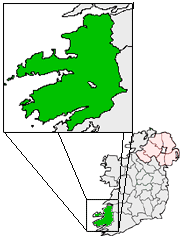
Written about ten years before the Great Famine (1845-1852), it gives the history and lay of the land of every little townland in Ireland. My father (James Patrick/Edmund FitzGerald 1910-1988) always said his father's FitzGerald line were from Castlemaine (Caislean na Mainge) in county Kerry. Castlemaine lies on a harbor at the junction of the Dingle Peninsula and the Ring of Kerry, or just under the first peninsula on the map. It was a market town and the site of a castle built jointly by two Irish chiefs, the Earl of Desmond and MacCarthy More, in order to defend the crossing of the River Maine. Each chief was to alternately protect the castle, but at one point MacCarthy decided he didn't want to give it up. It eventually fell into ruins. Today there is nothing remarkable about the town. A few pubs and bed and breakfast establishments and some fine views are all that distinguish it.

What my father didn't know was the name of the area in which his family had lived: a little part of Castlemaine called Farnes. He and my mother went over to Ireland in 1978 to visit some of his cousins, and I'm quite sure they went to the house his father was born in, below. By asking the local residents, they managed to find the FitzGerald homestead. Compared to the adjacent older cottage, this was quite a step up for the family. I do wonder how accurate our information was, though. I would imagine that my grandfather, Patrick John FitzGerald (1867-1949) was born in the little cottage and thanks to money he and his siblings sent back to Ireland from the US, the family was able to build this once fine edifice.

Ann FitzGerald, Myles Kimmitt, Priscilla FitzGerald
FitzGerald Homestead, Farnes, Kerry, Ireland, June 1989

My mother, sister and I discovered the name when we visited the local parish to view their records in 1989. All of the related FitzGeralds we found lived in Farnes.  Farnes is a townland (more like a village or a neighborhood) in the civil parish of Kilgarrylander, and never gets any press. This is understandable. There isn't much there except gorse-covered hills dotted with the occasional cottage. 


View of the Slieve Mish (Sliabh Mish) range from FitzGerald home,
Farnes, Kerry, Ireland, named after a mythological Celtic princess
who was famed for being cruel.


So there is no historical detail about the actual land my ancestors lived on anywhere, except in one tiny mention in Samuel Lewis' Topographical Dictionary in which he states: "Three miles to the west of the town are the ruins of Castledrum, erected by the sept of Moriarty; and on the lands of Farnass is a good chalybeate spa." What? Peasant farmers living by a spa? Well, this is exciting! Something, at long last to distinguish them from the hordes of peasants the world over. MY ancestors lived near a chalybeate spa. So what is it, then?

The word chalybeate derives originally from the Latin word for steel, "chalybs" which in turn is taken from the Greek "khalups" after those who had invented iron working in Greek mythology. It is simply mineral water that contains iron. Wikipedia has this to say about Chalybeate: "Early in the 17th century, chalybeate water was said to have health-giving properties and many people have promoted its qualities. Dudley North, 3rd Baron North discovered the chalybeate spring at Tunbridge Wells in 1606. Dudley North’s physician claimed that the waters contained ‘vitriol’ and the waters of Tunbridge Wells could cure: the colic, the melancholy, and the vapours; it made the lean fat, the fat lean; it killed flat worms in the belly, loosened the clammy humours of the body, and dried the over-moist brain." It was also said to cure hysteria.

And therein lies the heart of the trouble. By leaving the chalybeatic spa in Farnes (Farnass) my ancestors opened the door to all manner of physiological ills. No wonder some of us are melancholy, some too fat, some too thin. I see it clearly now! This is why my clammy humours are not loosened and my brain remains over-moist. (I do wonder if the roof on the old cottage had anything to do with an abundance of iron in the local water--see first photo.) It is apparent that we must now make an annual trek to the homeland to restore our shattered tissues. I look forward to asking the locals all about it!

Priscilla (Barnes) FitzGerald
Farnes, Kerry, Ireland, June 1989

11 August 2010

Wordless Wednesday - FitzGeralds


 Taken on the occasion of Patrick and Annie's 50th wedding anniversary, probably in Arlington, Mass. They were married in Boston on 6 September 1896. Their oldest child, Mary, is not pictured.

Left to right:
James Edmund "Jim" FitzGerald  [my father]
(1 August 1910 – 25 May 1988)

Phillip Francis "Frank" FitzGerald
(13 August 1906 – 20 April 1963)

Julia Theresa "Theresa" (FitzGerald) Murphy Bradshaw
(6 February 1902 – 11 May 1963)

Annie Josephine (O'Sullivan) FitzGerald
(18 December 1869 – 2 August 1949)

Patrick John FitzGerald
(21 March 1867 – 21 August 1949)

John Joseph "Jack" FitzGerald
(5 July 1899 – 11 September 1988)

Stories to come, in another post. One thing to note, since their dates are here is that they seemed to die in twos. Patrick and Annie died within three weeks of one another. Frank and Theresa died within three weeks of one another and Jim and Jack died a bit more than three months apart, and my wedding was sandwiched in between their deaths.