Kimmitt Genealogical Research

Showing posts with label Irish research. Show all posts

25 October 2014

He Endeavored to Lay His Claim to This Land But Was Prevented

Evicted Tenants' File No. 13,324; County Kerry; Landlord, Francis Pierce; 
Evicted Tenant, Patrick J. Fitzgerald
Other posts in this series:
1. "Back to the Old Home--Genealogical Research in Dublin"
2. "Digging for the Truth at the National Archives of Ireland"
3. "How Many Repositories Can I Visit in One Day?"
4. "Irish Land Records Not Just About Land!"
5. "Wronged Again"
6.  "He Endeavored to Lay Claim to This Land But Was Prevented"

In my last post I told the story of searching for proof of my grandfather's eviction from the family farm in County Kerry, Ireland in 1883. Before I left Dublin last week I requested case number 13,324 from the Irish Land Commission's Estate Commissioners' Evicted Tenant's Files at the National Archives. And today it arrived! But first a little background.

As is usual in genealogical research, the deeper you dig, the more you find. One newspaper article leads to research in Evicted Tenants, and that leads to studying the laws that caused the records to be created in the first place. And that leads back to the article to read it more closely.

Over the course of the eighteenth century for a variety of causes (emigration, competition from US grain producers, a mini-famine, inequitable laws, and all kinds of financial kerfufflement) the cost of leasing land became prohibitively higher and many tenants were evicted. From the 1870s to 1890s Ireland experienced much political and legal activity around inequities in land ownership. The Irish National Land League was established to improve the lot of poor tenant farmers and attempted to bring about redistribution of the land from landlords (especially absentee ones) to those who had occupied the land for decades or longer.

In response, the UK government introduced a series of laws (Irish Land Acts) in the late nineteenth and early twentieth centuries designed to improve the lot of the tenant farmers. The law of 1903, the Wyndham Land Purchase Act, was what spurred my grandfather to action. In that act: a) sales agreements were to be agreeable to both parties; b) the land was to be offered at fair market value; and c) the government was to step in to pay the difference between the price offered and the actual value. This effectively ended landlordism in Ireland and by 1914 about 9 million acres had been bought up by tenants.

Here is what came in the mail today.

This letter and the next essentially state that he missed the May 1, 1907 deadline as specified by the Evicted Tenants Act of 1907. Given what is stated in the Globe article, that is odd.


 This letter is from Patrick's solicitor (attorney) in Ireland, John O'Connell, LLD. It is dated Tralee, 28 October 1914, and is stamped [received] "Estates Commrs 26,573 - 29 Oct. 1914."

It reads:

Dear Sir:         Estate of Francis Pierce, Co. Kerry

I am instructed by Patrick J. Fitzgerald of 12 Lamson Ct. East Boston Mass. USA to inform you that he claims an interest as evicted tenant in part of the lands of Farnas at present in occupation of Robert Evans. He endeavored to lay his claim to this land but was prevented through non-delivery of his letters. The lands were evicted about 1884.

I would be obliged if you would let me know how the matter stands and what further steps my client should take to prove to you that he is entitled to consideration.

                                    Yours faithfully
                                             John O'Connell

Are you kidding? He "was prevented through non-delivery of his letters?" Sabotaged? Bad postal system? Rotten luck? What happened?? Why had so much time elapsed?

The December 27, 1903 Boston Globe article states "in the past 10 days the United Irish League in Ireland has taken steps to secure the best legal assistance in behalf of all the evicted tenants as part of the program of the national organization." It also says that the act had taken effect on November 1st of that year and "some 50 cases have already been brought before the Land Commission by the officials of the United Irish League of America, and of that number about one half of those affected are at present residents of Massachusetts, particularly in the vicinity of Boston. Among the number are the following:" And then he goes on to interview my grandfather. Well that explains how he was able to afford a lawyer.

I know this is my Patrick because the address he gives is the same street where the family lived when my father was born. For now, I am satisfied that Patrick did pursue restitution of his family farm. But it is still only his word that he was evicted, though there's really no reason to doubt it. I wonder if one of his brother's tried for it. He did have two brothers who remained in Ireland, John and James. John seems never to have left Ireland, but James went back and forth to the US and I haven't been able to find a marriage or death for him yet.

Does the No. 26,573 refer to another case file? I will request it and hope for further information, but something tells me I won't get it. I'll also now write to the archivist and hope he can give me some more ideas, but for now I guess I'm satisfied.

Wronged Again

Irish cottage, County Kerry, 1989
Other posts in this series:
1. "Back to the Old Home--Genealogical Research in Dublin"
2. "Digging for the Truth at the National Archives of Ireland"
3. "How Many Repositories Can I Visit in One Day?"
4. "Irish Land Records Not Just About Land!"
5. "Wronged Again"
6.  "He Endeavored to Lay Claim to This Land But Was Prevented"

I have been feeling mighty discouraged at the National Archives of Ireland's inability to locate a file in the Evicted Tenants collection which I am quite sure treated the eviction of my great-grandfather from the 75-acre FitzGerald family farm in Farnes, Kilgbarrylander, County Kerry, in 1883-84.

I have to say I was a little surprised at my reaction to the file not being found. It went beyond disappointment in not finding a record and instead felt like a slap in the face after all my grandfather had been through. He had been defeated by the system and so had I. I even felt a tear well up, and my friends will tell you I'm not the weepy type. This was pure frustration, passed down and brought to life a century later by one missing file.

What little I know of my grandparents came from my father. Both of his parents were dead by the time I was born and no one ever spoke much of them. They had been simple, hardworking folk, uneducated farmer types trying to survive in the swirl of greater Boston. They had thick brogues and couldn't read or write. My older siblings tell me that Patrick was strict and used to swing his cane at them, and Annie, his wife, liked a good snort of booze on a Friday night.

A first generation kid, born in the teaming tenements of East Boston in 1910, my father did everything he could to distance himself from his provincial parents. By the time he graduated from high school they had lived for nearly a decade on a little dairy farm in Lexington, Mass., just a stone's throw from Lexington Common, scene of the "shot heard round the world," and quintessential New England town. Pops was not one of those Irishmen who longed for the old country. It wasn't his country: he was an American. He didn't celebrate St. Paddy's day, didn't attend parades, hang out in pubs or drink much beer. He self-identified more as a Yankee than an Irishman and even went so far as to marry a Priscilla Barnes, a Protestant Mayflower descendant (below).

Priscilla (Barnes) FitzGerald standing on farmland previously owned by her father-in-law
Patrick J. FitzGerald's family, Farnes, Kilgarrylander, County Kerry, 1989

Because my father virtually ignored his Irish heritage, I just never imagined that his parents had wished to go home so very badly. So it took time for me to realize that Patrick really did not want to be here in the United States--he wanted to go home to his farm in County Kerry. He had come over just to make a little money to send home to his mother, and probably hoped he'd be home in a few years. Even after he met my grandmother Annie and settled down he did not stop longing for home, as we have seen by the 1903 article. At that time they had three children and would go on to have another three. He still lived in East Boston, an area heavily settled by immigrants.

I very much want to tell his story, and without that file I cannot. I'm pretty sure it is somewhere at the Four Courts. I wonder if it was pulled and filed in another later file, perhaps. I haven't given up. But at the moment, I'm denied that file. However, just the fact that there was a case in the index that matched what Patrick recounted provided some support to his statement that they had been evicted, though not nearly enough for me to feel confident in citing it as proved. With Irish research you have to be content with the tiniest of steps toward your goal, so I was ready to accept that.

In my previous posts I described the process for obtaining those files. First you have to request the "Evicted Tenants Index and Registers." These are held offsite, at the Four Courts and take a day to be retrieved. Once you have the index and registers you can search each one for your person of interest. They are a jumbled mess of three overlapping systems, in about 12 volumes, all of which must be searched. Some but not all information gets repeated. The volumes were not always labelled and some titles were illegible. The registers gave very little information beyond what the indices had, but sometimes very little is enough.

One set of indices includes people in all counties, arranged alphabetically by first letter, then first vowel of surname, and finally by county. So, for instance, I go to F for Fitzgerald, then at the top of the page you can see "i" above the columns, indicating the first vowel is an i, then I skim down to those in Kerry. At that point they are not in alphabetical order, so you have to look at all of the Kerry entries.


Above is the entry in the index for the file that could not be found, number 1624 for Patk Fitzgerald of Kerry. There was no further information, so I went to the register. 

Below is the entry in the Land Commission's Evicted Tenants, Register, vol. 4, that supports but does not strongly corroborate Patrick's story. It gives the landlord's name as Rae--a match!. And of course the case was refused, or Patrick and Annie would have gone back to Farnes. But I'd want to see more to be sure. The file being not found left me at a dead end.


So what do we do at dead ends? We reverse back up the lane a bit and see if there is alternate road we can explore. I had, in fact, found another possible file on my last day in Dublin. I could order it but it was offsite and wouldn't be delivered until I had left, so I requested that it be sent to me and paid a fee. Here is the entry, below, right page, then left.


 It was simultaneously encouraging and discouraging. This time he is Patk J, and my grandfather was Patrick John. Best of all, the townland is "Fainas"–close enough to Farnes to make me hopeful. The 1884 year of eviction is close enough to 1883 to give me more hope still. But the landlord was wrong.  What happened to Mr. Rae? And what was the outcome?

But OMG, the page is shredded along the left side where the file number would be. I panicked for a second until I realized that in this particular register the files were in numerical order. So I went back a page and counted forward, hoping that the gaps in numbering that I had seen elsewhere would not be a problem here! I came up with number 13,324, and I ordered the file to be sent home to Massachusetts. 

Now we wait...


17 October 2014

Irish Land Records Not Just About Land!


Registered Papers (left), Prison and Criminal Records (back wall)

This is part of a series of posts about a research trip to Dublin.

1. "Back to the Old Home--Genealogical Research in Dublin"
2. "Digging for the Truth at the National Archives of Ireland"
3. "How Many Repositories Can I Visit in One Day?"
4. "Irish Land Records Not Just About Land!"

5. "Wronged Again"
6.  "He Endeavored to Lay Claim to This Land But Was Prevented"


You may have noticed by now that we spend an awful lot of time examining records having to do with land. From Evicted Tenants records to Valuation to Deeds, much can be gleaned from land transactions.

After a somewhat leisurely awakening and breakfast I meandered over to the National Archives on  Thursday. I had a little more time to go through the remaining boxes of indexes to Evicted Tenants and found further reference to the entry I had found earlier which pretty much confirms it is my guy, or makes it very likely. The landlord was said to be Rae (yay!) and the year of eviction is 1884. the only sad thing is that his application was refused. With great hope in my heart to finally getting to the bottom of Patrick's family's eviction, I submitted the form and made myself wait one more day to find out.

No time for lunch. Donna and I stopped by the GRO again while on our way to the Registry of Deeds. I was the only person on the tour to opt for the Registry of Deeds. And I only did because of my husband's ancestors, not my own. My poor Irish Catholic farmers would not appear in these records. But landowners, and those entering in a marriage interested in protecting their assets would make special arrangements, so I had lots of good luck there. A person could spend many happy days there! Life would be a lot easier if they allowed us to use cameras to record the memorials, though. I transcribed like a fiend all afternoon. I am going to guest blog on Donna Moughty's Blog about it, so you can read more about it there.

I walked all over creation on Thursday and was really tired (a running theme!) by the end of the day. It was raining all the way home so I arrived like a drowned rat. We decided to dine in the hotel and had another two-hour relaxing meal.

Finally on Friday (today) I was to get the information I had been seeking. I came to the archives full of hope but before I could even set down my computer the man at the desk told me I had no file.* "It's not there." He was still convinced the number was too low, so I had to retrieve the index and show him the entry. He then made a phone call over to the remote site. They couldn't find it but did locate another John FitzGerald file. I ordered that and it will be mailed to me, but I'm afraid I'll never get the real story of what happened to the FitzGerald farm. (See next post for update!)

Dejected, I turned, finally, to the Registered Papers. Another fail! I had a box full of mostly mundane paperwork, generated by lots of different agencies, from all counties. The numbered case files I had ordered did not fall between the numbers contained in the box, so it was useful, if interesting.


Finally, one last trip to the GRO for some more John Fitzgerald death certificates. I keep thinking that to straighten it out I'm going to have to do a one-name study but unless I can involve my kids in it, I fear that's a project without end because I'd never finish it in my lifetime!

* I thought he said "You have no foil!" and that I had violated yet another rule. Took me a minute. Hey, it was morning!


How Many Repositories Can I Visit in One Day?


This is part of a series of posts about a research trip to Dublin in search of information about my FitzGerald ancestors

1. "Back to the Old Home--Genealogical Research in Dublin"
2. "Digging for the Truth at the National Archives of Ireland"
3. "How Many Repositories Can I Visit in One Day?"
4. "Irish Land Records Not Just About Land!"
5. "Wronged Again"
6.  "He Endeavored to Lay Claim to This Land But Was Prevented"


On Wednesday I was schizo! I had to fling back to the National Archives to see if the index for Evicted Tenants had come in so I could order the next round of files. It had! Great jubilation there because of the doubt created when the employees argued about how much info was required on the request form. I was happy to see it, indeed. I was also glad to learn a little more about the actual record group, especially that it was created by the Irish Land Commission. I only had time to go through one box because Donna had us booked for the Valuation Office in the afternoon, but I found a reference I thought looked promising.  


I took this information to the desk to request the file and another discussion ensued! It wasn't enough information. Or the number is too low. Yet no one could tell me what other info I should add, so I called on the archivist and they agreed they'd try and find it with that information. Since it was off-site, I'd have to wait until Thursday to get it. But I didn't have time to go through the rest of the boxes before hurrying off to our next appointment. I decided to come back Thursday and go through those, then order it.

Also, the wills I ordered came in, and they were lovely, especially my husband's great-greatmother's will: "To my daughter Mrs. Elizabeth Mary Stephens Churton ... the small silver cream ewer presented to me by my children on the twenty-fifth anniversary of my wedding..." an artifact which is probably still in the family. I love that!

Then we rushed off to the GRO to get some more certificates. I think. At this point, it's all a blur!

Finally, a long-awaited visit to the Valuation Office where we were able to consult the revision books. I won't go into detail on them because it's a bit complicated, but essentially you can follow the ownership of a piece of land through time, with changes indicated in different colored inks (if you're lucky), and a little key telling which year is associated with which color. I, of course, am not lucky. So revisions were made in brown or blue ink, and several in each, so it's impossible to be precise. In any case I did find my John FitzGerald where I had hoped to, in Farnes/Farna, but only for a short while. That is very good because he wasn't there in Griffiths, but he was there for the birth of his children from 1867-1875. He or another John also appears in another townland, too, Ballygamboon, and he is next to or with Garrett FitzGerald. I know my John had an uncle Garrett, so it will require some serious analysis. I took photos like mad and will study them when I get home. I don't like researching this way because sure enough I'll get home and wish I could see the books again for some reason or another, but when time and money are at a premium you just do the best you can and make sure that camera is charged!

By the end of Wednesday my eyes were tired, my brain hurt and I was pretty tired. We discovered a wondrous Italian restaurant that served the most tender and tasty salmon I've ever had. We loved our meals. The Nigerian chef came out to chat with us and it was a nice relaxing end to a frantic day.


Digging for the Truth at the National Archives of Ireland

This is the second in a series of posts about a research trip to Dublin.
1. "Back to the Old Home--Genealogical Research in Dublin"
2. "Digging for the Truth at the National Archives of Ireland"
3. "How Many Repositories Can I Visit in One Day?"
4. "Irish Land Records Not Just About Land!"
5. "Wronged Again"
6.  "He Endeavored to Lay Claim to This Land But Was Prevented"

I'm in Dublin, researching my FitzGerald grandfather's family and the loss of their 75-acre farm in 1883. An article in the Boston Daily Globe about Irishmen in Boston wanting to reclaim lost land after the Land Laws changed in 1903 gives some nice detail. The second page continues here.
"Back to the Old Home," Boston Daily Globe, 17 December 1903, p. 26, col 2; GenealogyBank (http://www.genealogybank.com: 15 December 2008).
I had already searched in the State Commissioner's Offices "Applications from Evicted Tenants, 1907," database on FindMyPast.com, to no avail. From what Patrick says above, it seems as though he had already started the wheels in motion by the end of 1903, so I needed to check the Evicted Tenants cases at the National Archives of Ireland (NAI) as well. But also, the last paragraph mentions that Patrick had made an appeal to the MP of West Kerry, Mr. Thomas O'Donnell, so I thought perhaps there might be some record of that still in existence. If it were, it would appear in the Registered Papers collection at the NAI.

Tuesday we came over to the National Archives. We had an orientation and got IDs, put our coats and items not allowed in the reading room in lockers and got started. I consulted with the archivist, Gregory O'Connor, who advised me on the use of their Registered Papers series. They come in the form of very large volumes in sets by year with an index and register for every year. The index is both subject and name-based, with different subjects then subdivided alphabetically. At Gregory's suggestion I began by looking under C for Constabulary, in 1883 and 1884, in case there had been any trouble with the eviction. I also looked under E for Eviction, F for FitzGerald and Farnes, K for Kerry and Kilgarrylander, and Rae/Ray, the landlord's name. I found nothing.

Registered Papers, Index to 1884, index tabs in brown ink, ripped and faded.
Next I moved on to 1903-1904 when the land laws changed and my grandfather appealed to O'Donnell. This time Gregory told me to look under the subject heading of Parliamentary Questions as well as the landlord. I looked also under E for Eviction, F for FitzGerald and Farnes, K for Kerry and Kilgarrylander, L for Land, and Rae/Ray, the landlord's name, and I added O'Donnell, against Gregory's advice, but I'm not going to take a chance at missing it! I found just a few references that seemed remotely possible so I had to request those files from the desk. They are filed offsite at the Four Courts so they would not be in until Wednesday.

(Gregory also advised me to check Hansard, an online database of parliamentary records (reporters, upon which the US system is based) but I'll save that for another time.

Knowing my grandfather was actively pursuing reinstatement of his land, I then explored the Evicted Tenants records. Using them is a three step process. You have to 1) order the index and registers (from Four Courts, so next day delivery); 2) consult those; then 3) order any appropriate files! So I ordered the Evicted Tenants Index and Registers. A great discussion ensued between NAI employees as to whether my request had enough information, but I was powerless and clueless so left it up to them to bash it out! I just hoped the index would appear.

I thought I'd do something straightforward, so I ordered the wills of my husband's great-grandparents since they were late enough not to have been burned in the Four Courts fire.

I still had nothing in hand for all of that research, but my notes were filled with references of things ordered, so when I left the NAI there was a feeling of great potential, but nothing more! I'm always struck by the contrast between instantaneous access on the web and archaically slow in real life. I have to say that I've been surprised by the number of times people have come back and told me a file or book or microfilm can't be found. I think perhaps they are lacking in resources and I fear that history is getting lost because of it.

From the National Archives I went with my friend Patti to the General Register Office. On the outside it looks like a hideout from a street war, with barbed wire and camouflage material. On the inside they are highly efficient, so I requested and received the maximum 8 birth, marriage and death certificates, at only 4 euros each. They were delivered promptly in less than 15 minutes! I now have the death certificates of three of my four Irish great-grandparents, and a whole bunch of John Fitzgerald deaths that aren't my grandfather's father! 

We dined out that evening with Donna, our trip host, and again went back to crash, I mean prepare for the next day's research!

16 October 2014

Back to the Old Home --Genealogical Research in Dublin

"Back to the Old Home," Boston Daily Globe, 27 December 1903, p. 25, col. 2; GenealogyBank.com (http://www.genealogybank.com : 15 December 2008).
This is the first in a series of posts about a research trip to Dublin.
1. "Back to the Old Home--Genealogical Research in Dublin"
2. "Digging for the Truth at the National Archives of Ireland"
3. "How Many Repositories Can I Visit in One Day?"
4. "Irish Land Records Not Just About Land!"
5. "Wronged Again"
6.  "He Endeavored to Lay Claim to This Land But Was Prevented"

Research Problem: My most obscure lines start with my father's parents, Patrick FitzGerald and Annie O'Sullivan from County Kerry. They emigrated separately about 1890 from neighboring townlands, met, then married in Boston in 1896. Patrick's father, grandfather and great-grandfather were all named John. The name is so common that is it really hard to conclusively identify one John FitzGerald from the next. The snippet above is from a Boston Globe article quoting my grandfather telling how the family was evicted in 1883 from a 75-acre farm in the townland of Farnes, Kilgarrylander. Family lore says that Patrick's father died when he was very young, but he was alive when evicted, so Patrick was at least 16. Patrick's mother Mary (Hurly) FitzGerald is in the 1901 and 1911 census, and her burial in 1919 can be found on the Keel Parish burial records online. The names FitzGerald and Sullivan are extremely common in County Kerry, making my job that much more difficult. In addition, John does not appear in the townland in the article above in Griffith's Valuation.

I've neglected my own Irish research for far too long so I signed up for a research tour with my esteemed colleague Donna Moughty, who hosts a tour every year and brings a group of wanna-be Irish genealogy researchers to Dublin and/or Belfast and enables them to hit the ground running. My reason for signing up: the worst part of visiting a new repository isn't necessarily what records they have, but rather figuring out what hours, identification, gear to bring, quirks of the staff, etc. By having Donna set up appointments, tours and introductions we were able to cram in a lot of research.

Before we left Donna asked us what we were working on, then sent back a detailed research plan. I already had my own research plan, of course, but really appreciated Donna's perspective because she knows more than I do about Irish records. There was nothing new in mine, but I liked that we were thinking along the same lines!

A week may seem like a long time to non-researchers, but with thousands of Irish ancestors to consider (between my husband's 3 grandparents and my 2, we start with 5 lines), and some darn stubborn problems on my Irish Catholic ones, it's hardly any time at all. Or "atahll," as the dear Irish would say.

Patti and Maureen in the Buswell Hotel
We gathered on Sunday evening in our hotel, Buswell's. I had spent the weekend with an ailing aunt in England and was feeling very sad about that so it took me a while to put that aside and screw on my thinking cap. We had a nice dinner right in our hotel, Buswell's which is directly across from the National Library. Two of my good friends are also on the trip, so it was fun to see them and meet the other people. Brian Donovan and Fiona Fitzsimons from Eneclann came as guests and told us a little bit about the latest project of digitizing the Valuation Revision books. In color!

Bright and early Monday we headed across the street to the National Library of Ireland. First we got an orientation and tour, then IDs, so finally a little before noon we were released for research, chomping at the bit! 

I first tried looking in some Kerry newspapers for an announcement of my grandmother Mary's death in 1919, but of the three newspapers I ordered, one microfilm couldn't be found; another listed incorrect dates in the catalog, so it wasn't available; and the third provided no article about Mary. 

Next I consulted a book called Lambert of Wexford by Hubart Andrew Lambert, Esq. It starts with the Norman Conquest and explores some very early branches, none of which can I yet connect to in my husband's family. However, I took a photo of the title page and each page of the article because you JUST never know! 

Finally, I hurried over to the baptismal records for my grandfather's parish, Keel and Kiltallagh (now called Castlemaine) in Co. Kerry. I had viewed the actual registers with my mother and sister in 1989, and carefully transcribed births and marriages for all direct line FitzGeralds and siblings, but since I was a baby genie back then I wanted to verify and get some images as well, especially since there is a conflict with my grandfather's father's name. His birth here shows him as son of John FitzGerald and Catherine Neil, but in his marriage to Mary Hurly it states that his father is Patrick. Gah! I also want to expand upon the larger family, but I ran out of time so will need to return.

All in all a rather frustrating day because I didn't get much done, and didn't get to the General Register Office as I had hoped. After a fine meal at Peploe, we came back to prepare for Tuesday's research.

See post about Tuesday and Wednesday.

29 March 2011

The Ancestral Chalybeate Spa

Ann FitzGerald, Priscilla (Barnes) FitzGerald and Polly (FitzGerald) Kimmitt
at the original FitzGerald cottage, Farnes, Kerry, Ireland, June 1989
My people should never have left Ireland. In so doing they deprived the family forevermore of the healing powers of ferruginous water. I know this because of one tiny phrase in a book with a very long title.

Reading contemporaneous accounts of Ireland helps us to envision ancestral townlands as they were before our families left. A mainstay in every Irish researcher's library is Samuel Lewis' A Topographical Dictionary of Ireland, comprising the several counties, cities, boroughs, corporate, market, and post towns, parishes, and villages, with historical and statistical descriptions; embellished with engravings of the arms of the cities, bishopricks, corporate towns, and boroughs; and of the seals of the several municipal corporations: with an Appendix, describing the electoral boundaries of the several boroughs, as defined by the act of the 2d and 3d of William IV, 2 vols., (London: 1837).

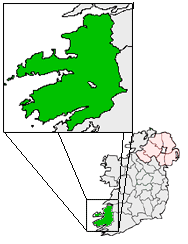
County Kerry, Ireland
Written about ten years before the Great Famine (1845-1852), it gives the history and lay of the land of every little townland in Ireland. My father (James Patrick/Edmund FitzGerald 1910-1988) always said his father's FitzGerald line were from Castlemaine (Caislean na Mainge) in county Kerry. Castlemaine lies on a harbor at the junction of the Dingle Peninsula and the Ring of Kerry, or just under the first peninsula on the map. It was a market town and the site of a castle built jointly by two Irish chiefs, the Earl of Desmond and MacCarthy More, in order to defend the crossing of the River Maine. Each chief was to alternately protect the castle, but at one point MacCarthy decided he didn't want to give it up. It eventually fell into ruins. Today there is nothing remarkable about the town. A few pubs and bed and breakfast establishments and some fine views are all that distinguish it.

What my father didn't know was the name of the area in which his family had lived: a little part of Castlemaine called Farnes. He and my mother went over to Ireland in 1978 to visit some of his cousins, and I'm quite sure they went to the house his father was born in, below. By asking the local residents, they managed to find the FitzGerald homestead. Compared to the adjacent older cottage, this was quite a step up for the family. I do wonder how accurate our information was, though. I would imagine that my grandfather, Patrick John FitzGerald (1867-1949) was born in the little cottage and thanks to money he and his siblings sent back to Ireland from the US, the family was able to build this once fine edifice.

Ann FitzGerald, Myles Kimmitt, Priscilla FitzGerald
FitzGerald Homestead, Farnes, Kerry, Ireland, June 1989

My mother, sister and I discovered the name when we visited the local parish to view their records in 1989. All of the related FitzGeralds we found lived in Farnes.  Farnes is a townland (more like a village or a neighborhood) in the civil parish of Kilgarrylander, and never gets any press. This is understandable. There isn't much there except gorse-covered hills dotted with the occasional cottage. 


View of the Slieve Mish (Sliabh Mish) range from FitzGerald home,
Farnes, Kerry, Ireland, named after a mythological Celtic princess
who was famed for being cruel.


So there is no historical detail about the actual land my ancestors lived on anywhere, except in one tiny mention in Samuel Lewis' Topographical Dictionary in which he states: "Three miles to the west of the town are the ruins of Castledrum, erected by the sept of Moriarty; and on the lands of Farnass is a good chalybeate spa." What? Peasant farmers living by a spa? Well, this is exciting! Something, at long last to distinguish them from the hordes of peasants the world over. MY ancestors lived near a chalybeate spa. So what is it, then?

The word chalybeate derives originally from the Latin word for steel, "chalybs" which in turn is taken from the Greek "khalups" after those who had invented iron working in Greek mythology. It is simply mineral water that contains iron. Wikipedia has this to say about Chalybeate: "Early in the 17th century, chalybeate water was said to have health-giving properties and many people have promoted its qualities. Dudley North, 3rd Baron North discovered the chalybeate spring at Tunbridge Wells in 1606. Dudley North’s physician claimed that the waters contained ‘vitriol’ and the waters of Tunbridge Wells could cure: the colic, the melancholy, and the vapours; it made the lean fat, the fat lean; it killed flat worms in the belly, loosened the clammy humours of the body, and dried the over-moist brain." It was also said to cure hysteria.

And therein lies the heart of the trouble. By leaving the chalybeatic spa in Farnes (Farnass) my ancestors opened the door to all manner of physiological ills. No wonder some of us are melancholy, some too fat, some too thin. I see it clearly now! This is why my clammy humours are not loosened and my brain remains over-moist. (I do wonder if the roof on the old cottage had anything to do with an abundance of iron in the local water--see first photo.) It is apparent that we must now make an annual trek to the homeland to restore our shattered tissues. I look forward to asking the locals all about it!

Priscilla (Barnes) FitzGerald
Farnes, Kerry, Ireland, June 1989