Kimmitt Genealogical Research

Showing posts with label Shrewsbury. Show all posts

19 February 2016

I'll Warrant Not Much Has Changed

I sing in a chorus that rehearses in a church hall in Worcester, Mass. On my way into chorus rehearsal a few weeks ago I came across this notice on the door. I was struck by how little has changed since the earliest days in Central Massachusetts when it was required to post the warrant for the annual meeting on the front door of the church. We're still electing a moderator and other officers, still voting on new and old business. And still physically posting the notification on the door!

Warrant for Annual Meeting of 31 Jan 2016, 2nd Parish, Worcester,
posted on the door to the First Unitarian Church,
photographed by Polly Kimmitt, 26 Jan 2016.

What has changed is who qualifies as an eligible voter. Only Freemen could vote in early town and parish meetings. That meant males over 18 who owed no money, were not in servitude, were in good standing with the town and church, and had taken the Freeman's Oath. Once they were Freemen they were allowed to own property and vote: a far cry from who is allowed to vote today.

Here is a transcription of a warrant for neighboring Shrewsbury, Massachusetts from 1756.


Transcription
Left Sidebar: Notification for the first precinct In Shrewsbury, November the 1, 1756
Body: These are to Notifie and warn all free Holders and other Inhabitants
Living in the first precinct In Shrewsbury Qualified by Law to
vote In precinct affairs to meet at the Meetinghouse in sd precinct on monday
the first Day of November - Next at one of the Clock In the afternoon
then and there In the first place to Chuse a moderator 2. To bring in precinct 
Depts and grant Money to pay the same 3 To see what the precinct will
give the Revd Mr Job Cushing for the present year to Make a sufficient
Sallary for his support 4 To Chuse a committee to Reckon with the
precinct Treasurer and to make Report at the Next Meeting \   \   \   \   \   \  
5 To Chuse a committee to Reckon with the Revd Mr Job Cushing In
order to get a Discharge 6 To See if the precinct will grant money
to Repair the windows of the Meeting house 7 To See if the precinct will
Chuse a committee to [Shut up?] the [ally] in the meetinghouse through the
Body of Seats as hath been voted or to act -- anything there on as the precinct 
shall think fitt 8 To See if the precinct will come into sum way to clear the
Burying place and to mend the fence or act anything thereon as the precinct
shall think fitt   \   \   \   \   \   \   \   \   \   \   \   \   \   \   \   \   \   \   \   \   \   \   
Shrewsbury first precinct                    Simon Maynard    }         precinct
Oct. the 11 1756                                  Ebenezer Keyes    }         Committee
                                                             Job Cushing Jr      }


16 May 2012

"I Call to Mind My Parent Dear": Isaac Stone's Tribute to His Mother

[Continued from Isaac Stone's Paternal Ancestry, posted 16 May 2012.]

In my previous post, Isaac had just finished describing his father's family. Here he begins on his maternal line, focusing for three pages on his mother, alone.  Two things strike me about this long passage. First, in the days before Mother's Day, children surely appreciated their mothers, just as we do now. And somehow they got by not buying Hallmark cards, taking her out to brunch, sending flowers or making keepsakes in school to demonstrate their love. No doubt they honored and respected both their mothers and fathers, or they would be in serious trouble. But I wonder if he ever mentioned to his mother how he felt about her? Did he discuss her with other people? I doubt it. You don't need Hallmark to get sentimental, as you can see from his memorialization--the feelings were there, just probably not spoken of. I suspect that then, just as now, mothers could feel the love of their children and didn't need any extravagances beyond the best gift all, a loving glance.

Sometimes people say that because death was so prevalent in earlier times, people were somehow hardened to it. Perhaps they didn't get attached to infants as early, didn't "decorate the nursery" before a child was born, but I love Isaac for making it perfectly clear that death struck an equally cruel blow two hundred years ago as it does today. Mother suffering for lost child, son lamenting loss of beloved mother, nothing can change the way our hearts react to losing loved ones. This letter is a treasure in the way that it brings out Isaac's humanity.


p. 4 [cont.]
My Mother, Raschel Stone was born at Marlbo-
rough April 2, NS. 1723. Moved with her parents
to Shrewsbury, 1737: age 14. Died April 17. 1787.


p. 5
Tues. eve. 10. o'clock. Married Feb. 1747: in a mar-
died state 40 years - - age 64. 7. 17. d. at Death.
   She was lame + feeble from her childhood;
a woman of Sorrows. Since my remembrance,
her lameness increased by a broken bone, at-
tended with anguish + exquisite pain. In
1759. In June her eldest daughter Lydia, was
sick; languishing thro' the Summer +
Autumn till Jan. 1760. By watching + ten-
ding, + by the death of her child, my mo.
ther received a shock, of which she never
recovered; tho' she had comfortable hopes,
that her little daughter was an heir of
heaven: after this She lived 27 years; but
could never promise herself enjoyments
in this world any more: willing to
wait, + to do, + to suffer her heavenly Fa-
ther's will, her great change appeared
definable in God's time. She was of a very se-
rious turn of mind while quite young; dedi-
cated herself, + made a public profession
early. She spent much time in secret meditation
+ prayer. Her mind was [best/bent] and looked, waiting
to learn Christ Jesus + holiness according to
the holy Scriptures. She deeply mourned for
her sins: abhorring all sin; renouncing
self, trusting in Jesus Christ. She constantly
took her infants with her to the house of worship.
She, watchful of her children, counseled them
most seriously with a mixture of tenderness.
Many of her pious counsels in her own hand
writing are my monitors and embalm her memory.


p. 6
She was ready to drop some pious word when
she could with propriety as long as she lived
She was provident in her family, careful +
an ingenious, industrious tayloress, curious
with her pen + needle, she employed her in-
ventive faculties + imagination judiciously.
She was a compassionate friend to all the hum-
ble + distressed. I call to mind my parent dear,
    Over her grave I weep__
Comfort! ____ Her Soul, her Mother's care,
   Tho in the dust she sleep.
From toil + sorrow ever free
   The Lord will raise the dead;
In realms of joy the blest agree
   With life eternal clad.
Monday, April 9. 1787. I wrote: "I visited my sick
Mother, last monday: found her in extreme pain
+ distress; waiting earnestly for her change. I was
filled with sorrow at seeing my kind parent in
such a wasted, distressed + low estate. She has ever since
my remembrance appeared to be a woman
of piety, always showing regard to God + to His in-
stitutions; expressing her dependence upon Christ
alone for Salvation. ___ She told me she had se-
cretly given me up [^to GOD] after I was born + before. __
I bless God for her earnest cries to Him for me:
+ for her pious care for me ever since I have had
an existence. I hope my parent's solemnly dedicating
me to GOD, their instructions, prayers + example
have been sanctified to me. Upon her death bed,
in the near [^view] of death, my Mother told me, she had
often cried to God, that I might be sanctified from
the womb. __I hope her prayers have been XXXXXX


p. 7
answered. May these considerations deeply affe[ct]
my mind, to excite me to strive to answer the
pious concern + expectations of [^my] Parents; that
I may be instrumental in promoting GOD's Glory.
The advancement of His kingdom, + the conver-
son of many Souls. __ If my mother is yet a-
live, I desire affectionately to commend her in
to the hands of GOD, thro' or Redeemer: GOD,
[alsoficient?] is our only hope. In extremity we
may safely trust in Him! May she have Divine
supports; when she  walks thro' the dark val-
ley of death, may she fear no evil: may thy
rod + thy staff comfort her! She has taken
her leave of us all: we leave her with GOD; hum-
bly pleading, that when death closes her eyes, all
her sorrows, grief + cares may end. May an open
+ abundant entrance be ministered to her into the
joys of her Glorious Redeemer. Weaned from the
world + from all its pleasures. She longs to be
with Jesus, I pray Thee, O my GOD, afford her Grace,
patience, hatred of Sin, self-denial, + to do, +
to suffer the whole will of God, until, full of love
to holiness, she shall be presented faultless + blame-
less before GOD, in chimes of boundless bliss, where
there is no sin, pain, nor Sorrow; but her Soul
shall eternally rest in God her Redeemer:
"April 22. '87. My Mother died Apr. 14 eve. 10 o'clock.
Her last words were, "I see the truth clearer than
ever." She bid my Father, "Farewell!" When he
asked her, if her faith held out? she answered, "yes."
How religion, how faith bears the Spirit up, un-
der most pressing pains + distresses? What a re-
commendation of religion, when its professors
p. 8
hold out to the end of life, + appear supported
by it, in distressing hours, in near views of Death.
////////////////////////////////////////////////////////////////////////////


[continued in "I Begun to Learn Latin Latter End of the Year 1763"]


Other posts in this series


Note: All ampersands have been replaced by a + symbol because of the interference with html.

11 May 2012

Sensible of His Own Vileness: The Battle for Isaac Stone's Immortal Soul

[continued from Isaac Stone of Shrewsbury, Mass., posted 10 May 2012]


When we left Isaac, he was recounting a visit to the deathbed of his grandfather, Isaac Stone. He quotes his own diary entry written nearly forty years earlier (22 April 1766) describing his feelings. At that time, Isaac Jr. was 18 years old and training for the ministry, and  like his grandfather, very concerned with the theological ramifications of death. He describes his grandfather's journey as he prepares to meet his maker. 

In the past I would have glossed over this bit, but the History of Shrewsbury, Mass., by Andrew Ward goes into excruciating detail on the battles fought over theological ideology and it seems that Isaac Sr. was well immersed in them. In particular, he was a staunch proponent of original sin! In 1750 the church appointed a committee to "discourse" with Dr. Joshua Smith and Isaac Stone on the controversy. "Isaac Stone [had] complained to the brethren, that one of them was defective in a fundamental article... The ground of controversy was doctrinal. It related to original sin. Mr. Stone contending for, and Dr. Smith against the doctrine."This was under the leadership of the first minister of the First Congregational Church in Shrewsbury, Job Cushing. 

Having served as the church historian at this very same church, I'm accustomed to reading exceedingly dry accounts of these discussions, whether taken in minutes of meetings or minister's records. You can tell that those involved felt very deeply about the issues, but still it comes across as lofty academic discussion. By reading Isaac's letter, on the other hand, you get a much more personal account, and see the implications of belief in certain doctrines. This poor man felt he had to spend his life atoning for original sin and spent his days weeping and gnashing his teeth. What a depressing existence he must have had!


2 [cont.]

                                ...He expressed
very comfortable hopes, that his sins
were pardoned;  that the consolati-
ons of God had abounded to him, more,
than in all his life before, in his time
of general calamity. Notwithstanding
the thought of Death seemed to lie with
weight on his mind." His countenance
was most solemn! Astonishing Solemn-
ity in his face + expressions, painted the
deep impressions made upon his
mind, by death, judgment + eternity.
in near view: Sensible of his own vile-
ness, by reason of original total de-
pravity + propensity to sin, he spent
much of hs time alone in his cham-
ber, many years before his death:
that he might mourn [for sin] + humble
himself: renouncing with abhorrence,
vile selfish feelings; striving to come near
to his dearest Saviour; renewably, + con-
tinually, devoting himself wholly to Christ;
he depended upon Him alone for rich-
teousness: + cryed earnestly. for the influen-
ces of Divine Grace upon his Soul: he re-
garded God above many; + poured out
Strong desires of his mind in prayer for


p. 3
the Strengthening of the church of
CHRIST; The advancing of the cause
of GOD: His native country Lay near
his heart: he longed for the Salvation of
[fellowday?], in all the world. His tempe-
rance was persevering. Years before his
death signs of a cancer appeared in his
face; he avoided cider, + whatever might
inflame: and it never increased. His com
plexion was dark, his eyes blue, his stature
a middle five; his features + deportment
quite agreeable: he retained his teeth + other
marks of a man of fewer years...


Note: Isaac used ampersands all over the place. But because the ampersand is an escape character in html, it appears as & when I type it here. I have therefore decide to replace all ampersands with a plus sign (+) instead.

10 May 2012

Isaac Stone of Shrewsbury and Douglas, Mass.

I don't choose my friends by how many historical documents with genealogical value they own. I just got lucky. Occasionally my pal Harry brings along a treasure for me to admire. It makes me feel like I did as a kid when my father would bring home a little trinket. Only what Harry has is immensely valuable to historians and genealogists alike.

A couple of weeks ago he appeared bearing a mylar pocket with a small yellowed letter in it. I only had to read a few words before I knew I'd need to transcribe the entire ten pages. The words of a man about my age, born a little more than 200 years before me, all about his life and family. He wrote it about a month before he was discharged from his position as a minister in the town of Douglas, Massachusetts.

I snapped photos of it on my kitchen table with my iPhone, at night, so the images aren't great. I can always go back and recapture them, but I want to share some of it with you here before I bust a gusset. It will have to be in installments, though, because it is so long. I have Harry's permission to publish this.


Letter in possession of private collector.
Written by Isaac Stone, 5 September 1805, Douglas, Mass.
Transcribed by Polly Kimmitt, 1 May 2012, 10 pp


p. 1
                            Douglas, Sept. 5, 1805

I, Isaac Stone was born March 17. 1748:
at Shrewsbury. My Father, Jonas Stone,
was born at Framingham, Massachusetts,
August 23, 1725* My Grandfather, Isaac
[footnote in right margin reads *died March 27. 1809]            
Stone was born at Framingham, Sept.
3. 1697. O. S. Died just before midnight,
April 22. 1776. N. S. In his 79th year. He
much encouraged me in my fitting for
College, at College, + since, in the gospel
ministry, as long as he lived. I received
many letters +; pious instructions from
him. He had 300 acres of excellent land
in Shrewsbury, new, when he first pos-
sessed it. Lived many years upon it, and
died there. He was an ingenious pen-
man and draughtsman_ he was town-
clerk _ he was accurate in his writings;
his labours were well accepted in church
+ town. When his deathbed sickness began,
he thought he should not recover. In my
Diary I wrote: "April 22. 1776. Last week
I visited my Grandfather, whose name
I bear, – was much affected at seeing
him sick, to appearance on the verge
of eternity! He desired me to remem-
ber him to Mr. Hall of Sutton, + to de
sire his prayers, that he might have
a safe + easy passage through the valley
p. 2
of the Shadow of Death, +that he might enter
into the haven of eternal rest... [much religious
verbiage follows].

Title page of Webster's 
Dictionary of the English Language,
 circa 1830–1840
The first thing that strikes me is that his spelling is virtually the same as that we use today. I've seen works by well educated men but there's always something that gives away the fact that spelling had not settled down into anything standard. This man was spelling words the way we spell them today, and it was 23 years before Noah Webster first published his Dictionary of the English Language in 1828. Of course that was when the difference in spelling between British and American English was really standardized, thus we find Stone spelling labours rather than labors. 

A brief entry in Andrew Ward's History of the Town of Shrewsbury, Massachusetts (Boston: Samuel G. Drake 1847), 425, states "Stone, Rev. Isaac (s. of Jonas) grad. H. U. 1770; ord. minister of Douglass, Oct. 31, 1771; married Susanna, D. of Benjamin Goddard, Oct. 27, 1773; dis. from his pastoral charge Oct. 28, 1805, and d. in 1837, aged 89."

H. U., as you may know, refers to Harvard University. And well yes, that's what Harvard did: it trained ministers and educated them extremely well. Still, I'm surprised by his consistency in spelling, the neatness of his writing, and his syntax. Can't help it. And I find it appropriate that he mentions his grandfather being "an ingenious penman and draughtsman" and notes that "he was accurate in his writings." The apple don't fall far from the tree!

I compared some of his date notations to the Vital Records of Shrewsbury, Massachusetts, to the end of the year 1849 (Worcester, Massachusetts: Franklin P. Rice, 1904). There, on p. 99, his birth appears as "Stone, Isaac, s. Jonas and Rachel, March 6, 1747-8." OK, pretty close. (We'll see later that he gives us his mother's maiden name as Rachel Rice). The History of Shrewsbury also gives his birth as March 6, 1748, corroborating the date in the published vital records. So I just wonder which date is correct. The dates for his father and grandfather's deaths agree in Isaac's letter and Shrewsbury VRs. 

The first page was enough to draw me in, and I continued to transcribe through his description of his grandfather's religious convictions, which I will present in the next installment.


*I have been obliged to substitute a + for an ampersand because of the limitations of html. If I can figure out a way around this, I will fix it.http://pk-pollyblog.blogspot.com/2012/05/sensible-of-his-own-vileness-battle-for.html

01 February 2011

Remembering Past Homes

Have you ever sat down and counted up all of the places you've lived in? As I write this, the list grows and grows! I've called lots of places home in my life even though I'm not really the moving type. Here's a rather long autobiographical post about places I've rested my head at night.

When I was born my parents lived with my mother's mother in the 200-year old Barnes family homestead, a big colonial in Scituate, Massachusetts. The house, at 48 Booth Hill Road, was built by my sea captain ancestor Israel Vinal Sr. and given by his grandson Nathaniel to his daughter Polly Vinal at the time of her wedding to Joseph Barnes of Hingham. This house is the basis of my logo, shown above and on my business cards.

Oldest photo I know of:
48 Booth Hill Road, North Scituate, Massachusetts

Grandma had raised her five children there and when I was born my parents and three siblings were living with her. We moved from Grandma's house when I was a little less than three, but I still have a few hazy memories of being upstairs in a crib watching the shadows playing on the wall while I waited for my mother to retrieve me. The difference in age between my older siblings and me is so great that my eldest brother graduated from high school in Scituate before we moved away, and my sister stayed with Grandma so she could graduate that year. And then they were off to college, and my parents and brother and I moved to Marshfield.

After we moved to Marshfield we visited my grandmother in Scituate on Saturdays until she passed away when I was just seven. I loved my grandmother wildly. She was the only living grandparent I ever knew and she played card games with me every Sunday when she came to have dinner at our house. I thought she was very funny because when I'd need to pause for a potty break, she'd say, "Go for me, too, while you're in there, will ya?" Grandma was intelligent and civic-minded and extremely well-read. I wonder what we talked about? One of my fondest memories was the old stone wall in front of her house. I just loved walking along on top of the stone wall and holding her or my mother's hand. It made me tall, granted me a new perspective on my small world and gave me a sense of power. This is where my love of history began.

48 Booth Hill Road
Stone wall in foreground has been cemented over
Taken sometime in 2009

Our next house is the one I think of as my childhood home, where I "grew up." I played outside in the woods, climbed trees, played house, got my first cat, Pansy, and learned to read, ride a bike, cook, swim, play the flute, hula-hoop, and on and on! It was a small ranch on an unpaved road only a quarter of a mile from the Atlantic Ocean in Marshfield, one town away from Scituate. We lived there for eleven years and I loved it. I knew every nook and cranny of the neighborhood and felt confident there. I had friends a few doors down who treated me like family, and to this day, when I smell certain smells or something triggers a memory, they always come to mind.

Growing up

My parents moved back to Scituate when I was in the middle of 8th grade. Lots of people seemed to know and remember me, but they were all strangers to me since we had moved away when I was so young. We lived just three houses down from 48 Booth Hill Road, at 84 Booth Hill Road. It was an old house, built before the Civil War. The people who had lived there hadn't renovated it ever, except to add a bathroom. My parents had to install a heating system, even! This is the house I lived in from about age 13 until college, with the occasional stays until 1990. If I had to choose one house to call home, this would be it. My parents lived here from 1968 until 1990 or so. My brother inherited the house from my mother and lives there with his family.

84 Booth Hill Road
Painted for our wedding, in 1988

Updated 84 Booth Hill Road in 2008

Once I went to college things started to pick up. I lived in two different college dorms at UMass, Knowlton (all female––synchronized periods!) and Lewis. I worked at the Cape in the summers and lived in a rooming house (!) and a motel. The latter was distressing to my mother because I brought home "water bugs" aka cocroaches!!! in our minifridge at the end of the summer. Nasty.


UMass, Northeast area, circa 1977


As an exchange student in France, I rented a room from a very old woman and her daughter who invited me to dinner every Sunday night. The daughter, Therèse, had quite a beard going, and she would slurp her potage, fall asleep and snore loudly, leaving Madame Habeault and I to chat about World War II and other niceties. Again on exchange, this time for a summer in Quebec, I stayed in a house with several other students. All I remember is sparse. Then after college, I lived briefly in a double decker in Watertown until I moved to Italy.

In Rome I lived in lots of different abodes, including: a couple of different pensiones; a tiny, grubby, garret studio apartment; a nice apartment that I shared with two Iranian cellists (?); my office in Piazza Barberini; a horrible room in a horrible apartment rented to me by a horrible man (beard stubble in soap--shortlived); my temporary fiancé's mother's house, and a few other forgettable places. At that time I was living out of a huge suitcase, so the trauma of moving was minimal, but I hated not being able to put down solid roots. The fiancé thing didn't work out, so I returned home.

Piazza Barberini
Rome
Cockroach closeupImage via Wikipedia

After staying for a few months with my parents I moved into an apartment in Watertown, sharing a double decker with a different roommate. The place was okay, but the landlord was a creep and wouldn't fix things, so I moved to more cockroaches in Cleveland Circle, Brighton. Of course I didn't know it when I moved in, but a lady down the hall had extreme squalid conditions in her apartment and oh, never mind. Bad memories of wearing a hoodie to bed at night tightly ensconced under the bedclothes. As soon as I could I moved to a fine studio apartment in Central Square in Cambridge, walking distance from work. I loved that little place. So easy to clean, as opposed to the 10-room monster I now live in. No roaches, but you could hear the people in the next apartment via the oven vents and they sounded as though they were in the same room. Final working girl apartment was again in Watertown. Nice place, clean, one-bedroom, easy commute to work, easy parking. Loved it but finally moved when we married.

Me, my niece Aimee and my mother, Priscilla FitzGerald
Moving me from Watertown to Cambridge
1984

For someone who liked to feel settled, things weren't going well. Myles and I packed up our respective apartments and put it all in storage because we moved to England for a year so that he could get his Master's (Mahstah's) degree in electronic chip design at the University of Southampton. We lived in international student housing in a dear dwelling I referred to as the "Hell-Hole." Talk of sparse! There was a coin-operated machine in a closet via which we purchased electricity, and it took us three months just to get a telephone. The walls were moldy, despite the under-floor heating which just served to bring all of the hidden bacteria from countless past students to the optimal temperature to spread disease. Eww.

I made a scrapbook of our time there. Forgot all about this!

Back to live with my mother at 84 Booth Hill while we shopped around carefully for our first home. I was psyched! We ended up in Shrewsbury, just past Boston's Metrowest, because the cost of living was great, schools had a fine reputation and it was good commuting for Myles. We bought a little brown cape we nicknamed "The Snuggy Brown House." This is the house where I finally got to unpack my wedding presents two years after we married! Its where we brought all three newborn sons home, where they puked and pooped and drooled and ripped and scribbled their way through their early years.

Snuggy Brown House ca 1995

When we reached the point of having three kids share one bedroom, we decided to move, and finally came to our present home, still in Shrewsbury. It's big and comfortable and was brand new when we bought it. It doesn't have the character of an antique home, but new construction is so much easier to maintain. This is where my babies have grown up, gone off to college and where I've honed my genealogical skills. After this I don't think we'll live in more than one more place. Or I would have said that before writing this post, but seeing how easy it seems to have been for me to move, maybe I'll be proved wrong.

Current Dwelling Place

It's funny how quickly someplace can feel comfortable, become the spot where you unwind, the spot you crave when you are tired. Big or small, new or old, I remember that about all of my homes.

Enhanced by Zemanta

19 November 2010

Woman's Missionary Society, First Congregational Church, Shrewsbury, Massachusetts

Here's a little excerpt from a register of the minutes of the Women's Missionary Society of the Shrewsbury Congregational Church. It's quite interesting in how it reveals the women of 1915 dealing with women's issues. Just a few of the things they discussed were childrearing, immigration, education of women, missionary work overseas, and of course, religion. They sang, discussed issues of the day, held fundraisers, did crafts together, prayed and did all they could to learn about the world outside of Shrewsbury.

The very neatly written register. A joy to transcribe!

March 18, 1915

On Thursday afternoon, March 18th, the
regular meeting of the Woman’s Missionary Society
was held in the Vestry. The meeting was opened
by the president, Mrs. Cook, who read the account
of Christ’s being found in the Temple in serious
conversation with the learned doctors of the Law.
Prayer was offered and the secretary’s report
was read and approved. The usual offering
was taken. 

Miss Grace Marion Holland, one of the many young ladies who went abroad to serve as a missionary, in India. Her sister, Ruth, died of typhoid fever in Ceylon after she had served there for a little over a year, on 11 January 1921.

Letters from our missionary, Miss Abbie G.
Chapin, of Tungchou, North China, and her
friend, Miss Phelps, were read. They wrote
of their Christmas celebrations and told what
was done with the bags and handkerchiefs
we sent them (about 100 of each).

Mrs Willis Knowlton then took charge
of the meeting. A Gospel hymn was sung
and the last chapter of the study book was
considered––The child at work for Christ.
One or two selections were read from
the book, following which Mrs. Shepard
expressed her feeling as to what the children
of Shrewsbury need to have done for them,
and the importance of having a parish
house.

Miss Marble, our kindergarten teacher, spoke
of ways in which we may be of service to the
French and Italian children and mothers
at the Lake. Miss Marble has made a
thorough canvas of that district and has
found there one hundred children of
kindergarten age. The mothers are eager
to learn how to do things in the American
way; and Miss Marble thinks that after
the kindergarten at the Lake is started
and the teacher has won the confidence
of these mothers, there will be an op-
portunity for us to teach them cooking,
sewing, care of children, and care of their
homes.

The music consisted of singing by the
Sunshine Club, accompanied by Miss Doris
Donaldson.

The attendance was eleven members,
four adults visitors, and eight children––
total 23. 

Postcard found in the Shrewsbury Congregational Church Archives.
Float created by members of St. Mary's and St. Anne's parishes,
also in Shrewsbury.


Decorations of flags were furnished by
the flower committee, and a begonia in
full bloom.

Since our last meeting, one of our
members, Miss Mary L. Norcross, has been
taken from us by death, after a long and
painful illness. Her name first appears
in our records in October, 1901, when she
was chosen secretary of the society.
From that time until her last illness,
so far as her health permitted, Mrs. Norcross
was always ready to do her part in the work
of the society.

Ida L. Bement Sec’y.
An early view of the First Congregational Church of Shrewsbury, Massachusetts

16 September 2010

Treasures from a Church Fair

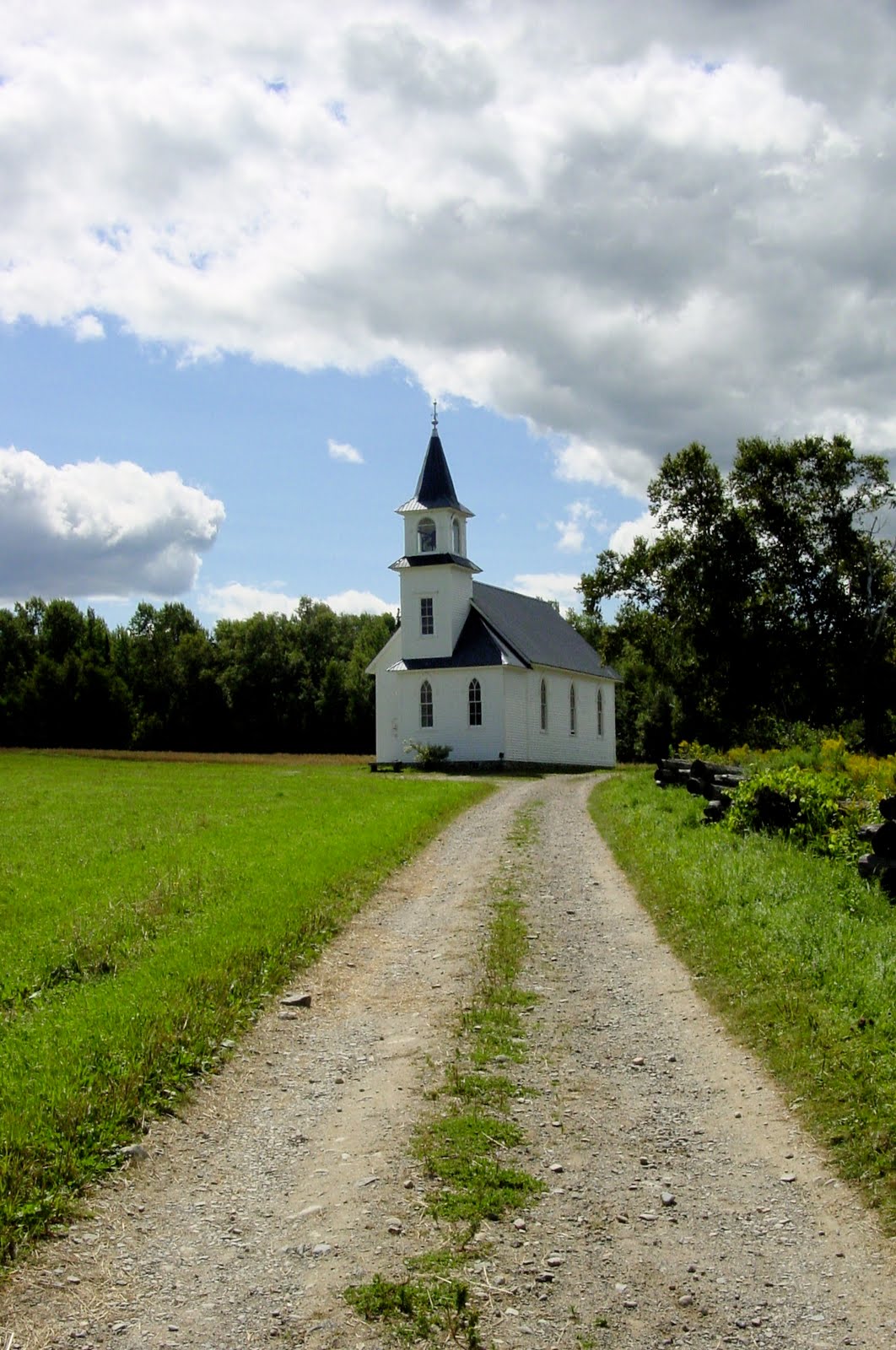
Sweet little church, Kings Landing Historical Settlement, New Brunswick

I was the Church Historian at the First Congregational Church in Shrewsbury for about six years. In 1998 I met my predecessor, Barbara Santon, when I was taking the National Genealogical Society's Basic Course in American Genealogy. One assignment was to go to a church and learn about their archives. Barbara was the Church Historian and was so friendly and welcoming I loved her instantly! We must have talked and laughed for three hours that day, and before I left she was already grooming me to take over, as I happened along just as her term was ending. Lucky me!

Barbara called herself "The Hat Lady" because she loved to wear fancy hats: not the Red Hat Society kind of hats, but classy, British wedding-type hats. Gloves, too! She was smart as a whip, a very snappy dresser, had a bawdy sense of humor and was a dedicated worker. Anyway, one of the many talents Barbara shared with the church was her ability to organize a church fair. She had a favorite poem which she had unearthed in the archives. Though it describes a springtime fair, I thought it appropriate for the season, as in New England, we tend to have lots of fairs in the Fall due to our gorgeous yearly pageantry of color.

The poem had no source attributed, but seemed to be written by the ladies in the congregation who were organizing the fair.


“LINES" ON AN EARLY FAIR 1838

Thrice welcome are ye all, kind friends,
To meet us here today,
Ye’ve called to see our fairy things
This twenty-fourth of May.

We welcome thee, for here thine eyes
With pleasure shall behold
A multitude of pretty things
All ready to be sold.

Here is a beau for some fair lass,
All dressed in sailor’s clothes,
He will ne’er give thee one cross look,
Nor will he come to blows.

Here is a lady gay and prim,
Say, will you buy her too?
Her clothes are fine, and then her cheeks
Are of the reddest hue.

Here’s pin-balls, cheats, and needle-books,
Of various form and size,
And hearts rejoice with Scripture lines
To make you truly wise.

Here’s dickeys, ruffled bosoms too,
For gentlemen to wear,
And for the ladies, turbans, nets
Which will preserve the hair.

Here’s tulips, cherries, flowers, to sell,
With baskets, boxes fine.
And racks to hold the ladies’ cards,
And useful in their line.

Come buy; the object’s truly good;
The poor and needy claim
A portion of your liberal hand;
They’ll thank you for the same.

It is more blessed, as we read,
To give than to receive,
And we shall feel the promise sure,
If we this truth believe.

And now we proffer you our thanks,
And ask you for a share,
And hope you never will repent
Of coming to our Fair.

First Congregational Church, Shrewsbury, Massachusetts

I can't find access info on this year's fair, but here's a newspaper announcement from a couple of years ago.

SATURDAY, OCT. 25, 2008
Church Fair — The First Congregational Church of Shrewsbury plans a Church Fair from 9 a.m. to 2 p.m. In addition to the “gems” at the always-popular Jewelry Table, there will be jams and jellies, baked goods, knit and craft goods and plants for sale. There will also be a Silent Auction, Flea Market and Cookie Walk. The First Congregational Church is the Church on the Green in the center of Shrewsbury at Main Street and Route 140. All are welcome.