Kimmitt Genealogical Research

06 August 2010

Contemporaneous Thoughts on Hiroshima

My parents did not serve in the military in World War II, but their siblings did. My mother's twin sisters, Abbie and Anne were in the Waves and Wacs, and Billy was in the Navy. My father worked in munitions stateside and my mother had two small children. Here's a little snippet in time...

This is my Uncle Billy, William Humphrey Barnes (1920-1992), and his mother, my grandmother, Vernetta Gertrude (Jones) Barnes (1892-1962). I don't know when it was taken, but I think Billy looks about 17 or so: definitely before World War II. He was Vernetta's only son.

This is a letter in the Barnes Family Papers, passed down to me by my mother. It was written by Vernetta to Billy.

[page one]
Sunday, Aug. 12, [1945]
Dear Billy, Isn’t the news wonder-
ful? It won’t be long before Japan
gives in – and how thank-
ful I , and millions of us, will
be. I keep wondering where you
are. in Pearl Harbor, I guess.
Just now I am waiting for
the official news of peace – the
radio is on practically all
the time ––
Maybe I sounded a
little soft over the Atomic
Bomb, but I can’t see waging
wars on innocent children,
altho heaven knows they
would [on us, interlined] quickly enough.
Anyway the news of Peace
will be wonderful, and I

[page two]
can rest easier over you.
Louise says Ed is being dis-
charged. Abbie thinks she
will be released soon – I only
hope she completes her course
first. Anne will be in for
quite a long time even
after Peace. How long do
you think it will be before
you get thru? I hope it
will be soon. The State of
Mass is giving each returning
veteran $100 – the federal
gov’t more.
Abbie was going to come
home last night but called

[page three]
up in tears from New York
to say she missed her train –
no more last night. Its
hard to tell who felt the
sadder Abbie or me.
I’ll write again, maybe
tomorrow – –– (if its V. J.) I’ll
be sure to.
Did you get the books
and magazines?
Love to my dear boy
my brave boy. Oh I’ll
be so glad to know
you won’t be in danger.
God bless you
Mother

Georgianne "Anne" (1924-1994) Barnes and Billy Barnes, shortly after the war, I think. 


Anne, Louise Bethia (Barnes) Sullivan (1915-1997) and Billy
Dec 1944


The note is self explanatory. 

This photo and the one above were scanned by Abbie and her husband Kenneth, and put onto a CD which was distributed several years ago. My sister gave me a copy at the recent family reunion, and I'm loving it!

03 August 2010

Sarah and Ann Drury, Mountain View Cemetery, Shrewsbury, Massachusetts

Here lies the body of Ann Drury


Here lies the body of Sarah Drury

Ann and Sarah were twin daughters of Daniel and Sarah Drury. Their births on 23 November 1738 are listed in the published Vital Records of Shrewsbury, Massachusetts to 1850. Their deaths are also: Ann died 30 June 1740 and Sarah died 20 July 1730. Daniel and Sarah went on to have many more children, but this must have been very painful to bear. No cause of death is found in either the vital records of Shrewsbury or in Andrew Ward's History of Shrewsbury.

Despite the closeness in time of their deaths, their gravestones seem to be of different kinds of stone. The carver is the same. Note that his N's are backwards! I love how the stones lean towards each other, as if trying to console one another. Also, the large, primitive letters, just like those a child would write, and the damage, giving the impression of something unfinished.

29 July 2010

In the Event of My ... Silence?

Genea-Bloggers
52 Weeks To Better Genealogy - Challenge #30 

Radar image of Hurricane Ike at landfall. HGX ...Image via Wikipedia
Week 30: Create an emergency chain. Select someone you trust to handle duties should you be unable to access your research, blog or other genealogy projects. Chances are that you have an online presence and genealogy friend with whom you are in regular contact. If you are unable to get online for a significant period of time, how will you let everyone know? Use this week to give your contact information to at least one genealogy friend so he or she could check in with you or your family in case of unexplained absence. The genealogy community is pretty tight, and we worry when one of our own hasn’t been heard from in a while. This challenge was inspired by Hurricane Ike and 14 days without power. Bloggers: describe the steps you take to establish an emergency chain to help your readers      do the same.

OK, I've been stuck on this one for a few minutes. I could select someone close by, like my lovely friend, neighbor and quickly rising genealogy prodigy, whom I shall call KK. But if it were a natural disaster, power outage or something local, and my communication were to fail, then so would KK's fail. On the other hand, if I delegate someone far away, how the heck would I get word to them? As for someone I trust, that would be my dependable and technologically gifted husband, Myles. But he isn't a genealogist.


A61RJ MOHAMMED HASSAN P.O.BOX: 70006 SHARJAH U...Image via Wikipedia
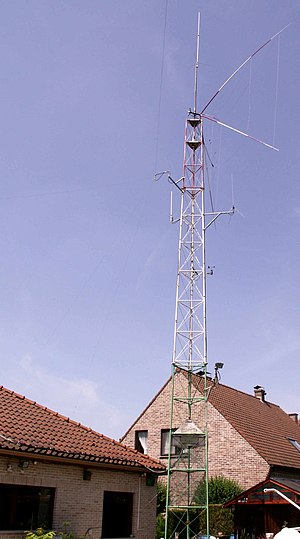
I am left with devising a chain, or an endless loop, I'm not sure which it is. Therefore, know all men by these presents that I declare Myles as the provider of personal information and KK as my link to the genealogical world. Myles has the key to my heart and my house, along with the password for my computer, our local area network, home video camera and bank accounts, amongst other things. KK is a great genealogist and communicator, and she is efficient, empathetic, and lives right across the street. AND, get this! If the power is out, Myles is a licensed ham radio operator and could send radio messages! How cool is that! What a team they would make. KK could dictate and Myles could transmit the old fashioned way. He even knows Morse Code. Very Sci-Fi. dit dit dit, daaaaaah daaaaah daaaaaaah dit dit dit. And no, that's not a dit name.

I'm wondering, however, if all this would really be necessary. "If you are unable to get online for a significant period of time, how will you let everyone know?" Believe me, they'll know it. I'm so obnoxiously present on the web (updating Facebook, emailing, texting, phoning, skyping, using the new iPhone's face-to-face feature) that if something goes wrong it will be clear. I have enough real life friends that are also FB friends that they could easily post something on my page.

What is more concerning though is, should I fall ill, go insane or die, who would tell my clients? I have customized folders for my current clients, both in Safari (email) and in my Clients folder on my hard drive. I also use Bento database software to keep track of my projects. In Bento you can see the status of each project since I update it with notes as I go along. I usually don't have more than five clients at any one time. Of course I always have hard copy files accompanying the digital data. That is usually splayed across my desk. The other thing to check would be my very lengthy work to-do list. Since I have a brain the size of a pea, I update that list daily. It's a great means to be pseudo me during my unfortunate incapacitation. The work to-do list (not to be confused with my regular to-do list) works in tandem with my calendar. And my address book has any phone number or email address you should need.

Facebook logoImage via Wikipedia
Personal research and family papers have been left to a local society in my will, so I'm not worried about that problem. It is mainly cyber-info that could be lost. And what is out there? Not much really: just this blog, Facebook, my simple webpage at kimmittgenealogy.com and my personal webpage. I've put a
 tree up on Ancestry that is only for my own convenience and that of relatives. Once I'm gone, hey, make it public, I don't mind! Relatives would want to keep the personal website, though, because that is where I store family photos. My Facebook page can be retired. Well. If I'm dead, I mean. Don't go sneaking around just because I'm in a coma and delete all of my fun stuff! At least hold a mirror up to my mouth first. And while we're at it, I'd like a string down in the coffin attached to a bell in the graveyard. Just in case. Oh wait, I want to be cremated...

"Funnily enough" (my mother-in-law used to say that) a friend of mine suggested to me today that one way to preserve my blog posts would be to print them out and keep them in a binder. Nothing like good old paper. It's just there, doesn't need a password, no media conversions, no file formats to worry about. Just open the cover and you're off. How refreshingly simple. Of course, then links don't work, but, eh, too bad. I hardly use them. There is a way to back up the information in your blog, but I think I tried it and it was too complicated, so I abandoned it. And I could place this blog post at the very begininning. It would be out of chronological order, but could prove useful some day.

In the meantime, as the post shows, I'm still blabbing away. The weather is fine and electricity is pouring into our house. I feel better already, though, knowing that cyber me will be looked after.

Navy Quartermasters have many diverse responsi...Image via Wikipedia
Enhanced by Zemanta

27 July 2010

Cousin Joanna Barnes Invited to Next Barnes Family Reunion

In my last post, I talked about how it is impossible to trace the descendants of all of your ancestors. Even finding all descendants of just one ancestor, though possible, is daunting, and I haven't attempted it. I'm just too involved in other endeavors, and frankly, I don't think anyone is particularly interested. Besides, a lot of it has been done here and there, just not compiled in one place.

At our family reunion I was asked twice about Joanna Barnes, the actress. "Is she a relative?" "I always heard she was a cousin!" Now I had heard this claim, too, but was keenly aware that the sources were prone to exaggeration and/or wishful thinking. Yet, most family stories/myths end up having more than a grain of truth to them: fact and fantasy intertwine seamlessly and need to be separated carefully. So like a good genealogist, I wanted to verify this information before confirming the family story.


This is Joanna Barnes* (1934–  ). You can see her listing in the Internet Movie Database at http://www.imdb.com/name/nm0055645/. My uncle, William Humphrey "Billy" Barnes (1920-1992), used to boast that Joanna was a relative. He'd bat his eyes winsomely, swoon and generally get all soft of expression. He was quite the jokester, and I always thought he was making it up, or simply wishing it were true. She was a beauty and he fairly turned inside out everytime she came on TV. Whelp, we just had a Barnes family reunion this past weekend, and the subject came up. I was sceptical about the relationship until I heard she was from Hingham. Since I know that my immigrant ancestor, Thomas Barnes, was the only Barnes with lots and lots of progeny in the area, I thought it plausible that she, too, had descended from him. 

So I googled her when I got home, and once I saw her photo, I knew she was related. She's got those wide-set, light colored eyes and dark blond hair, thin upper lip/thicker lower lip, oval face, with heavy eyebrows. Lots of Barnes descendants seem to have these features. In fact, I think she looks a lot like my sister.

 I also knew that she could not be a close relative. I'm aware of everyone descended from my great great-grandfather, Israel Merritt Barnes I, on down. Israel I's father, Joseph Barnes, had moved from Hingham to Scituate to marry Polly Vinal, and they were given the old Capt. Israel Vinal homestead, built about 1723 on what is now Booth Hill Road, as a wedding gift, according to family stories. The land had originally belonged to John Booth (hence the modern street name) but was sold to Israel Vinal early in the eighteenth century. That home remained in the family until Uncle Billy sold it in the 1960s.

Joseph and Polly had eight children, the youngest of whom was Israel, born in 1820. I was pretty sure she wasn't descended from any of them because they remained in Scituate or moved to Boston. None went back to Hingham. Joseph only moved to the next town, but he did not seem to have many interactions with his siblings except in a few land dealings. That still left five previous generations. 


Joanna is too young to appear in the census, since 1930 is the most recent to which we have access. It appeared that she is still alive. I didn't want to get all caught up in invented or undocumented family trees and was hoping to find some original information on the web since she was so famous. I googled "Joanna Barnes" and "daughter of" and found a newspaper announcement from 1959 in Hingham which said she was the daughter of John Barnes. From there I could go to census and on back bouncing vital records off of census and other records–– easy peasy––until I found she is descended from John, grandson of the immigrant ancestor. So she is my sixth cousin once removed!

It's got to be coincidence that she looks the way she does, but it was still fun to find Barnes relatives in Hingham more than two hundred years after our own ancestor left. I know there are scads more, but since Hingham is so easy to research it feels more like record-keeping than genealogical research. Countless people have transcribed original records, and written town histories and genealogies, so it is not as compelling as solving those brick wall mysteries. I think I'll leave it until I'm older and can't get around as well...

Cousin Joanna, nice to know you're part of the family! We hope you can join us at the next Barnes Family Reunion, not yet scheduled, but sure to occur in the near future!


* Photo of Joanna Barnes courtesy of "Ace Photos" website (http://www.acephotos.org/c13578426/joanna-barnes-photo.html : accessed 26 July 2010).

Enhanced by Zemanta

23 July 2010

"Hey, Can you Give Me the Family Genealogy?"


No, actually. Not easily! There's too much of it! It's going to take years to write it up, if I ever feel ready to do that. We're having a family reunion this weekend and I want to provide information for my relatives. It lies relatively hidden on my computer and in files in my office, and it's certainly not ready for distribution, yet there is plenty I will share with my Barnes cousins.

For over twenty years I've been gently working on my family lines. A great deal had been done by other family members, so often I'm just verifying or trying to break down the few brick walls, especially on the Barnes side. I have to admit though that I spent most of my early years learning about resources, methodology and professional practices until I felt reasonably qualified, then I began taking clients. What I haven't done is concentrate on descendants of my ancestors because there are far too many. I've got enough Barnes descendants to make an impression, but probably not even one tenth of the total! I just document them as I run into them, to distinguish them from my own direct lines, for instance. But let's not even talk about the descendants of my other lines! There are scads of Litchfields, for instance, probably a billion living in Scituate alone (haha), but I've only taken note, again, of those families that are in my direct line, or those who could be confused with them. This is hard to explain to people who wonder why I can't just hand over the book. Yes we're related to Israel Litchfield of diary fame, but not directly, so he doesn't appear in a pedigree or fan chart. He's my 5th great-uncle, brother of my 5th great grandfather Capt. Daniel Litchfield Sr. (see my John Hancock post).

Now we're about to gather a big gang of Barnes descendants together and I wish I had a book to hand out! So instead I've made some charts––big ones––to hang up on the side of the house. I'm bringing red pens so people can make corrections. I've asked them to sign their notations so I can know who my sources are (I neglected to do that in 1995) and I'm bringing along some family group sheets for those extra large families of unknown cousins. 

Here are the charts I'm making:
•  10-Generation fan chart starting with my grandfather and his siblings and moving back to 1600s.
•  All descendants of Capt. Joseph Barnes and Polly Vinal, mostly via Israel Merritt Barnes I. This one has photos included.
•  Descendants of the father of immigrant ancestor Thomas Barnes for 6 generations.
•  Lists of Revolutionary War, Mayflower, and Ancient and Honorable Artillery ancestors.

I use Reunion for Macintosh, which creates lovely charts but is quite buggy, especially with a 100-page chart. These charts contain so much info that they have to be huge in order to be legible. It's much too expensive to print them in color so it's black and white and the photographs suffer. 

The fan chart at the beginning of this post will be 16 inches by 30 inches. Not too bad considering how many names it has. People enjoy seeing the whole she-bang at once. Get a load of those glaring brick walls. How they torture me!!

The next chart is the descendants of Joseph Barnes. This one took a lot of tweaking before I could get it down to 100 pages. I forget the final dimensions, but it's something like 18 inches by 120 or thereabouts! It will include everyone at the reunion and many more.

And the final one, below, is 16 inches by 51. It has descendants of the immigrant down six generations. I love doing these because they show me gaps. I need to do some work on the early Barnes generations.


When I feel ready, I'll get one done up properly by the Chart Chick, Janet Hovorka, at generationmaps.com, who does wonderful work, but for now, we intend to scribble on these and use them as information-gathering vehicles, so I don't want to spend too much money or time. Besides, I'm not ready yet. This is kind of joke because you're never ready. You can never be finished with genealogical research. There is always one more source to consult, one new ancestor who blesses you with two more progenitors. 

Anyway, I'm excited to display these for my Barnes cousins and even more excited to see everyone!

05 July 2010

Atwood Mott and His Mysterious Female Relatives


It seems fitting on this Fourth of July weekend to discuss the family of one of my own Revolutionary War ancestors, Atwood Mott. Atwood, it seems, was surrounded by women of unknown origin: both his mother and his wife are shrouded in mystery.

I was first introduced to Atwood in the context of a Mayflower line. In 1979, my mother and Aunt Abbie were accepted into the Mayflower Society on a line back to Stephen Hopkins through Atwood's mother Deborah Atwood. By 1998, when I tried to join the Mayflower Society on that line, it was rejected––precisely because of Deborah Atwood! I won't dwell on Deborah here except to say that that I know she's not going to be easy to find.

I haven't delved into thorough search on Atwood yet. I have two other proven Mayflower lines, so it has never seemed too critical. Plus, I know that these are not going to be simple to solve, and because I've been so preoccupied with clients, family and other ancestors, he remains on my "Requires Further Research" list. He was born 18 September 1736, in Scituate, Massachusetts, son of Ebenezer Mott Jr. and Deborah Atwood, according to the published Vital Records of Scituate (1:262). His marriage to Mrs. Hannah Whood on 23 July 1758 also is listed (2:211).

And Samuel Deane, in his History of Scituate, says only this about him:  "Lieutenant Atwood Mott, a worthy man (the father of the wives of Nehemiah Merritt, Nathaniel Vinal and Laban Rose), was also son of Ebenezer, Jr. He married Hannah Hood 1758. Hannah (widow of Laban Rose) was wife of Gamaliel Merritt, 1782."

How's that for a confusing treatment? I find it odd that for a man described only in terms of his daughters' husbands, the other two women in his life are so hard to pin down. You'd never know it from the above paragraph, but the Hannah in the last sentence is his daughter, not his wife. Of his three daughters, two were married twice, both to Merritt men, not brothers. The other sister was my ancestor.

Anyway, for a "worthy" man, he doesn't get much space in the history books. He is, however, mentioned in Mass. Soldiers and Sailors of the Revolution (11:168):

"Mott, Atwood, Scituate, Corporal, Capt. Samuel Stockbridge's co. of Minutemen, Col. Bailey's regt., which marched on the alarm of April 19, 1775; service, 21 days; also, Lieutenant, Capt. Samuel Stockbridge's co., Gen. John Thomas's regt.; list of officers who were commissioned May 19, 1775; also, Lieutenant, same co. and regt.; muster roll dated Aug. 1, 1775; engaged May 10, 1775; service, 2 mos., 3 weeks, 6 days; also, company return dated Oct. 7, 1775; also, Capt. Seth Stowers's co., Col. J. Robinson's regt.; engaged June 27, 1777; service, 6 mos. 3 days, at Rhode Island."

Apart from his military service, the only other information I have in my notes is that he was admitted to full Communion in the First Church of Scituate on 4 February 1770 (Mayflower Descendant 10-11:208).

Nothing on his mother, not much on him, so my first step will be to get a look at some land and probate records. These will hopefully also provide some information on his wife, Mrs. Hannah Whood. WHOOD? What kind of name is that? The vital records say it could also be Wood or Woods, and somewhere else I saw Hood suggested. Still, nothing comes up in Scituate. She's a mystery, plain and simple. From the Mrs. we can deduce that she is a widow of a man named Whood. My mother always thought that maybe she was Native American. That is probably because the only time the name, spelled as Whood, is found, it belongs to some "Indians" around Plymouth. The name has also appeared in Middleborough and in Shapleigh, Maine.

I don't even dare to guess at anything, though, and I think it would be jumping the gun to make any kind of research plan before even seeing land and probate records. This is the kind of project that will require writing up as I go along, and I'll have to suffer a lull in clients before I attack it, but whenever that happens, I will enjoy it, I'm sure!

25 June 2010

Capt. Daniel Litchfield [Sr.] and his brush with John Hancock


I found this in an online German auction a few months ago [http://www.autogramme.com : 20 Apr 2010]. Capt. Daniel Litchfield is my ancestor. Here is the text that accompanied it.


"John Hancock (1737-1793)
Merchant, statesman, and prominent Patriot of the American Revolution. He served as President of the Second Continental Congress and was the first Governor of the Commonwealth of Massachusetts. He is remembered for his large and stylish signature on the United States Declaration of Independence, so much so that "John Hancock" became, in the United States, a synonym for signature.


Revolutionary War Era Appointment of Daniel Litchfield, Gent. as Captain of the Tenth Company, Second Regiment of Militia, Plimoth (sic), under Col. William Turner, dated April 2, 1783 and boldly signed by both John Hancock as Governor and John Avery as Sec'y, with embossed paper seal upper left, in rigid archival sleeve, SS: 11x10.5 inch, 3 vertical & horizontal folds, small holes at the crossfolds, tones, minor foxing. Docked on reverse with witness to oath of office. Daniel Litchfield was from Scituate, had already served as a Private in Capt. Hayward Pierce's Company, Col. Cushing's Regiment, marched to Bristol, RI on the alarm of Dec 1776, later Capt Bonney's Company, Col Sparhawk's Regt, at Castle Island Oct-Dec 1778. Rare !
Preis: 4500  Euro  ID:21418"


Wow! That's a lot of money: 4,500 Euros is about $5,574!! I obviously did not purchase it. If it weren't a John Hancock signature, of course, it wouldn't be worth more than a couple of hundred dollars. But it's a great piece of evidence in my Barnes family history archive. Daniel Litchfield was always referred to as Capt. Dan'l, but I couldn't figure out why. Mass. Soldiers and Sailors doesn't mention this! The only two entries for him are these:


Volume 9page 860
LitchfieldDaniel. Private, Capt. Hayward Peirce's co., Col. John Cushing's (2d Plymouth Co.) regt.; service, 15 days; company ordered to march to Bristol, R. I., on an alarm in Dec., 1776; roll dated Scituate; also, Capt. Ichabod Bonney's co., Col. Nathan Sparhawk's regt.; marched Oct. 5, 1778; service, 1 mo. 15 days, at Castle Island; travel home (4 days) allowed; company discharged Dec. 11, 1778.
Volume 9
page 864
LitchfieldDaniel, Scituate. Private, Capt. Samuel Stockbridge's co. of Minute-men, Col. Bailey's regt., which marched on the alarm of April 19, 1775; service, 21 days.


The Litchfield Family in America has this to say about him: “A large and imposing man with a ‘deep, gruff voice,’ he ‘lived in that part of Scituate facetiously...called ‘Sodom,’ of which he was wont to say jocosely that he was King.’ Daniel was a natural leader who filled important public offices including one year as representative to the General Court (1785); he also served as a private in Capt. Pierce’s company of minutemen.” [Wilford J. Litchfield, The Litchfield Family in America, 1630-1900, 5 booklets bound together, v. (Scituate, Massachusetts: Wilford J. Litchfield, 1901-06), 283-300.] This is a great book, by the way, and has much more on him.


He held a position of great respect in Scituate and a memorial to him stands not far from the graves of my other ancestors, including my own parents. My brother bought a house that was built on the site of Capt. Dan'l's house (the Captain's house burned), and coincidentally, that house abuts the cemetery, Mt. Hope in the West End of Scituate. My brother is also buried in that cemetery. 


I found his signature on Footnote.com in the Revolutionary War pension of Samuel Hyland. [NARA M804, Revolutionary War Pension and Bounty-Land Warrant Application Files, Mass. Pension Number: S. 32,880.]

18 June 2010

Lucky the Massachusetts Genealogist When It Comes to Vital Records

Genealogical research in Massachusetts can be so easy, it feels like cheating. We've got many sources of original information which have been duplicated in various forms through the years. But using them wisely and efficiently takes experience. Analysis of evidence includes considering when, how and by whom a record was created. Who provided the information, and how close in time to the event being documented? What was the author's motive and how many times it has been duplicated or transcribed? The only problem we have in the Bay State is that we need to be careful not to grab the first available source, but to ferret out the best one. And that can get tricky.

It's Vital to Start Early
From the earliest days of settlement, we've been diligent about recording vital records and noting town business. The first step in establishing a town was usually for a group of proprietors to petition the Crown or General Court for permission to settle. They were then ordered to gather "a church," "call" a minister and raise a meeting house. So the minister and church clerk books start up very early in the life of a town, right along with the town clerk's records. We've been ahead in the record-keeping game since the Pilgrims landed.

In Mourt's Relation, Edward Winslow sent home glowing reports to England, trying to put a positive spin on the Plymouth colony, and gave us some insight into the very earliest of activities here. Later, of course, William Bradford wrote Of Plimoth Plantation, which is the source of a great deal of information on "decreasings and increasings" (deaths and births) of the "first comers" and their progeny, mostly gleaned from his own contemporaneous notations.

A Funny thing Happened on the Way to the Church
Marriages in the early Plymouth church were celebrated by magistrates––not clergy as in England––a practice which the Pilgrims had discovered during their stay in Holland. As Bradford says, they had adopted the "laudable custome of the Low-cuntries, in which they had lived, [which] was thought most requisite to be performed by the magistrate, as being a civill thing, upon which many questions about inheritances doe depende." He then goes on to say, "The practice hath continued amongst, not only [the Plymouth church], but hath been followed by all the [Congregational] churches of Christ in these parts to this time, Anno: 1646." [William Bradford, History of Plymouth Plantation 1620-1647, ed. Worthington C. Ford, 2 vols. (Boston, 1912), 1:218.] Eventually marriages were noted both in the church registers and in the town records, so we have a second chance at finding those elusive connections.

Is That Legal?
By 1672 the Colony had published very specific laws on this aspect of government, considering it a necessary administrative function which allowed those in charge to monitor population and trends, and as Bradford indicated, to keep track of the legality of inheritance.

"It is therefore Ordered by this Court and Authority thereof; That no person whatsoever in this Jurisdiction, shall joyn any persens together in Marriage, but the Magistrate, or such other as the General Court, or Court of Assistants shall Authorize in such place, where no Magistrate is near."

Couples were married by the Magistrate, or Justice of the Peace, and though this was a civil process, it was not seen as ungodly or irreverent. A newly married couple's first visit to meeting on Sunday morning was celebrated with great fanfare, and often the bride was allowed to select a Bible passage upon which the sermon would be based. And to add to the multiplicity of records available to the lucky Massachusetts genealogist we have banns of marriage, or publishments, and marriage intentions:

"Nor shall any Magistrate or other person Authorized as aforesaid, joyne any persons together in Marriage, or suffer them to joyne together in Marriage in their presence, before the parties to be Married have been published according to Law [1646]."

Cause of Death Leads to Longer Lives
By the nineteenth century Massachusetts was in the vanguard of the public health field, thanks to Lemuel Shattuck. A schoolteacher and bookseller earlier in life, Shattuck was grieved by several deaths in his family caused by communicable diseases. He realized that in order to control these diseases, a systematic study of public health statistics was required, and so he was instrumental in creating a system by which to study and track public health. Following the lead of England and Wales, Massachusetts passed the first state vital registration law in the United States in 1842. Shattuck was later summoned to Washington to design five of the six census schedules in 1850, which then enabled agencies to track health and demographic trends and start to improve sanitary conditions. So, by the 1850s, just in terms of vital records, Massachusetts had town records (births, deaths, marriages), church records (baptisms, publishments, marriage intentions and marriages with an occasional burial), state records (births, deaths, marriages). There can be considerable overlap and duplication in these records, or there can be absolutely nothing at all!

In the early twentieth century the "official" series of vital records books was published. They are sometimes called "the tan series," because most were bound in tan cloth. These included vital records from about 200 of the 351 towns and were compiled using town clerks' records, church registers, gravestones, family bibles and other private records. The individual towns compiled them and they were published individually, though most of the manuscripts were deposited at the State Archives. Towns that are missing from this series, especially in the western part of the state, may be found in the Corbin Collection, which has its own set of pitfalls.

The mid-twentieth century brought us microform publications, and thanks to the Family History Library microfilms and Jay Mack Holbrook's series of microfiches, many of the original town and church records are available. Of course, the New England Historic Genealogical Society is probably the third largest genealogical library in the country, so that is an enormous benefit to the Massachusetts researcher, as is the American Antiquarian Society.

But now we find ourselves in the twenty-first century facing a multitude, of both source types and source media to consult. Many of the above sources exist not only in original and printed form, but in microform, on CD ROMs or in subscription (or free) databases somewhere on the vast worldwide web. Because many people know about the abundance of records here, and that they have been published and widely distributed, it is assumed that genealogical research will be easy. This is sometimes true and makes genealogy more accessible to amateurs and the casual family historian. But  as in every state, courthouses burned, basements flooded, messy scribes used highly acidic paper and ink that burned right through the page. Four hundred years of small town life has provided many opportunities for purging of unsavory family records. Attempts at consolidating information have fallen short of the ideal, and the professional is left to sift through hundreds of sources. Sources found online can be frustratingly vague when stating their own provenance, even when they are digital images of originals.

Source Overload: Consult me! No, Look at Me! Over Here, Read Meeeee!
A survey of the existing literature isn't always so quick in Massachusetts. You can't, for instance, just jump into "the tan series" of published vital records and expect to find the a birth in Easton in 1833, because Easton did not participate in the official series publications. Therefore, neither should you search in NewEnglandAncestors.org's "Mass Vital Records to 1850" database. The FamilySearch pilot site has a database with Easton vital records, but does not give detailed source information. The Family History Library has filmed some records, and Holbrook has done a fantastic job of filming and breaking the information into reasonable sections. In addition, Jay Lucas and David Lambert have been transcribing the Easton vital records for years in the Mayflower Descendant. You have to know how the literature was compiled and not just go by the title of a book, series or database. All can be misleading.


But pain is relative, so when the going gets tough and casual family researchers gets stuck, they call upon professionals to help them break through their brick wall. While we are fortunate to have a plethora of sources to consult, we must take care! There are conflicts in different versions of these records, and segments that have been lost, so that a diligent search turning up no information is not necessarily a negative result. It is easy to get side-tracked, but it is always best to search out the original form of a record, and the derivative copies can lead you right to them.

Massachusetts is abundant in the usual genealogical sources like probate, land, diaries, family letters, account books, tax lists, census, military records, naturalization, and more., But nothing can beat those direct evidence tidbits and dear friends, vital records: originals, clerk duplicates, later clerk copies, DAR compilations, extractions, transcriptions, photocopies, typescripts, index cards and more iterations than you can name. Just remember, it's not as easy as it may seem!

01 June 2010

Flag-Waving

Memorial Day used to have a different feel to it and I'm not sure if that's because I have grown up or times have changed. I remember teachers in school using it as a springboard to discuss a plethora of subjects––patriotism, geography, war, loyalty, compromise, religion, history, tolerance and medical curiosities. We sang patriotic songs in music class. We read proclamations aloud at solemn school ceremonies. Widows and mothers wept. But the parades were big and loud, and men were proud of the part they had played in protecting the country and fighting for freedom. And we were proud of them. It was easy to confuse the bass drum's reverberations in your chest with your excited heartbeat. Two of my greatest life passions were forged at those Memorial Day parades: music and history. We were all on the same team and it felt good. It all boiled down to the flag in my young mind: the bigger the flag the happier and safer we must be. We gathered together underneath it, one people, one goal, one pledged allegiance, secure and calm.

I was born in 1955, ten years after World War II ended. Our life was comfortable, my world safe, and most of what I knew about the outside world was brought to me courtesy of whitewashed images on television and in the movies. My parents presented the rest in an optimistic, dumbed down, yet stiff-upper lip fashion. People were kind to me and I learned to be kind to others. There was nothing we couldn't "rise above."

Early imprinting: Grandma Barnes with two equally patriotic pals by her huge flag!

From that vantage point the nastiness of war seemed more unfortunate than horrific, yet we knew there was more. When kids are curious, uneasy or scared they are likely to play their way to some resolution. Consequently, both boys and girls played games of war, swooping around making bomber noises, diving into makeshift kid-bunkers, attacking the enemy on their weak right flank (Mrs. Welch's iris garden). We re-enacted grade B "cowboys & Indians" films, and the younger you were, the more likely it was you'd get the role of the scalping, whooping wild Indian. We used to don pretend gas masks before attacking a stockade fort, mixing Indian massacres together indiscriminately with the Civil War and World War One battles. It was all about fighting, death and mourning, and always culminated in a jubilant ceremony in which the winner slowly raised the American flag over his or her conquered territory. The flag was the resolution of the problem, symbol that all was once again right with the world. No need to fear.

Jared FitzGerald in Vietnam 1965

My oldest brother went to Viet Nam when I was in elementary school. I still didn't have much use for history or wars and much preferred playing house or dolls, and school. I couldn't figure out why men fought all the time instead of just working things out. But of course, Viet Nam changed the perspective of the entire country, not just baby boomers, and nothing was clear any more. The war seemed unwise to my immature mind, but it was scary, and I mostly turned away. I wrote goofy letters to my brother, listened to the occasional reel-to-reel tape he would send, and boasted about him being in the Air Force to anyone who would listen. All I knew was that my brother was in danger and many civilians were dying right along with soldiers. Oh dear. Hard to raise a flag over slaughtered women and children. Still, the flag was a comforting reminder of the freedom we were able to enjoy. It represented our ideals, not stark reality. You don't only wave it when times are clear and solutions easy. You wave it to show that as long as we continue to be a team, with common goals and compromise, we'll be proved right and all will work out–the founding fathers will be vindicated. I waved the flag, supported the veterans and was very, very grateful when my brother returned home. My other brother came of age later in the war, when things were not going well and it was apparent to many that it was an unwise war. He managed to avoid the draft. I understood how he felt, as well, but never stopped waving that flag. 

Today Memorial Day today seems rife with anger and accusation, one political party constantly accusing the other of sowing seeds of revolution. The memories are fresh and raw, and it's the veterans themselves who weep while recounting their experiences and mourning their fallen comrades. Waving the flag can seem filled with vengeance and hatred for the enemy, rather than a common rallying cry. People carry on banale conversations during the services, completely oblivious to why they have even joined together this day. This year, as a prayer was being offered, a man behind me said, "So, how's the potty training going?" 

Memorial Day 2010, "Family Planting"

While planting flowers at the cemetery this weekend it occurred to me that my strong positive feelings toward my country and my flag are ignored by many in the country. Half of the country believes that because I am a Democrat I must hate the flag, hate America, love communism, want the downfall of the United States. How can this be? I thought we were on the same team? I wave my flag more frantically. "I'm with you! We're on the same team!"

OK, yes, I have a thing about flags. I like big ones, and I'm going to continue to wave mine as long and hard as I can. After 911 I got a gigantic one that had flown over the US Capitol and donated it to my DAR Chapter when my term as Regent was up. I have little ones that I like to put in my garden on appropriate holidays. But I have grown up and now see that the flag is not a wand: waving it does not banish problems: that will take some growing up for all of us. It's time to stop the name calling, put on our thinking caps and come up with some positive solutions. Wave a flag to show your solidarity with the basic values of American culture. E Pluribus Unum!

With my brother Tim, by Jed's grave, two flag-waving Democrats.


Gravestone of my Irish grandparents, Patrick J. and Annie J. (Sullivan) FitzGerald, and two of their children, Mary and Frank. Daughter Theresa and her husband Hugh Bradshaw are listed on the back of the stone. Mt. Pleasant Cemetery, corner of Chestnut and Mystic Streets, 70 Medford St., Arlington, Massachusetts.


06 May 2010

Early Fan Club

Genealogists in the know follow Elizabeth Shown Mills's teachings. She has learned, through hard work and great insight, techniques to help with brick wall problems. One that I particularly adore is the Friends, Associates and Neighbors concept, wherein you examine not just the ancestor presenting the brick wall, but extend the search out beyond him and his family to his Friends, Associates and Neighbors (FAN). The concept of studying our Irish ancestors' neighbors, witnesses on documents, godparents and fellow church-goers is invaluable when the townland of origin proves elusive. Maybe your great-grandfather didn't leave many records, but his best buddy who he knew from the old country might have left a gold mine of information, and by researching that buddy, you will discover more about your great grandfather.

This technique works well not only with genealogy, but also in our personal lives. Recently I connected with two ladies who, 50 years ago, were my entire world. You won't find them in my genealogical papers, but my early childhood is jam-packed with memories and images about them. They were my best friends growing up. We only hung out with each other for a total of eleven years, but the impact they had on me was enormous. I moved near them when I was two and left when I was thirteen.

I think it is worthwhile to remember the impact that our FAN club has in our own lives. I was young when I played with them, and those memories get hazy and narrow in scope after 50 years! So when we chat via email, we exchange memories that one or the other of us had forgotten and it all comes flooding back. In this case, we are particularly blessed because their mother is a VERY young 83 years old. My parents are both gone and though I have two living siblings who remember things about Musket Road (named by my father, the gun collector!), I am just so tickled that my childhood second mom is still around. I hope to meet up with her this summer. I want to let her know that her constant, patient presence and supportive environment helped me feel safe and appreciated in this sometimes unwelcoming world. And I would love to hear her memories of that time.

So thanks, Maude, Joanne and Denise, for being part of my Fan Club, as I am part of yours!