Kimmitt Genealogical Research

07 October 2009

Treasure Chest Thursday - 1858 Letter from California!


As far as I can tell, my Barnes ancestors didn't much like travel. Apart from the immigrant ancestor, Thomas Barns, who came from Hingham, Norfolk, England in about 1636 to Hingham, Massachusetts, they stayed put. Oh, our branch (Joseph Barnes) left Hingham and went to Scituate about 1800: a distance of no more than five miles.

Joseph's youngest son was my great-great grandfather, Israel Merritt Barnes [I] (1820-1892). He always had his eye out for money: investing in stocks, racehorses and who knows what else. He was the first commuter in our family, riding the Old Colony Railroad back and forth from Boston to his mother's farm in Scituate. He served as Weigher and Inspector of Bundled Hay in Boston for many years running. He and Olive Litchfield (the dour one) were married in 1840, and by the time the Gold Rush came around, he and Olive had already had two little girls and lost them both to an intestinal ailment. They had another son, Webster, who they lost at only 8 days, in 1855. In 1858 he received the letter below which I have transcribed. I just wonder if by the time he received it he wasn't tempted to chuck in the towel and flee. Did he discuss it with Olive? Did he remain unimpressed? Did he perhaps go out to visit his enthusiastic friend? I wonder how hard he thought about it. When we look back on past events we don't often think about the thousands of decisions everyone made which constantly directed the course of their lives. I get the feeling that Israel adored Olive and perhaps he did not want to subject her to too much stress, while they were still hoping for children. In any case, they did not leave Massachusetts. Their only surviving child, my great grandfather, Israel Merritt Barnes [II] was born in Scituate in 1861.


Transcription 

San Francisco, June 19, 1858

I believe I promised to write you. when I got to the
land of gold. I should written you the last mail but I felt
So bad on account of the Death of our little Lillie that I
could not Write. I Suppose you had the news by my letter
of last mail to the National House. I find the Boys doing
well and living in good Stile. They drive a good Horse and
carriage. which cost one thousand dollars. they keep House 
Separately they pay $50 dollars each for House Rent pr
Month and pay $30 dollars pr month for hired Girls they 
have two girls each. their family expenses is about
three hundred dollars each per month making Six
hundred pr month for their families expence besi[des?--- ripped]
Clothing and other expences which we Should think
rather high at home...
... I went down by Stage
to San Jose last Friday June 11th a place about fifty miles
from San Francisco. to See the country and Such crops I
never See before, we passed fields of grain Wheet Barley
and oats. Such fields as I never Saw before but have
herd of them the whole distance was covered with crops as
far as the eye could See we drove through fields for Mils
whare there was no fence only the road run through thousan[cut off]
of acres of grains and Such grain you neve See it was as
high as my Sholders and as thick as it could Stand
the whole valley is a complete granary without a tree in
Sight the Soil three feet deep and the climate here 
is just rite for grain and patatoes fruits and all kinds
of vegetables we get the Sea [pecan??] here in the Summer
which makes it much cooler than it is farther back
into the country. I also Saw Many young orchards 
and Grape fields. Some as large as one hundred ackers
it is the greatest place for grapes you ever herd of
there is manny men that make thousands of Gallons of
grape Wine I saw one farm whare the man Sold eight thousend
dollars worth of Wine last year and Six thousand dollars worth
of Peaches. he also had one hundred ac[k overwritten to r]es of young orchard he
thought he should have four hundred Bhl of Apples this
year and the largest tree is not bigger then your rist. Apples
ware worth last year 25 ct pr bb. every thing is Sold here by the
Pound. the Man had Six hunderd ackes in his farm he Kept
four hundred head of cattle they live the whole year without
feeding which does not cost any thing to raise them and
Cows are worth from Sixty to one hundred dollars a piece
Some extra[s] fetch as high as one hundred and fifty Hiram
has got one that he paid $125 dollars for. and other cattle
in proportion. there is a place across the bay here about
Seven miles whare a ferry boat runs which I think
of locating it is a beautiful place they came a plenty
of Strawburys than I have Seen many fields from ten
to thirty ackes [corrected to acres] many men do no other business than to
attend to raising Strawburys for the market many 
men clear ten thousand dollars a year off of twenty
acres of Strawburys the Boys Say that if I will go over
ther and build a good House and have raise a plenty of
Poltry and garden Stuff that they will come and board
with me they Say that they will pay me one hundred and
fifty dollars a month for each family which will make
three hundred a month for both families. and then I Shall
go into the Stock ranch business Some
I think can make money much faster then I can
at home for it does not cost anything to raise Stock
here only you have to hire a man to watch them and take
care of them. the Boys Say if I will try it one year and
if I do not like it they will take my property and
pay me the money and let me go home if I wish. they
think me a little home Sick., perhaps I am Some what
different from Some folks about leaving home and Friends.
When I think of my old home the land of my hearth the
many Friends I have left behind, and think the many
miles that Sepperate [interlined us] the mighty ocean between us. I Say
Some times when meditating all alone uppon the many happy
ours I have Spent with Friends at home. my Heart leaps
to be free again uppon my native [interlined soil and] country at home with
my old friends again. well I have made up my mind to
Stay one year and try the winter Season. as well as Summer
perhaps I Shall like better then at home. I think at any
rate I Shall come home on a visit in a few years unless
you all come out here. I think you had better come out
here and go into the Stock ranch business with me
we can make fifty thousand [interlined dollars] a piece in five years
and then go back to Boston and [??] if we do not like this
place. you prommised to write me up I would you now I
want you to write me all about things and all about
the National House how my friend Stackpole gets along
if he is a prospering well and making money. if
he does not prosper I may have to come home and take
the House again. but I think he will make money
there if any one can. now be Sure and write me and I
will write you again and let you know how I am
prospering. I am getting 2 pr cet for what money I have [S--?]
about Six thousand dollars (I mean 2 pr cent) a month
Mical Tubbs


06 October 2009

Wordless Wednesday - The Oaks, a DAR Chapter House


The Oaks
Chapter House of the Colonel Timothy Bigelow Chapter
National Society Daughters of the American Revolution
Worcester, Massachusetts
House Tour Hosted by Preservation Worcester
8 June 2008

View from left side of house as it faces the street now. This used to be the main entrance.


The Library


The Old Dining Room, leading into the Breakfast Room

This house was built by Judge Timothy Paine, originally a Loyalist, but who eventually came around to the side of the Americans. Work was started in 1774, paused during the Revolution and was completed afterward. Judge Paine eventually petitioned the government to become a US citizen.

You can visit their website at http://www.massdar.org/coloneltimothybigelow.html.

Tombstone Tuesday - A Rabbit-Proof Fence at Shocklach


My father-in-law, Brian R. R. Kimmitt ("Grandad") lives in Malpas, Cheshire, England. It's a beautiful place – low, rolling hills dotted with great trees who, never having been obliged to share the sunlight with their brethren, spread majestically across the misty backdrop, daring you to don your Wellies and wander among them.


My mother-in-law, Rosemary Kimmitt ("Granny"), née Ida Rosemary Churton, passed away in 2001. She is buried in an isolated church yard called St. Edith's in Shocklach, Cheshire. Some say the church belonged to a village which was burned after one of the many bouts of plague which swept England, but others say this is a myth and there is no evidence of other buildings on the site. In any case, there is no longer a Shocklach village – only the tiny Norman church remains.


St. Edith's lies hidden behind hedgerows off the main road, about half a mile from the River Dee. It was built in about 1150 by the Lord of the Manor, Thomas de Shocklach. It is constructed of irregularly shaped red sandstone blocks held together with mortar. The nave is almost entirely 12th century and the chancel is 14th century. Against the west wall are two large buttresses. The south door archway dates from about 1150 and is a good example of Norman work. The baptismal font is unusual in that it is seven-sided. The church registers date from 1538 and the churchwardens' accounts from 1725. ["Photographs of Shocklach, Cheshire," webpage; (http://www.thornber.net/cheshire/htmlfiles/shocklach.html : accessed 6 Oct. 2009); citing Raymond Richard, Old Cheshire Churches, with a supplementary survey of the lesser old chapels of Cheshire, completely revised and enlarged,  (Didsbury: E. J. Morten, 1973, first published in 1947.]


I was utterly charmed by this place when I was first taken there in 1986. Approached via tiny lanes through pasture land tastefully decorated with grazing animals, the spot remains hidden until the road turns abruptly just before you arrive, revealing this unexpected relic. You feel as if you are intruding and the gravel crunches loudly underfoot as you walk from the carpark to the church yard gate. Conkers (horse chestnuts) litter the ground and become playthings for any Brit under 75. They can't help themselves. The ancient gravestones tilt at awkward angles and evoke black and white visions of Scrooge on his knees begging for a last chance at redemption. Birds twitter, cows low, wind lifts the grasses, gravestones lean darkly. It's just beautiful.


My father-in-law has served as a lay minister at St. Edith's for many years, so when it was time to christen our first son, we chose to take him to England and have the ceremony performed at St. Edith's. We took advantage of the unusual seven-sided font, and Grandad assisted. And when my mother-in-law passed away, she was of course buried at St. Edith's.


Herein lies my trauma. Along with the grief of losing Rosemary, I felt sad at the realization that her final resting place was not going to be romantically set amongst the leaning stones, but rather at the other end of the yard. Today's gravestones are straight and polished, with (gasp) san serif type! Still, I thought at the time that she was lucky to have such a glorious spot in which to rest her bones for all of eternity.


However, that wasn't the end of it. Granny was a fantastic gardener. She loved flowers, was a master flower arranger and spent much of her free time in the garden. Yet the charm of the pastoral setting interferes with the rite of leaving flowers at the grave. The bunnies eat them! Grandad vowed he would prevent the bunnies from running amok, so he built a chicken wire fence around Granny's stone. I don't like the fence. It feels contradictory that in such a peaceful and natural setting, she should be caged. It is as if she's in a detention camp or something. I think he saw it as his final way to protect her. His grief softened visibly after that ugly fence went up, so I decided I could cope. Nevertheless, just for the record, I don't want a rabbit-proof fence around my gravestone! RIP rabbit-free, Rosemary.

05 October 2009

Monday Madness - The Mad Juggler


The need to juggle comes about when you have more than one item for which you are responsible and not enough time to deal with it. Each item requires your full attention during the time in which you are responsible for it. When you have multiple responsibilities, you realize that though you are in charge of an item, you don't have time to focus exclusively upon it. So you give it your all for a finite amount of time and then, knowing you have to let go of it, set it on a predictable trajectory from which you can later recover control of it. Only to let go of that control once more: ad infinitum.

That's my life. That's everybody's life. So what I am currently juggling is the care and feeding of a marital relationship (literally); the raising of healthy, intelligent, kind and thoughtful men; maintenance of two homes (ours and Grandad's) and three cars; chorus (learn the music before we go over it... sell lots of tickets... volunteer...); weight loss, despite very low metabolism and doctors telling me to give up (includes careful dietary planning plus continual exercise regimes, oh, and migraines which seem to make me ravenous!); rest and relaxation; and finally, my favorite – genealogy. But then genealogy subdivides into a plethora of sub-categories: volunteer organizations like DAR and APG; self-education; networking; client work; writing; and documenting my own family.

No wonder I'm always behind! I think from now on I can never ever take on anything new. I have enough projects right now to last me until I die, even if that comes at age 109. I want desperately to simplify, but that means never having the thrill of starting a new project. What fun is that? It reminds me of the stash of yarn in my cupboard. I have loads of yarn I purchased at phenomenal prices, with the idea  that someday I could make a high end scarf, baby outfit, sweater, vest or socks, because I got a great deal on foofy yarns. But once you look at that yarn on a regular basis for six months or so, the thrill is gone, Baby. Even knitting feels like a chore! That is just wrong! So last Saturday I bought two balls of expensive yarn because I wanted to make a scarf with flecks of color that match my eyes. Oh, brother!

So what does this have to do with genealogy? Nothing much except to say that I have been neglecting my client work while I get all of these other things into their trajectories. It's hard to explain to people what I do every day because I dance around between laundry and car inspections to Boy Scout merit badges to booking nationally known speakers for our chapter of APG. Aunty Tealy, of whom I have spoken in earlier blog posts, told me yesterday not to be such a perfectionist. But if you don't try, you don't even get close. So I have to keep on trucking and hope that soon I catch a break and everything will just run smoothly.

I want to find a way to simplify that won't take away that zing of excitement that comes when starting something new. I just have to reframe the discussion, that's all.

I forgot about blogging. You may have noticed that I haven't written in about eleven days. This is not a laudable trait in a blogger. When I was blogging last month, I was a bit rabid about it. Ideas came flying into my head. I thought people might be interested in my ideas. This month. Nuthin'.


I'm going to try and get back on track, but I feel a bit of paralysis because another Kimmitt male is about to enter the household for a month, and that jacks up the speed of juggling quite a bit. So bear with me while I plant my feet, gird my loins and breathe!

I miss blogging and hope I still have something interesting to say to anyone who cares to drop by. Thanks!

24 September 2009

Treasure Chest Thursday - Joseph Barnes and Polly Vinal Family Register


                          F A M I L Y  R E G I S T E R
Joseph Barnes                                        Polly Vinal
born in Hingham                                    born in Scituate
March the 4th 1778                                March the 20th 1784

NAMES                           BIRTHS                     DEATHS
                                    Month Day Year         Month Day Year
William Barnes           August 4th 1804
Mary Barnes               June 16th 1806
Cushing Barnes          June 16th 1808
Priscilla Barnes           February 23d 1811
Joseph Barnes Jr.        September 10th 1814
Elijah V. Barnes         September 10th 1818
Elisha J. Barnes          September 10th 1818
Israel M. Barnes         September 23 1821
              Lith & Pub by N. Currier, 2 Spruce St. NY
-------------

This is a hand colored lithograph of a “Family Register” produced by Nathan Currier. It has been in the family since it was created, precise date unknown. Perhaps the best reason this item is to be treasured lies in how it was discovered. As a frugal young bride, my mother asked her mother if she had any picture frames she wasn't using. My grandmother gave her a little frame she didn't care for and when they removed the picture, they found this register hidden behind it! Turns out it was the original, 100 year old frame.
It gives birth dates and places of Joseph Barnes and Polly Vinal and birth dates of their children. It would be very easy to give this document a very high evidentiary value given its apparent age and probable source (mother). The problem is that the data does not entirely agree with the very reliable published Scituate vital records. Should we trust it or not? How can you tell?
There are lots of clues in this one little piece of stained paper. First of all, publisher's information allows us to narrow by date of printing. Nathan Currier was in business on his own, before Currier & Ives, from 1835 to 1856, but only at 2 Spruce Street from 1838. So it could not have been created before 1838. It also could have been started as late as 1856. We therefore know that none of the entries was contemporaneous with the events it records, and this slightly reduces their value as a source.
Next, take a look at the handwriting: it is uniform, seemingly done in one hand and one ink. The way the words line up vertically indicates it was perhaps written in one sitting, as it drifts left and right in a smooth way. The handwriting is typical of  mid-nineteenth century. We can imagine a mother whose eight children are perhaps all in school finally getting enough time to fill in such a register, and doing it by memory.
In addition, at the base of each column is a space in which to write the death information of the parents. The two empty plaques near the bottom of the page could indicate that neither parent has died as of the creation of the register. Joseph Barnes died 16 January 1843 [Foster, Vital Records of Scituate, Mass. to 1850], so we can at least guesstimate that it was done between 1838 and 1843. Polly did not die until 23 December 1868 [NEHGS, "MA Vital Records 1841-1910,"subscription database linked to digital images of state copy of vital records; newenglandancestors.org, Deaths 1868:213:218].
Finally we look at how the information correlates with other sources. The first four children’s births agree with published vital records [Foster, Vital Records of Scituate, Massachusetts to 1850], but the second four are all off by either one day or one year. You can imagine that the dates of birth of her earlier children would be more easily remembered than the later ones when her house was probably a lot more chaotic and she was older.
For instance, take my gg grandfather, Israel M. Barnes, last born child. The published vital records of Scituate has the following entry for him:
“ BARNES, Israel Merritt, s. Joseph and Polly, Sept. 22, 18[torn] [rec. after ch. b. Sept. 9, 1817]. [[h. Olive L.] Sept. 23, 1820, G.R.8] [Sept. 23, 1820, P.R. 12]”

It gives various dates and lists three sources for that information: September 22,18[torn] (citing town records), 23 September 1820 (citing gravestone), and 23 September 1820 (citing Barnes family bible). We can add to that the entry here of 23 September 1821, and also NEHGS Deaths 1892: 428, 605, Israel M. Barnes with age at death of 72 years, 3 months rendering a birth date of September 19, 1820. That makes three sources that give a year of 1820, one undetermined and one of 1821. Personally, I'd give the most weight in this case to the family bible, death record and gravestone.  
The town record book is torn in the place where it would show the year of his birth. That birth was registered immediately after one on 9 September 1817, and presumably was one or both of his elder twin brothers, Elisha and Elijah (as that is their date of birth in the published records). His birth is listed in the Barnes family bible (P.R. 12) as 23 September 1820 also. However, the family register conflicts with the bible, listing his birth as 23 September 1821.
Although it would seem that the family register would be highly reliable, the fact that it appears to have been created well after the birth dates of the children renders it a little less so. It is also interesting to note, too, that it differs from the family bible. I concluded that this was created from memory later in life by Polly Barnes without consulting the bible, and is therefore not quite as reliable as the published town records which were created from church records, town vital records and the Barnes family bible, now vanished.
Regardless of its evidentiary value in proving a date of birth, it is still something I cherish. It hangs on the wall in our dining room keeping me deeply rooted in the past.

20 September 2009

SNGF- Ahnentafel Roulette


Last night's request for SNGF (Saturday Night Genealogy Fun) by blogger Randy Seaver from Genea Musings is Ahnentafel Roulette. Here are the instructions:

Here is your assignment if you choose to play along:
1) How old is your father now, or how old would he be if he had lived? Divide this number by 4 and round the number off to a whole number. This is your “roulette number.”
2) Use your pedigree charts or your family tree genealogy software program to find the person with that number in your ahnentafel. Who is that person?
3) Tell us three facts about that person with the “roulette number.”
4) Write about it in a blog post on your own blog, in a Facebook note or comment, or as a comment on this blog post.
5) If you do not have a person’s name for your “roulette number” then spin the wheel again – pick your mother, or yourself, a favorite aunt or cousin, or even your children!

Here is mine, a day late, hopefully not a dollar short:

My father, James Edmund FitzGerald, was born 1 August 1910, so he'd be 99 today. Wow. Divide that by 4 and you get almost 25.

# 25 in my Ahnentafel is Olive (Litchfield) Barnes, 31 Dec 1820 to 22 August 1886. She's my gg grandmother. Olive is one of my favorite ancestors, mainly because the above image of her hung on my Aunt Louise's and then my brother Jed's wall all through my childhood. Poor Olive was the subject of great mocking by children because of her dour expression. I bet she was about the age I am now, 54, when this portrait was done.

Here are three quick facts:

1. Of of her four grandparents, three were Litchfields.

2. Olive's paternal grandfather, Capt. Daniel Litchfield [Sr.] built a house in Scituate which my brother bought in the 1970s. When Aunt Louise gave Jed and his wife Regina the portrait of Olive it was as if she had come back home.

3.  She died of a cerebral embolism.

The most striking element of Olive's life concerns the children she bore and lost. She and her husband, Israel Merritt I had only one child who survived to adulthood: Israel Merritt Barnes II. The Vital Records of Scituate, Massachusetts to 1850 showed the deaths of two little girls within eight days, both of them from tummy troubles: i.e. "dysentary" and "bowel complaint." My mother always said that IMB II spent away the family fortunes, and did so because he was a spoiled brat, born an incredibly long 17 years after their deaths. Plenty of time to long for, and then spoil a child.

In pursuit of certification, I looked into this family in more detail and was quite thrilled to uncover the birth of another baby, which took place between the deaths of the two girls and birth of IMB II. It started with an entry on Ancestry World Tree, a place I don't often visit for serious genealogical pursuit. However, I was really puzzled as to why someone from Scituate would have entered this birth and death, so I contacted the author. It turned out her mother was a friend of my Aunt Abbie, grew up in Scituate, and probably got the information, whether directly or indirectly, from an elderly genealogist friend of the family, who may have actually remembered the event! I knew her mother's name very well: Polly. I'd heard it growing up but don't think I ever actually met her. I can count on one hand the number of Pollys I've met. I couldn't ignore that posting, so I persisted and eventually pinned down a newpaper notice that confirmed the birth and death of a baby Webster in 1855, 11 years after the girls died, 6 years before IMB II was born. Following that, I found conclusive evidence in church records in the Scituate Archives.

It's always hard finding information on women. The poor things were restricted in what they could do, so they didn't leave anywhere near as many records. However, the joys and pains of childbirth are something I can relate to, and though I used to mock poor Olive in my youth (see below), I have a great amount of respect for her now that I've grown up.


Making the Dour Olive face, 1986
Laura FitzGerald, Priscilla FitzGerald, Polly FitzGerald.

16 September 2009

Cousin Frank's Violin

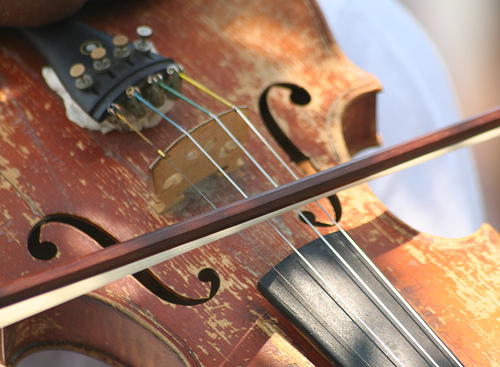
My mother kept her ironing basket in a laundry closet right outside my bedroom door when I was very young. I loved it because it also held her most treasured personal keepsakes: fancy gloves (which she never wore); costume jewelry; letters from her pen pal; and buried at the back under wrinkled dress shirts and aprons, an ancient violin. When I wouldn't go down for a nap, she would sit by the closet and fuss around with her things while I eavesdropped from my crib. Hearing her rustling set off my imagination and usually did the trick. 
Once in a blue moon I'd awaken from my nap with questions about the violin. She would pull it out with solemn reverence and open the battered case. The strings were broken, the finish dull, and it had a musty smell that could knock a three-year old girl right over. She probably initially brought it out just to humor me, but I wasn't allow to touch it! Here was this beat-up old violin and she wouldn't let me fiddle with it, literally! I would get frustrated that it couldn't be played and I think because of that shunned it when later in life I chose to play the flute instead. 

As I grew up, we'd occasionally pull it out on days when absolutely nothing was going on: probably in the highest heat of summer. What I remember most is that I could see she had really loved playing it when she was young. She had been tutored in music by her "Cousin Frank," who I had always thought was a Jones relative (her mother's maiden name) from Lawrence. Her eyes would sparkle as she reminisced about the letters he would send her when he wasn't visiting the homestead in Scituate. 

Now. I sort of forgot about this guy. My mother gave the violin to her sister, Abbie, who gave it to her daughter, my cousin, because she played the violin. I think they had it appraised and it wasn't worth much, so I don't believe she ever restored it to playing condition, if that was even possible. Note to self (ask Betsy!) If Priscilla was playing it as a young girl, it couldn't have been very valuable or my grandmother wasn't very smart. Since I know Grandma was a highly intelligent lady, then it must have been a run-of-the-mill student instrument. Anyway, it was always love, not value that made my mother's eye twinkle. That's why she gave it to Betsy, aka "Pet."

But who was this Cousin Frank? My mother passed away in 1996 when I was in the throes of raising two out of three of my wildly boys, and by then her mind was confusing details. When we talked genealogy, which was frequently, it was on the topic of brick walls and mostly in direct lines.  Looking back now, I realize that no matter how confused her memories were getting, I should have just sat down with a tape recorder and got her to tell me everything. I bet she would have got the Cousin Frank story straight because she was an original source, and it happened when her mind was fresh.

So I was left wondering. Was he the same guy that she went out of her way to honor every Memorial Day? An isolated grave, far away from the main family graves, that we would also decorate? All I knew was that she had the same kind of wistful smile when we visited that grave as she did when she talked about Cousin Frank.  I searched the cemetery but the only Frank I found was Frank E. Clapp who fought in the Spanish American War. A quick check on Ancestry places him in the 1880 household of Charles W. and Abby B. Clapp. His birth year is 1871. Looking at the NEHGS online database "Mass Vital Records 1841-1910," (Births 1871:242:441) I find he is son of Charles Whitcomb Clapp and Abby Billings (Merritt). You can't say no relation when they've all been living within two miles of each other for two hundred and fifty years, but I'll say no close relation. So the Frank Clapp is just a red herring and will have to rest in peace.

Happily, I have two artifacts in my possession that have helped me identify this Cousin Frank. They have been in my "treasures" box of old family papers and photos, preserved, but not published. It wasn't until I started the process of becoming a certified genealogist that I really began critically examining every scrap of paper. In my portfolio, I refer to these treasures as "Barnes Family Papers." Just so you know.

I found the calling card shown below and surely let out a huge AHA at the time!


F. B.[sic] Barnes
March and Circle.
1. Waltz,
2. Galop,
3. Quadrille,
4. Schottische,
5. Waltz,
6. Lanciers,
7. Caprice,
8. Polka,
9. Portland Fancy,
10. Waltz,
11. Galop,
12. Lanciers.
13. Schottische,
14. Galop,
15. Waltz,


F. P. Barnes' Concert Ball Room Orchestra,
694 Washington Street, Boston


A search on his background reveals that he is Franklin Pierce Barnes, son of Elijah Vinal Barnes and Lydia D. Studley [NEHGS (Births 1853:74:16)]. This means that he was the first cousin twice removed of my mother! His father Elijah was one of my mother's great-grandfather Joseph Barnes' twin brothers, the other being Elisha.
And what's that in his hand? A violin! He looks like a lively sort of fellow, just the kind that would turn a little girl's head. He probably taught the girls to dance, too. No wonder she got a twinkle.
To seal the deal, I found a charming letter from him to my grandmother Vernetta. At this point, my mother, Priscilla, the eldest, would have just been turning 20. Her only brother, Billy/Willie, wwould have been 14, a lot older than he sounds here.
-----
                                Boston Dec. 20th 1934
Well _ Well Well Vernetta,  
That was some card I received this A.M.
and was very much pleased with It
I see little Willie in it holding the
lantern and Myself Playing the Great Great
Big Fiddle (Tell little Willie) with my
tall hat on.
Who the Lady was singing I can not
make out, I seem to think the man
with the tall Hat, playing the trombone
is A man that drives one of the
White Milk Trucks from Wollaston, down
through Scituate. (Tell little Willie and the
children) I am very much pleased with
the card, Tell the Cildren, and how they will
laugh. and what a time they wil have
talking about it. I can well understand –
I am sorry to hear about your Cow.
We are having good weather for this
time of the year, and I hope it will
continue. When it is convenient for you,
you let me know when to come Down,
and talk music to the Children
                                                       over
Tell the children the music
on the card, was very very very
melodious, and charming, (and how
they will Laugh). What a time they
will have when you read this note
to them.
Ask Priscilla to keep at all of
them. to know the. Do. De. Ray. Re.
me.Far. etc. up and down the cromatic
scale. that is the sylablic,
they can then go ahead very fast.
Ask Her Please to have little Willie
stand up with them.
I hope you are all Well. and Please
let me know when to call.
(Is Wm. going up and down in his Car-
this Winter?)
        So good by to all hands
        until later. And a Merry
        Christmas and Love to the Children
        Franklin P. Barnes
        #83 Carver St__
                                     Boston__
How could you not love this guy? So focused on children at 81 years of age! I haven't done any more research on him, but I tend to think he had no children. Someday I will add more detail to his life (is he buried at Mt. Hope Cemetery in Scituate, e.g.?), but for now it is enough to reflect on how one man's spirit can trickle down through the ages. Thank goodness we have people like Cousin Frank! My son Daniel plays the violin now. And he loves his music teacher. The teacher is nothing like Cousin Frank, but he loves Dan, too, because he's an old soul. He says Dan is the only student he has that lowers his blood pressure. I just hope that someday Dan's teacher gets remembered as fondly as good old Cousin Frank is remembered today.

15 September 2009

Tombstone Tuesday – The American Cemetery in Normandy


Last summer we took the boys to England to visit relatives and friends. From there we embarked on a 10-day holiday in northern France. When they weren't whining about missing their friends and championship sporting events, they really enjoyed being tourists. Despite themselves, I think they may have also learned a thing or two.

One of our most moving stops was Normandy, site of some of the most brutal fighting in World War II. In a bizarre parallel of the Invasion of Normandy, we traveled by ferry from Southampton to Cherbourg. It was a smooth sailing, and as we dined comfortably on breakfast, we tried to evoke images in their young minds of what it must have been like for those soldiers en route on 5-6 June 1944. We had watched a few movies before setting off, like The Longest Day(for Myles and me) andSaving Private Ryan (for the boys, too gory for me. I can imagine evisceration without it being graphically depicted, thank you), and this made a convenient reference for certain parts of the battles.

We drove along the still very sparsely populated coast, through tiny but familiarly named towns like Pointe du Hoc and Ste Mère Eglise. We stopped there to to glance around, imagining the horror of war, and even saw the effigy of the poor parachutist who got stuck on the church tower (see above). We were there just a few days after the celebrations of the 64th anniversary of D-Day, and I noticed the boys casting sidelong glances at some elderly gentlemen, obviously veterans, who were also touring the countryside. I wanted to invite them to come along with us. They are precious.

The locals were all very friendly and welcomed us with smiles and a courteous attempt to understand the boys' (and my!) French. You can see that even people who were not alive in WW2 still recognize the contributions the Americans, British and Canadians made. We were glad we had skipped Paris – this time, at least.

Next day we motored over to the American Cemetery in Colleville Sur Mer. Most people have at least seen it on television, as we had, but there is nothing like being there. It is set in a most splendidly glorious spot on a bluff overlooking Omaha Beach. When you first arrive, you admire the setting, noting how beautiful the world can be. It is so still that you hear the birds, even with 3 boys in tow. The museum is strategically placed so that you visit it before entering the cemetery. I think it serves both to educate and to prepare people for the experience.

BOOM, there you are, transported back in time, watching scratchy black and white films of wave after wave of seasick and petrified soldiers jump off the boats to almost certain death. Relentless Nazis gun them down. "They are all so young," I tell the boys, "That's you, next year, Ry." You see bits of their uniforms, photos of old French peasant women running down the tiny streets, waving and smiling, offering loaves of bread to soldiers. Young girls kissing them. All the while the sounds of guns and waves and death screams meander in and around the speeches of leaders lending hope and inspiration.

Then BOOM again. You emerge, blinking, into the bright sunshine. Echoes of the battle din reverberate in the stark silence. Perfect weather mocks their memory. All is calm and serene. You stand there in a bit of shock. Now you're ready to visit the cemetery.

Row upon row upon row of symmetrically placed crosses stand at attention in military precision overlooking the beaches, bearing witness to the horrors of war. I sent the boys off on a mission so I could enjoy the peace. I was moved by the occasional Star of David marker, and when I came upon the one below, of Sam Rubin, I stopped to photograph it.

SAM RUBIN
PVT 358 INF 90 DIV
MO JUNE 15 1944


As I took my face away from the camera, one son came along and said, "Oh, somebody left dirt on this one," and swiftly brushed it away, before I could let out a yelp of alarm. For Jews it is an act of respect to continue in the "mitzvah" of marking a grave by placing pebbles or dirt on the stone. It is a way to indicate participation in the mitzvah of erecting a tombstone, even if only in a more symbolic way. It shows that someone has visited, someone remembers.

After a brief lecture by Mom, suitable replacement stones were laid with great ceremony, accompanied by an apology to Private Rubin.

We looked at hundreds of stones that day, came across makeshift flower memorials that get cleaned up every evening by the staff. We found Medal of Honor winners and all sorts of funny names and things to spark the imagination of boys. But the one we remember most will always be Sam Rubin.


11 September 2009

Marking the Day - The Terror of 9/11

The north tower (1 WTC) of the World Trade Cen...Image via Wikipedia

Some details of that horrific day are starting to fade, so before I forget, a brief note for my descendants...

Myles and I had been married 13 years on September 10, 2001. We chose to go into Boston for a romantic dinner and overnight stay in a hotel. I think it was Mrs. Potter who babysat our sons who were 10, 8 and 4. So on the morning of September 11th, we weren't even home. We were enjoying a fine breakfast in bed on the tenth floor of a Back Bay hotel admiring the beauty of a cloudless September view of Boston. You could see all the way to Logan airport and we watched the planes coming and going, wondering how they managed not to collide. We turned on the TV and towards the end of the Today Show, Katie Couric and Matt Lauer (I think!) brought us the news of a plane striking the World Trade Center. Not many days before that, a small plane had crashed into a building in NYC, so no one was particularly alarmed, and certainly no one seriously thought "terrorist attack." They may have mentioned terrorism, but the media is always trying to jack us up emotionally, and we were used to dismissing their excited chatter as the usual hype.

It was when the second plane hit that it sunk in. From that point on, we were riveted to the TV, occasionally switching channels to make sure Katie and Matt weren't hallucinating. Information was coming in from so many sources that no one had time to vett it and certainly couldn't make any sense out of it. They announced that air traffic was being halted all across the country. Glancing out the windows again we found the view of Boston was now eerily still. A city frozen in fear. I started feeling a bit vulnerable up there on the tenth floor, and wanted to leave, but Myles wanted to watch events unfold, and swept aside my anxiety with a dismissive, "Oh, relax!" News of a third hijacked plane came in. Accounts varied as to where it might be headed. the White House, the Pentagon, the Capitol?

It wasn't until the first tower collapsed that we looked at each other and started moving. We got a call from the desk telling us the hotel was being evacuated and we should check out right away. We hustled downstairs but instead of checking us out they just waved us away, barking out, "Just go! Go!" There were lots of people standing on the street, and police everywhere. Later we found out that the hotel was evacuated because they had already traced some terrorist suspects to the 9th floor, just one floor beneath us.

We had come in separate cars and I was really freaked out driving home alone in heavy traffic on the Mass. Turnpike. I called Myles and we stayed on the phone during the ride, silent, listening to radio accounts. All I could think of was that my little quiet town of Shrewsbury would never be a target for this sort of attack. I wanted to be near my children. Even if they were only in school, I needed that proximity so that if I had to I could even walk over to get them. It was listening to the radio in the car that really made me very afraid. They were following the course of the plane over Pennsylvania and trying to predict where it was headed. It just felt at that moment like someone was targeting everything we Americans look to for authority and protection. How many planes had been hijacked? Five, ten, fifty? Which news accounts were true, and which were panic? I already felt the psychological damage this would have on our country.

The stark irony of that gorgeous blue sky portending such danger was impossible to reconcile. We watched TV all day. They recommended that we prepare children, yet keep them away from the broadcasts. We greeted them as they got off the bus and tried to brace them for turmoil. Then for days and days Americans watched as the full horror unfolded. More and more accounts came in. The Pentagon, the plane in PA, all of the people lost in NY, makeshift memorials, relatives and friends pleading for information. And so many tears. We were totally vulnerable and bewildered. The whole nation was depressed, lifted occasionally by stories of great heroism.

September 11th, 2001 marks a vast division in the psyche of the nation. Before that date, most people had heard about terrorist attacks but pretty much ignored them because they did not take place on American soil. Newscasters would report disasters overseas only by relating how many Americans were killed. We were an insular, self-absorbed country, trusting that our own goodness would keep us safe. But when you stop being vigilant about your actions, and not protecting yourself, you are likely to get hurt.

I've lived in several foreign countries. When I lived in Italy in the late 70s and early 80s, I found out what it is like to know that terrorist attacks may strike. You just go on living –– but if a terrorist does strike, it does not have the devastating effect of shock as 9/11 did on Americans. It had never actually occurred to most people that we could become victims. Coming back to live in America, I knew it was just a matter of time. Our borders seemed wide open compared to those of other countries. If you read the newspapers, you were aware that there were many groups who hated or blamed the United States and the Western world in general for just about anything they didn't like. Fundamentalism, poverty and ignorance had combined to create a steaming cauldron of rage. I wasn't shocked, just petrified.

A chasm separates the day of our 13th anniversary, September 10, 2012,  from September 11th. Like Adam and Eve gazing down at their own nakedness, we are now cognizant of both our own vulnerability and aware that we have some accountability. We moved forward with ideas on how best to protect ourselves that mark a political split as well. We are now a nation sharply divided, driven to extremes by the intense fear of that day. I just hope that one day our great nation came come together on those values that we share, which are many more than divide us, and work together to keep America safe.
Enhanced by Zemanta

10 September 2009

Treasure Chest Thursday - Georgia's Glass Jar


Certain items in my possession
were passed down to me with a higher-than usual degree of decorum. This cut glass jar with sterling lid is one of them. My mother told me, when she presented it to me with a flourish, that it is the only surviving item from my great-grandmother, Georgianna (Hagerman) Jones (1868–1932). This makes a girl sit up and take notice. Your mother's mother's mother and one item remains? You bet I was listening!

My mother kept marbles in it, crystals, just like I do. She kept it in a secretary desk that my father brought home "from Sam's" one day. Sam's was an antique/second hand shop used that he used to frequent, owned by a man named Sam Castano. Sam and Pops became best buddies, despite the fact that each was taught in early childhood to despise the ethnic group of the other. When my father grew up in East Boston, gangs of Italian kids used to fight gangs of Irish kids. That's the way it was and still is: new immigrants fighting slightly older immigrant groups for a piece of the pie. According to angelic Pops, he never partook in these activities, and actually, I sort of believe that he didn't, for his bark was far worse than his bite. Yet, it scarred him and left him wary of Italians in general. I'm sure Sam felt the same way about the Irish. So when Pops and Sam first had dealings with each other it must have been against each's better judgment! Yet, Pops continued to frequent Sam's, and they became very close friends. I learned as a small child that whenever Daddy brought a treasure home, it must have come from Sam's. I still remember the day that the secretary arrived, mostly because my mother was pleased with it. Generally she could think of better ways to invest the family income than in antiques! But on that day she was ecstatic and immediately began loading her favorite keepsakes onto the shelves.

Like much of the content of my mother's house, the secretary passed down to my brother Tim and family. With three small children, the secretary's function changed from curio display to videotape library, and after a few years the scratched and battered secretary was banished to his barn. I asked him one fine day if I might adopt its warped and mildewed self, and Tim obliged, so we carried it back to Shrewsbury. It stunk badly of mold, and aggravated some hearty allergic reactions. We had it refinished and finally I was overjoyed to place Georgianna's glass jar upon the shelf once more.

Georgianna and her husband Jared Smith Jones (1860–1943) were born in New Brunswick, Canada. They were both descended from Loyalists who had fled the brand new United States at the conclusion of the American Revolution. A century later they were part of the mass immigration into the US in the late nineteenth century, in search of jobs and a better life. They went to Lawrence, Massachusetts and Jared worked variously in the textile mills and driving a team of horses. I know that they had very little money. I wonder if, and want to believe that the glass jar belonged first to Georgia's mother, Louisa (Carr) Hagerman.

My grandmother Vernetta was Georgianna's only daughter. Vernetta had four daughters. The matrilineal line died out in my Aunt Louise's line and in my mother's line, since my sister and I do not have daughters bearing daughters. I have inherited the glass jar purely by chance. But I want this jar to remain a matrilineal, mitochondrial DNA kind of hand-me down. So, when I die, it will go to one of the female descendants of either my Aunt Anne or Aunt Abbie (twins) both of whom have daughters with daughters with daughters! Though she may not know it, some little girl had an ancestor who cherished a piece of cut glass and kept it safe to pass down, just for her. What good is studying family history if you don't bring it to life for younger generations? Maybe, in some small way, this jar will do just that.