Kimmitt Genealogical Research

28 June 2013

William Frederick Fitzgerald: Lifespan--One Holiday Season

In Memory of Uncle Freddie, 16 November 1912 - 6 January 1913. At one month, 22 days he could coo, he liked high pitched sounds, and he was only another month away from sleeping through the night. Despite what everyone else said, his mother KNEW that he was smiling, not grimacing from gas pains. He smelled good. When his aunties held him he would gaze at their faces, already beginning to work out the complicated use of language and social cues. He couldn't roll over yet, but was tracking his brothers and sisters with his eyes. He was at the bottom of a very steep learning curve, but he had a big family to teach him.

One of the dormant projects in my "brick wall" category was the case of Uncle Philip. Or Freddie. Or, "it could be anything, really." Born after 1910, or maybe in the 1906-1910 sibling gap. Lots of maybes and what ifs. And a nightmarishly common name like FitzGerald in Boston at turn of the 19th century that dulled my enthusiasm for the hunt. So it remained on the back burner for decades.

In 1989 we went to Ireland to visit the townlands of my Irish grandparents. We read the parish registers and I tried to pump my mother for information. She suddenly told me for the first time of the existence of this baby! She couldn't remember his name, but thought it might be Philip. This would have been a bit odd since one of the other children had Philip as a middle name, but it happens.

One of the reasons it took so long is because research at the Massachusetts Registry of Vital Records proceeds at a snail's pace. You consult an index, create a request slip, wait for a call for slips (every 20 minutes, and only 3 at a time!), wait 15 minutes for the books to come, and check them. If they are wrong start the process all over again. There were only open for 3 hours at a time, so you could never examine more than 12-15 records, and that only if you were very lucky, and a whiz, and not intimidated by the staff.

I tried it and realized I was none of those, so I waited until the records from this time period were moved to the Massachusetts State Archives where they are open for a full day and you have free access to the microfilm. I remember about fifteen years ago giving it a good try. The goal: examine every male FitzGerald baby born in Boston 1906 to 1915 or so [laughs shrilly]. After that, I put it away and forgot about it.

So here is why we love the internet. Last night I was just goobering around on FamilySearch because I was pouting about Ancestry's intention to remove the Old Search function. I'm sure it will be fine, but it did put my nose slightly out of joint... Anyway, I was using that delightful trick of entering parents names and seeing all of their children magically appear when I thought of long lost Baby Fitz. And I found him!

William Frederick Fitzgerald was born 16 November 1912 to my grandparents, Patrick J., Longshoreman, and Annie (Sullivan) Fitzgerald (this lower case g in Fitzgerald is making my relatives cringe but that's what the record reads...sorry, folks!) It gives 2 Lamson Court in East Boston as the family's address. [1] Now of course this makes me wonder about how little William F. was welcomed into the world. He had three brothers and two sisters: Mary, 15; Jack, 13; Teresa, 10; Frank, 6; and my father, James, 2. I'm sure Mary and Teresa helped their mother out around the house, and Jack probably had a part-time job to help the family. It was a busy household. Annie must have been out of-her-mind tired! And it was Thanksgiving, Christmas and New Years.

One month, 17 days after his birth, Baby Freddie came down with broncho-pneumonia. It lasted for 5 days. He would have been fussy, had trouble eating from his blocked up nose, and it must have been scary as anything to see a baby suffer like that, not having the reassurance of antibiotics in the back of your mind. Five days later, Baby Freddy died, on 6 January 1913, Epiphany. [2] (I just suddenly realized that my father was always adamant that the Christmas tree remain up until Epiphany. I wonder if that year they had taken it down earlier.)

Here is Freddy's death record. He died at home, at what I believe to be the correct address: 12 Lamson Court. He was buried at Holy Cross Cemetery, Malden, by undertaker NJ Kelly.


A quick phone call to the helpful lady at Holy Cross Cemetery reveals that he is buried in the Baby Section, at 7 South St. Anthony, Grave 99 West. He was the second baby to be interred there, the first being James Sullivan who was buried on 1 September 1912. There are also Baby Sullivan, and Nora Sullivan. The grave was purchased by Catholic Charities at the time of the James Sullivan's death, and she was unclear whether or not it had a marker. She recommended I apply for one if there is not, as they are free. She is emailing me a map and when I get a chance, I'll rope my dear sister into going over to have a look and lay some flowers down in Uncle Freddie's memory.

As a young mother I was absolutely terrified that something might happen to my babies. I used to wonder often how mothers in earlier times coped-- days fraught with tension even just about kids catching colds. Our fellows suffered from croup, ear infections, pneumonia, and allergies, but I always had the comfort of wonder drug antibiotics. Annie and Patrick didn't have that, and they suffered what I was so afraid to. It is no wonder that they are often described as being somewhat gruff.

Footnotes

[1] "Massachusetts Births, 1841-1915," online database linked to original images, William Frederick Fitzgerald, n. 18099, 16 Nov 1912, Boston, no v. number, p. 403, image 1152; FamilySearch (http://www.familysearch.org : 27 Jun 2013). Also, same database, William Frederick Fitzgerald, n. 18798, 16 Nov 1913 Boston, no volume n., p. 418, image 422.  Second record is off by one year, as he died on 6 Jan 1913, but has correct residence address of 12 Lamson Ct.

[2] "Massachusetts Deaths, 1841-1915," online database linked to original images, William F. Fitzgerald, reg. n. 213, 6 Jan 1913, Boston, no v. number, p. 217, image 762; FamilySearch (http://www.familysearch.org : 27 Jun 2013).

21 June 2013

Kilburn Merritt Cemetery–A Neglected Gem


Genealogists are so weird. We treat a visit to a cemetery like a day at the carnival. We are the happiest people cemeteries have ever seen, easily recognized by the camera, broad grin, and high-spirited step. I'm somewhat ashamed to confess that even at a funeral my gaze has been known to slowly wander towards the ancient slate-stoned section. I'm very sorry about that but it is completely involuntary.

I found myself in this delighted state of mind at a private burial ground in my hometown of Scituate, Massachusetts last week. Long, long ago, my best friend in high school, let's call her "P," told me of her family's private cemetery hidden deep in the woods behind her house. Or that's how I remembered it. I kind of remember discussing it during an episode of Tales from the Darkside, so my facts could be a tad confused. Sadly, we never managed to get out there to explore it.

Forty-plus years later my cousin, herein referred to as "C," sent me some photos of this burial ground and I nearly jumped out of my skin. I knew that the Town of Scituate, in their infinite wisdom, had commissioned a study of all of the burial grounds in Scituate, published in 2007. It is an exquisite little report, detailing the history, ownership and condition of each site, and making recommendations for improvements. Cousin C. also mailed me the link and got me jazzed up about it all over again, and we planned a visit.

The published survey says this about the history of this site:

"The Merritt Cemetery (also known as the Kilburn-Merritt Cemetery) was established c. 1811 as the family burying ground of the Merritt family who owned land in this area of North Scituate. Surrounded on four sides by a dry laid stone wall, the cemetery was originally accessed from two points, (1) a dirt road leading from Clapp Road southward in a straight line to the cemetery, and (2) via a meandering footpath leading from the Merritt home (on Clapp road to the east of the cemetery) through the woods. Today the meandering footpath is no longer visible, but the dirt access road remains. Other than the 1811 tomb, the earliest burials date to the 1830s and 1840s, and the most recent burial took place in 1938. Today, a descendent of the Merritt family, [Xxxxxx] Merritt, cares for the cemetery grounds. The cemetery covers approximately 1⁄4 acre of land."[1]

Six years after the report was published, I'm here to tell you that this cemetery is suffering from neglect, and I've got the photos to prove it. C and I wandered around, snapping photos, straightening flags and lifting those stones we could to a better position. Some will require heavy equipment. There is a lot of brush at one end that needs to be cleared. We left with a sense of purpose: find out if the Town plans to intervene, map out the stones, investigate WPA surveys from the 1930s, and especially, talk to P's mother to see if she has more information.

This stone cries out to be righted!

Tomb of Unknown Revolutionary War soldier
This cemetery does appear on FindAGrave and has photos of many stones, a few of which I didn't catch myself. [2] And I took a few that the FindAGrave author didn't have. I will upload them soon.

Until then, the only direct relatives of P that I've identified so far (but I've hardly begun) are her gg grandparents, Martin Dawes Merritt and Debby Bailey. Some of the stones, including this one, are very hard to read. More investigation imminent!!
MARTIN D. MERRITT
DIED
June 18, 1882
Aged 80 years &
DEBBY
His wife
Die May [1?] 1865
Aged [60?] years
--------
[ illegible]

Footnotes

[1]  Martha Lyon Landscape Architecture, Fannin-Lehner Preservation Consultants, and CME Associates, "Scituate Burial Sites Survey" (prepared for Town of Scituate and the Scituate Historical Society, 2007); Town of Scituate (http://www.town.scituate.ma.us : 22 Jun 2013), 26.

[2]  "Merritt Cemetery," website with images of gravestones; FindAGrave (http://www.FindAGrave.com : 22 June 2013).

17 June 2013

The Miserable Life of Miss Dora L. Jones, Latter Day Slave

"Mrs. Ingalls Guilty of Slavery Charge," Boston Herald, 20 Jul 1947,
p. 1., cols. 5-6; GenealogyBank (http://www.genealogybank.com :
 14 Jun 2013)
My last post included a newspaper photo. On that same page I happened to notice this account of the bizarre and disturbing case of a couple who kept their maid in bondage for over 40 years! Mrs. Elizabeth Ingalls, 62, "descendant of Massachusetts colonial Governor Bradford," was "convicted... of enslaving her maid," 58-year old Dora Jones! The DA held that Mrs. Ingalls and her husband, Alfred Wesley Ingalls, 64, a former Boston lawyer and legislator (!), "reduced the maid to slavery for 40 years by threatening to expose her affair with Mrs. Ingalls' first husband, Walter Harmon of Washington." [1]

Now maybe everyone else knows about his, but I certainly didn't. It cries out for research! Why should the maid be afraid of the affair being made known? Wouldn't the married man be more worried? Maybe that's what caused the divorce. Wasn't it awkward having Dora living under the same roof with husband number two if she had had an affair with husband number one? Was this seriously the first slavery case tried since 1880? I found it curious, and decided to have a look in some original and contemporaneous records, working backwards from 1947.


What Do the Records Say?


In 1940, 52-year old lawyer Alfred W. Ingalls lived with his family at 28 Bassett Street in Boston. His wife, Myra E. was 51, and with them were daughters Ruth, 32, and Helen, 20, both single. Ruth was born in Washington, DC, Helen in Mass. Also with them was Dora Jones, 50, a maid born in Alabama whose race is described as "Neg." [2] This matches the newspaper account pretty well, assuming Myra's middle name was Elizabeth. Interesting to note is the 12-year gap in the daughters' ages.

Let's look at the 1930 census: The family are in the same house at 28 Bassett Street. Their ages are off somewhat: Alfred-47, M. Elizabeth-45, Ruth L.-22, Helen-10, Dora-40. They also have Elizabeth's widowed mother, Estelle Kimball, 70, in the household. Oh, and Dora's race is now white. [3]

In 1920: Same house, same cast of characters, ages are somewhat in line with 1930--Alfred-27, Myra-38, Ruth L.-11, Helen K.-2 months, and Dora-30, who this times is called Mulatto. [4] So they've all been together for at least 27 years.

In 1910 Elizabeth K. Harman, 26 lived in Washington, DC with her first husband, Walter P. Harman, a 29-year old government clerk born in Vermont, and their 2-year old daughter Ruth L., plus Dora L., 20, Mulatto. [5]

What happened between 1910 and 1918?? Well, for one thing, Elizabeth and Walter broke up. The WWI draft registration card of Harman gives his father as his closest relative. His permanent residence is at 137 Grove St., Rutland, VT, but he works in NY, NY. [6]

In 1920 Walter P. Harmon was 38 years old living in DC (born in Vermont), a single clerk working for the US government and  boarding with an 80-year old widow. [7]

On 15 November 1923, in Rutland, VT, Walter Penfield Harman of Takoma Park, MD, born Bennington, VT, son of Henry A. Harman and Ellen Bromley, married Myra May Hulst, his second marriage. [8] Another wife named Myra, just to confuse future genealogists. (For a while there, I thought Elizabeth might have been living a double life!)

In 1942 Walter Penfield Harman of Takoma Park, MD, registered for the World War II Draft giving his date of birth as 12 Jan 1881. He provided his nearest relative as Mrs. Walter P. Harman. This would have been his second wife, Myra. [9]

These records not only confirm information in the article, but help us put together a rough timeline of their lives.

Timeline

1907  (ca) Walter P. Harman and Elizabeth Kimball marry
1908  Ruth L. Harman, daughter of Walter P. and Elizabeth Harman, is born in DC.
          She is not Alfred's daughter.
1910  Walter Penfield Harmon and Elizabeth Myra (Kimball) Harman are living in Washington
           DC with daughter Ruth L. and a servant named Dora L. Jones.
          Walter and Elizabeth break up
          Elizabeth marries Alfred Wesley Ingalls of Lynn, MA
1918  Walter lists his father as next of kin on WWI Draft, so is probably single
1918  Helen Ingalls, daughter of Alfred W. and Elizabeth Ingalls, is born in Massachusetts
1920  Walter lives in DC, is single.
1920  Elizabeth lives with 2nd husband, Alfred Wesley Ingalls, at 28 Bassett St., Lynn, MA
1923  Walter remarries, to another Myra (!) in Vermont
1930  Alfred W. and family still live on Bassett St.
1940  The family is still at Bassett St.
1942  Walter Penfield Harman of Takoma Park, MD, registered for the World War II Draft
           giving his date of birth as 12 Jan 1881.
1942  Alfred registered for the World War II Draft, stating...
1947  Case comes to trial


Wider Implications for Civil Rights

Yikes! I mean, Mira Elizabeth Ingalls [13]
According to the article, the Ingalls were the first to be charged with slavery in the United States since 1880, a violation of the 13th amendment. In The Lost Promise of Civil Rights, Risa Lauren Goluboff refers to this incident as a "watershed case" and goes into considerable detail. It was the Ingalls' younger daughter, Helen (Ingalls) Roberts, who reported her parents to the Department of Justice. [10]

The sordid details of the case were that Elizabeth kept Dora working without pay and in bad conditions by threatening her with prison or a mental institution if she did not comply. Dora's offense thirty-eight years earlier, or circa 1909, was having had an affair with Walter and an abortion after that. She told Dora she could be arrested for that, and either go to prison or a mental institution.

Goluboff states, "For more than twenty-five years, Jones had been 'required to arise at an early hour in the morning and perform practically all of the household labor in connection with the maintenance of the Ingalls household. She was forbidden to leave the household except for the commission of errands and performed drudgery of the most menial and laborious type.'" She was forced to sleep in a car on the street, or in bathtubs, not provided with sufficient food, and given only cast-offs for clothes.

They were unable to convict Alfred, but Elizabeth was sentenced. What made this a watershed case was the fact that not only did Elizabeth have to pay damages to the US government, but she also had to pay poor Dora the sum of $6,000. Elizabeth's prison sentence was suspended, however, perhaps due to fears expressed by her counsel that her life would be threatened.

Some Questions Answered, But Take With Grain of Salt!

An article in the Toldeo Blade provides more detail. "The five-foot, 100-pound maid, Theodora Lawrence Jones... was 17 when she was befriended by the present Mrs. Ingalls, then Miss Elizabeth Kimball, a missionary school teacher in the reconstructed south. When Miss Kimball married her first husband, Walter Harmon, they took Miss Jones to Washington DC, where ten years later they were divorced...In 1918, the former Alabama teacher married Ingalls. [11]

Another article worth mentioning is "Slave Trial Jury Told Dora Jones Was Pushed Down Stairs." We learn more details of Dora's sad existence: that Helen had actually tried to rescue Dora from Elizabeth, who had struck and scratched her, among other things. And finally, we get some great genealogical information: Elizabeth's other daughter Ruth's married name was Castendyk, and she was in Chicago in 1947; Dora had at least two siblings--Myrtle Turrentine of Athens, AL and Arthur Jones of St. Louis! [12]

Alfred Wesley Ingalls, 1947 [14]
There are many, many articles on this case, and by reading them all, you can fill in the timelines with much more precision. Though sometimes contradictory or wrong, they do provide hints on where to search further. Here is a link to another one: "Coronado Couple Held on Charge of Holding Housemaid in Bondage," in which we learn that Elizabeth and Alfred married in 1907 and were divorced in 1917. There are more details of Dora's horrible treatment, and best of all, photos of the offending couple. [13]

Now I ain't no Judy Russell, but this is one interesting, groundbreaking, horrifying and amazing case. And the only reason I found it was because my little mind was wandering to other articles on a newspaper page!

Bygone Era Be Gone!

I found it interesting that "the Jury went out to dinner at 10:30 and resumed their deliberations at 12:00 o'clock." I wonder why they went so late. Was it perhaps to avoid the cost of putting up the jury overnight? I was also sort of surprised at this, too: "Mrs. Ingalls heard the guilty verdict without a quiver. She was remanded to the custody of the US Marshall, who escorted her and her husband to dinner." How very civilized that they were escorted to dinner. Why the hell didn't they take DORA to dinner? By all accounts she needed it. and clearly, Elizabeth was well nourished.

Oh yes, it was an era of stoicism and gentility and SLAVERY. We've come a long way since 1947, but even then this case was outrageous. Newspaper accounts about a crime like this can exaggerate or just be wrong, so these articles should not be considered completely reliable! You can read a summary of the trial at United States v. Ingalls, 73 F, Supp. 76, District Court, S. D. California, S. D., 29 July 1947. [16]

I like to imagine that Dora took that money, went back to her family and lived an easy life thereafter. She certainly deserved it. There are no words for the vile behavior of this couple and I can only hope that they were ostracized from their socialite community for the rest of their lives. They really should have gone to prison for life. It would have been sweetest if Elizabeth had been forced to work for a living, for someone such as evil as herself.

---------------------
Footnotes

[1]  "Mrs. Ingalls Guilty of Slavery Charge," Boston Herald, 20 Jul 1947, p. 1., cols. 5-6; GenealogyBank (http://www.genealogybank.com : 14 Jun 2013).

[2] 1940 US census, Essex County, Massachusetts, Lynn, ED 19-34, sheet 64A, household 365, of Alfred W. Ingalls; Ancestry.com (http://www.ancestry.com : 16 Jun 2013).

[3] 1930 US census, Essex County, Massachusetts, Lynn, ED 151, sheet 9A [penned], sheet 278 [stamped], dw. 130, fam. 260, household of Alfred W. Ingalls; Ancestry.com (http://www.ancestry.com : 16 Jun 2013).

[4] 1920 US census, Essex County, Massachusetts, Lynn, Ward 3, ED 146, sheet 5A, dw. 69, fam. 103, household of Alfred W. Ingalls;  Ancestry.com (http://www.ancestry.com : 16 Jun 2013).

[5] 1910 US census, District of Columbia, Washington, Prec. 10, ED 203, sheet 18A, 425 [Mien?] Pl., dw. 327, fam. 391, household of Walter P. Harman;  Ancestry.com (http://www.ancestry.com : 16 Jun 2013).

[6] "World War I Draft Registration Cards, 1917-1918," Walter Penfield Harmon, Serial n. 490, Order n. 1264, b. 12 Ja 1881, employed at ; 347 Madison Ave., NY, NY, Local Board Rutland, VT, for Div. N. 1, City of NY, NY, 7 Jan 1918;  Ancestry.com (http://www.ancestry.com : 16 Jun 2013).

[7] 1920 US census, District of Columbia, Washington, ED 284, sheet 5A, 1613 Irving St., dw. 25, fam. 92, household of Maria J. Miner; Ancestry.com (http://www.ancestry.com : 16 Jun 2013).

[8] "Vermont Marriage Records, 1909-2008," Harman-Hulst, n. 138, 23 Nov 1923, Rutland; Ancestry.com (http://www.ancestry.com : 16 Jun 2013).

[9] "World War II Draft Registration Cards, 1942," Walter Penfield Harman, Serial n. 0303, no Order n., b. 12 Jan 1881, Bennington, VT, Local Board n. 3, Prince George's Co., 27 Apr 1942; Ancestry.com (http://www.ancestry.com : 16 Jun 2013).

[10] Risa Lauren Goluboff, The Lost Promise of Civil Rights (Cambridge, Mass: Harvard University Press, 2007), 162-68; GoogleBooks (http://www.books.google.com : 17 Jun 2013).

[11] "Slavery Trial is Opened for Couple in California," Toledo [Ohio] Blade, 24 Jun 1947, p. 2, cols. 7-8; GoogleNews (http://www.news.google.com : 17 Jun 2013).

[12] Ted McKenna, "Slave Trial Jury Told Dora Jones Was Pushed Down Stairs," The [St. Petersburg, FL] Evening Independent, Home Edition, 3 Jul 1947, p. 2, cols. 2-4; GoogleNews (http://www.news.google.com : 17 Jun 2013).

[13]  "Bondage Charge Faced by Couple," and "Coronado Couple Held on Charge of Holding Housemaid in Bondage," San Diego Union, 26 Feb 1927, p. 1, col. 3, and p. 3A, col. 2; GenealogyBank (http://www.genealogybank.com : 17 Jun 2013).

[14] "Alfred Wesley Ingalls," San Diego Union, 26 Feb 1927,  p. 3A, col. 2.

[15] "Mira Elizabeth Ingalls," San Diego Union, 26 Feb 1927,  p. 3A, col. 2.

[16] United States v. Ingalls, 73 F, Supp. 76, (S. D. Cal. 1947); Leagle (http://www.leagle.com : 17 Jun 2013).

13 June 2013

Brothers United


"Plucky Veteran's Family," Boston Herald, 20 Jul 1947, p. 1,
cols. 4-6;  "Barnes Family Forum," Facebook
(www.facebook.com : posted 30 Aug 2012), citing
NewspaperArchive.com.
You may remember the story of little Stephen Barnes who was tragically killed by a trolley car on December 16th, 1947. The circumstances remain unclear to this day, but the pain caused in the family has been very real for over 65 years.

He left behind his three brothers, David, Robert, and William, and his parents, Russell Pierce Barnes and Margaret R. (Mumford) Barnes. Shortly after his death the brothers were sent to foster care and the parents split or drifted apart.

The three remaining boys never knew much about their family but thanks to an unusual family name, Israel Merritt Barnes (four of 'em!), and the wonders of internet searching, their children were able to reconnect with the Barnes family, including three half-siblings!

So it was that the ceremony described in my post of 12 October 2012 took place. The family gathered to erect a stone (inscribed with "Never Forgotten") on the site of Stephen's grave and to bring together what once was ripped apart by tragedy. Stephen's two older brothers had already passed away--Bobby in 2001, and David in 2007, and some of David's ashes were placed at Stephen's grave at the ceremony.

When Stephen's third brother, William, alias Hubcap (!), passed away in April of this year, his wife and son decided that they were going to bring his ashes from Texas back to Massachusetts to reunite him with his brothers. Yesterday, another small ceremony was performed, with Stephen's cousins and all three half-siblings, and we heard a little prayer of healing from William's eloquent son. Three of the brothers are in a sense back together, and children of the fourth were there to bear witness to the events.

Does it matter that their earthly remains have been gathered? Of course that depends on your own religious point of view, but I do know I witnessed incredible healing, and I so hope for my cousins that they can feel some peace. Yet there is still a lingering question: I know that all of us want to know what became of Margaret. She virtually disappeared afterwards, perhaps remarrying, perhaps just living quietly on her own. Though I've been able to trace her ancestry, I won't let this issue go until I find what became of her. 

12 October 2012

Stephen R. Barnes (1942-1947) - Never Forgotten

Stephen R. Barnes
(1942-1947)
 "East Boston Boy Playing 'Holdup' Killed by Trolley,"
Boston Globe, 17 Dec 1947, p. 4, cols 3-4, photo inset.
I have a sad story to tell, but though it entails much sorrow, it ends with healing and hope. It is of a rather sensitive nature, but I want to write it down for my family, so that Stephen will not be forgotten.

Tomorrow will be a solemn but special day for our extended Barnes family members and for one little boy whose fifth birthday was his last. Just before Christmas in 1947, Stephen Russell Barnes, like his three brothers, like most kids, was very wound up in anticipation of a visit from Santa Claus. So when his mother sent him and his older brother David outside at dusk the boys wandered down the street to a busy Boston intersection. David, only seven himself, could not have prevented what happened next. According to witnesses, Stephen, forming his little hands into imaginary pistols, began to play 'stick 'em up" with the trolley driver. I imagine he thought he was a cowboy holding up a train in the Old West. Tragically, the driver did not even see him and the child was crushed to death, almost instantly.

From that moment a huge rift was created in our family which was so deep that many of us had never even heard about it. Being a genealogist, I had of course asked about the children of my grandfather's brother. I knew one personally––my mother's Cousin Ruth, and I had asked her a few times to share the story. Finally, on June 12th, 1995, she phoned me, specifically to talk about her mysterious brother, Russell. I was surprised that she shared a bit of the story, though she was very sad and hoped I would keep it confidential. [Forgive me, Cousin Ruth!] She said only that Russell was a "black sheep" had led a somewhat bohemian lifestyle, and that he and his wife had lost a child due perhaps to negligence, perhaps to alcoholism. She thought Stephen had been killed by a trolley car and that the family had lived in Boston, but she couldn't recall the date. Following the accident, her parents and siblings fought among themselves and her brother disappeared. I noted the story in my genealogical files and left it alone.

Thanks to the distinctive name of my great grandfather, Israel Merritt Barnes II, descendants of this lost branch have reconnected with the main Barnes family. One of my second cousins appeared at her uncle's funeral (Israel Merritt Barnes IV) in 2005, and another wrote to me in 2009 in response to a blog post about my Barnes ancestors.

In 2010, partly to welcome to these new relatives, we held a family reunion in Scituate, Massachusetts, and for the first time I met some of my long lost cousins. The details of the tragic aftermath of Stephen's death started to emerge from what had been a hazy story. The surviving children were removed from the home and sent to separate foster care homes. They saw their mother maybe one more time and their father only rarely. They had no knowledge of their ancestry except that they were related to an Israel Merritt Barnes. Russell went on to marry again and had three more children.

I wrote a blog post after the reunion which yet another cousin found. His dad is one of the three sons given up to foster care, and while his dad sat next to him we chatted on Facebook. I determined right there the ancestry of his mother, Margaret, and he described the tears running down his father's face as he learned about his family. They provided me with the name of lots more relatives and I had more fuel for research.

So I found Stephen's death certificate, then a newspaper account of the accident, and much later, another account of how his mother sent the children outside because she was expecting delivery of a Christmas bike. The family story, though vague, was pretty much true. And Russell and his wife Margaret did the best they could. I never found what became of Margaret, but haven't really spent a good deal of time in pursuit. I certainly did not find her in the Massachusetts deaths. Her father and brother died in Vermont, and one family member said she may have gone to Maine. But that will be for another time.

Barnes Family Reunion, 4 August 2012, North Scituate, Massachusetts
Turns out our black sheep has lots of descendants! When we held another reunion just a few months ago, the same young man I had talked with on Facebook traveled up from Texas! Children and half-siblings of the other brothers attended and shared their stories and you could almost hear the pain dissipating with every sigh.

So we are reunited as a family. And without exception we mourn the loss of little Stephen, who, in the turmoil after his death, was almost forgotten. Except in the minds of his three brothers. When our Texas cousin went to Mt. Hope Cemetery in Mattapan to visit his uncle's grave, he found no headstone. So the family has raised funds to have a gravestone carved. And tomorrow on what would have been Stephen's seventieth birthday, we will gather for a small ceremony at his graveside where it will be installed. I hope that Stephen will rest in peace and that his close family members will also find peace in knowing that he is not forgotten.

Gravestone of Stephen R. Barnes, photograph courtesy of Ruth Yarborough


28 May 2012

Our Loved One Sleeps For His Country's Flag: Pvt. Hosea Orcutt Barnes (1842-1864)

by Fearing Burr and George Lincoln, 1876

Today is Memorial Day. Somehow Memorial Day and Veterans Day have morphed into similar holidays and many people don't know the difference. Memorial Day is in danger of being swallowed up by Veterans Day. It's not a huge deal, really, and I'm glad that people pause to remember servicemen at all on this weekend that is most commonly associated with barbecues, the start of summer, being granted permission to wear white shoes, and the Indianapolis 500.

On both holidays we make a point to let our servicemen know we are grateful to them for keeping us safe. We salute the flag, hear veterans' memories and pause to pray. After all, the vets are still among us, and we need to make it clear to them how precious they are to us. And of course, we take a minute in our incredibly self-obsessed lives to be grateful for what we have. But there is actually a difference in these two holidays, and a place for both.

The tradition of decorating the graves of fallen soldiers with flowers is surely timeless. But after the Civil War, the sheer numbers of lives lost caused people to gather and pause, and eventually the practice was formalized into Decoration Day. By the early 20th century, decorating graves extended beyond soldier's graves to all family members, and it has become a sort of Day of the Dead. But Decoration Day was already well established when we declared Armistice Day, a day to remember all those who had fallen in World War I. In Great Britain, Armistice Day was also called Remembrance Day because they didn't have the equivalent of our Decoration Day. In the US, Armistice Day was renamed Veterans Day in 1954, and on that day we celebrate and remember the horrors, thank the veterans, acknowledge that peace is much nicer than war, etc.

But just for today let's talk about remembering and memorializing those who actually died in battle or in service to our country. Not to minimize the suffering of returning veterans or their families. My own brother was a veteran and died prematurely because of exposure to Agent Orange in Vietnam.

My work on Army repatriation cases makes this a sore spot for me. Most of the servicemen whose families I trace were just about 20 years old and not married when they disappeared or perished. Many have no one left who even remembers them--no one even interested in claiming the remains, or being honored by a stately military funeral. The serviceman's sacrifices have disappeared into a file somewhere in St. Louis. He is invisible. And I'm not talking about the Civil War. I'm working on Korea and World War II. Poof. It's like these kids never lived, fought, suffered or died. I sit with the file and wonder if I'm the only person alive who knows and cares, and is grateful.

So I went through my own files to find a family member who died young and unmarried. I don't have too many, thankfully. But this one actually did fight in the Civil War. He got plenty of accolades, perhaps more than usual for a private. But I want to thank my first cousin three times removed, Private Hosea Orcutt Barnes. Hosea was mustered into the Massachusetts 10th Battery, Light Artillery on September 9, 1862, just after turning 20.

Pvt. Hosea Orcutt Barnes,
photo from Barnes family album
Fearing Burr and George Lincoln's 1876 book, The Town of Hingham in the Civil War... (available on Google Books) tells us on pp 324-25:

Hosea Orcutt Barnes, whose name is upon the Soldiers' and Sallors' Monument, son of Elisha J. and Harriet A. (Peakes) Barnes of Boston, was born in Scituate, Mass., June 13, 1842. He joined the Tenth Light Battery, under Capt. J. Henry Sleeper, and was mustered as private, Sept. 9, 1862.

During the time young Barnes was connected with the battery, it was engaged at Kelley's Ford, Mine Run, Po River, Spottsylvania, and North Ana.

May 30, 1864, the battery went into position on the south side of Pamukey River, at a place called Jones' Farm, and was about to engage the enemy, when a detachment of four men was sent to cut down a tree which stood in a position that 'prevented accurate firing.[no end quote] The men returned and reported that it could not be accomplished by reason of exposure to the enemy's sharpshooters. Private Barnes then *volunteered* to perform the duty, and had removed the obstruction when he received his death-wound.

He was a promising young man, and a favorite with all who knew him.

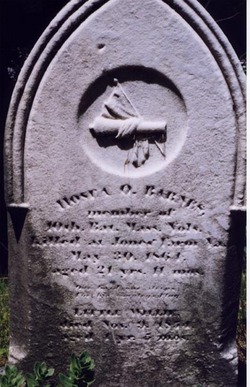
A marble tablet, erected over his remains in the Hingham cemetery, bears the inscription:––
HOSEA O. BARNES
member of 10th Batt., Mass. Vols.
killed at Jones' Farm, Va.
May 30, 1864
Aged 21 years, 11 months.
-------
Our Loved One Sleeps
For His Country's Flag


Tombstone of Hosea O. Barnes and Little Willie,
Hingham Cemetery, Hingham, Massachusetts,
FindAGrave.com, memorial n. 2012533, added by MP, 27 Jun 2007;
(www.findagrave.com : accessed 28 May 2012).
I located a History of the 10th Battery, Mass Light Artillery, 1862-1865 online and it has a description of Hosea's death, but it is not as detailed as the one I found on a website dedicated to Hosea back in 2001. You can reach it via the Wayback Machine at:
http://web.archive.org/web/20080217210820/http://home.earthlink.net/~mmp2000/index.htm. The author was Mary Powers. She said:

It was high noon when three Union soldiers scrambled over the works to clear away brush that obstructed the view of the gunners. A single shot rang out from a rebel sniper's gun and found its mark. Private Hosea Orcutt Barnes lay mortally wounded from a Minie ball. He was just one month shy of his 22nd birthday...As reported in the battery's history written in 1909: "It was Hosea O. Barnes, Number Three man on the Third piece. One of his companions lifted him up and bore him into the breastworks, but he was rapidly entering the valley of shadows. ‘I am about gone,' were the last words that passed his lips. Shrouded in his shelter tent he was laid in a grave dug near by, and the spot marked by a hastily carved board placed at his head. His death cast a deep gloom over the Company, for his many good qualities as a soldier, notably his genial temperament and good humor, had made him a general favorite."

26 May 2012

Elizabeth Warren's Ancestry a Problem? Meh!

Someone asked me what I thought about the whole kerfufflement over Elizabeth Warren's ancestry. I've been really busy lately, and haven't read deeply on the issue, but here goes.

I'm not well versed in Native American ancestry, but I don't even think that's the issue. There are lots of descendants of Native Americans today that don't look have the stereotypical "look", and therefore don't suffer discrimination based on race. So theoretically they shouldn't be entitled to benefit from affirmative action policies. But it doesn't mean their ancestors didn't suffer disadvantages. Elizabeth Warren does not appear to be disadvantaged in any way, but there are lots of reasons why one still would want to claim that ancestry other than milking the system: pride being foremost among them.

I've been too busy to follow it closely, but from skimming reports, etc. it seems as though Warren and Harvard used this label to perhaps satisfy some quota. So big deal. Not the best idea, but did this take anything away from a "real" Native American? I don't see how it could have. I'm not sure, but suspect that affirmative action has a double purpose: make up for past transgressions and give a leg up to people still suffering. Part of the beauty of affirmative action is being played out right here. It undoes the stigma attached to a group of people and moves everything back towards equilibrium.

I know Warren has been mocked because of the "high cheekbones" comment. Hello, we genealogists call that a family myth. Is she just lying? I don't actually care, because I do not think it indicates anything evil in her character. I'd so much rather talk about critical issues. The high cheekbones comment is simply the basis for future research: one clue in thousands to help us figure out the ancestral trail. The general public, including Harvard, has no freaking idea on how to prove such a claim. There are deserving Native Americans who cannot claim membership in a tribe because the tribes are extremely picky about who they let in, and rightfully so. But that does not mean that those individuals do not have Native American blood. It's just a very complex issue that cannot be distilled down to a sound bite. Or a paragraph.

So what percentage of ancestry qualifies you to call yourself black, white, Native American? Why is Obama always thought of as black? His mother was white! He's neither and both, something the press can't seem to handle. People assume I'm Irish because of my FitzGerald maiden name, and although my grandfather was an Irish laborer straight off the boat during "Irish need not apply days," my mother's ancestors came over on the Mayflower. There are just as many family stories about freckle-faced redheads indicating Irish ancestry, or platinum blonds revealing Scandinavian blood, short people being Pygmies (kidding). It doesn't mean she's evil if she believes her mother's stories about family. That's where we all start out. Family tradition. I'm Irish. And I'm a blue-blood. And I'm descended from kings and peasants.

Summing up, I think it is a non-issue and wish it would just go away. That fact that she's a blue-eyed blonde is irrelevant. I do kind of like it that today people are fighting to prove that ARE Native American. Makes a tiny dent in the horror that has been inflicted upon people for their race/religion/sexual orientation. If it can help balance the universe and help us let go of these labels, I'm all for it. And to Elizabeth Warren I'd just like to say I know the best Native American board-certified genealogist in the country and would be happy to refer you to her!

18 May 2012

"I Begun to Learn Latin Latter End of the Year 1763"


[Continued from "I Call to Mind My Parent Dear": Isaac Stone's Tribute to His Mother


This is the last installment of Isaac Stone's beautiful manuscript on his family history. It's not addressed to anyone in particular, so I wouldn't call it a letter. It's more about his relatives than himself, so not really autobiographical, either. Yes, I guess it is notes on his family history: almost a compilation.

I took to my software program (newly updated Reunion for Macintosh, v. 10) and created a tree using only the information in his letter, and only if I was sure of what he meant. The relationships in this portion of his work are not always so clear, so I left a bunch of them out altogether. I resisted the temptation to check it all via the published vital records, and will leave that to anyone who really wants to pursue Isaac and his family, or for another time.


p. 8 [cont.]


My Father mar.d to Miss Anna Parker Feb. 28. 1788. __
My children. Mos. born March 2. 1774. Mard Nov. 6. '94.
His child.n Jonas_ June 6. '93. Died Sept. 30. '95. Sukey Feb. 19.
'92. Moses Died, in the morning, May 10. 1803. ~
~ Sukey – Sept. 14. 1776. Luke Rice _ Aug 10. '78. Jonas _
Nov. 17. '79. Died, Nov. 19. 48 h. old. Grace Nov. 28. '81.
Submit. G. July 6. '88. ~ My sis Lydia inft. Mar. '50.
Died Jan.    '60. ~ Rachel_Oct. 20. '54. Mard Sept. 3. '84.
Racl Rice_[Nye?]_Sept. 4. '85. Elisab. Feb. 4. '87. Olive___
June 26. '88. Mary, Sept. 21. '90. Lydia _ May 1. '93.
Jonas _ Ward _ Decr '95. ~ Sis. Parer, Lydia 2nd
Mar.     '61. 1Sally_May 4. '84. '84. Died, Mar. 27. '803.
2Lydia_       '86. 3Lucy June      '88. 4Luke '90
5.Jonas_ Friday, Oct. 25. '92. 6Simn Mar. 11. '95.
7[Scratched out then faint overwrite of Phebe] '97. 8[Phebe scratched out and Mars? overwritten, faintly] April.   1800.
9Asa_ Oct. 13. 1802. 10 [^illegible addition] Stillman. 11. [Eb. Druids?]
///////////////////////
L.R.S. Mard to N.S. June 24. 1804. Nabby Taft_
_Jan. 14. 1777. Now, N. Stone. Moses their son___
May 2. 1805. Na[t/b] Stone Sept. [20]. 180[4/9].
////////////////////////////////////
Susanna Goddard born August 4 O.S. 14. N.S. [^1744]
Marrd Oct. 27. 1773. I begun to preach about 14.
of Oct. 1770. _ Came to Douglas, Mar. 30. preached
first at Doug. Mar. 31. 1771. Ordained Oct. 30. 1771.
I begun to learn Latin, latter end of the year 1763.
Joined the ch'h in Shrews. June or July '64 being
16 years the Mar. before. Studied [^with] Mr Sumner
next winter. abt. 17 '65 I went to Mr. Payson's__
'66, July after I was 18. I [??, ink blot] College. Isaac Stone.


p. 9

[accounts]


Douglas, 1807. George Riedel Dr

   Horse to Providence, cr 1 day.
x Mr. G. Briggs Horse + Hey
twice to Sutton    in 1807. + 1808
Mr Saml Smith, Dr 1807.
Horse to Uxbridge_ + Buck Hill_
Mr. Hunt unwilling to pay__
Mr. Clar[kson?] Hunt had my horse
several times + paid. But Decr
1805. He had my horse to Mendon.
It was to have been paid by [^Mr] Oliver
Flint_ it was not _
Febry 1808. Mr. Simeon Marsh
   had my horse + Sleigh to Worcester
Mr. Stoddard had my horse to
Uxbridge. all which I wish may
be paid to Luke R. Stone.
April 16. 1808      Isaac Stone.


p. 10
Freeborn White had my
[???] Freeborn White had
my horse _ _ March 1808.
[Bottom of page, upside down]
Luke? April 16, 1808


This chart comes out very tiny here, but gives you an idea of how much information Isaac provided!


This is the end of series on Isaac Stone article. For other posts in the series, please see:

16 May 2012

Isaac Stone's Paternal Ancestry

Continued from Sensible of His Own Vileness: The Battle for Isaac Stone's Immortal Soul, posted 11 May 2012*

Isaac traces his paternal ancestry back to early Cambridge, Massachusetts.

p. 3 (half of page: image in previous post)

My Grandfather's Father, Nathanael
was the Son of John Stone, an Elder in the
church in Cambridge, N. E. Probably, while
Mr. Shepard, Mr. Mitchel + President Oakes mi-
nistered there. Likely, his gravestones [sic, that would be a headstone and footstone] are yet
legible, in the burying ground, near the Col-
lege. GrandF Stone's [^Mother's] maiden Name was Waite,
Elder Stone + his son Nathanael lived to


p. 4
be old: the elder had two brothers settle at Lex-
ington, then Cambridge Village.
   My GrandMother Elizabeth Stone was born
Nov. 1696 - died 1792. - aged more than 95 years:
In Shrewsbury. In her prime she was a
prudent, resolute, sensible woman + a tender
mother. Her father was Mr. Brown of Sud-
bury: her mother Miss Abigail Haynes: Mr.
Brown's Grandfather came out of England:
his wife's Grandfather Hayes came in the
same ship. Each had a son with him, who mar-
ried to two young women who came in the
same ship. These two couples were the parents
of Mr. Brown + his wife; grandparents to
My Gr.Mother Elis. Stone.
   I affectionately remember my dear Mother,
+ her relations. Her father [^Luke Rice] was born at Marlboro' Mas.
Nov. 30 1689. Died suddenly, June 8, 1754:
in Shrews. age 64 + 6 mo.- was reputable,
Town clerk + c. Her mother, Rachel Rice
was born at Marlboro' Feb. 14 [old stile] 1690. Died at
Shrews. Feb. 12. 1780. N. Stile. age 90. Maiden name
Stow: her mother's maiden Name Stone.
Her sisters Azuibah Baker, died while her children
were young. Dinah Eager died since my mo-
ther; Her brother Hezekiah some years
before. Lydia died [^young]. My Aunts, Abigail May-
nard, Priscilla How + Sarah –. Survive.


Continued in "I Call to Mind My Parent Dear": Isaac Stone's Tribute to His Mother.


Other posts in the series

"I Call to Mind My Parent Dear": Isaac Stone's Tribute to His Mother

[Continued from Isaac Stone's Paternal Ancestry, posted 16 May 2012.]

In my previous post, Isaac had just finished describing his father's family. Here he begins on his maternal line, focusing for three pages on his mother, alone.  Two things strike me about this long passage. First, in the days before Mother's Day, children surely appreciated their mothers, just as we do now. And somehow they got by not buying Hallmark cards, taking her out to brunch, sending flowers or making keepsakes in school to demonstrate their love. No doubt they honored and respected both their mothers and fathers, or they would be in serious trouble. But I wonder if he ever mentioned to his mother how he felt about her? Did he discuss her with other people? I doubt it. You don't need Hallmark to get sentimental, as you can see from his memorialization--the feelings were there, just probably not spoken of. I suspect that then, just as now, mothers could feel the love of their children and didn't need any extravagances beyond the best gift all, a loving glance.

Sometimes people say that because death was so prevalent in earlier times, people were somehow hardened to it. Perhaps they didn't get attached to infants as early, didn't "decorate the nursery" before a child was born, but I love Isaac for making it perfectly clear that death struck an equally cruel blow two hundred years ago as it does today. Mother suffering for lost child, son lamenting loss of beloved mother, nothing can change the way our hearts react to losing loved ones. This letter is a treasure in the way that it brings out Isaac's humanity.


p. 4 [cont.]
My Mother, Raschel Stone was born at Marlbo-
rough April 2, NS. 1723. Moved with her parents
to Shrewsbury, 1737: age 14. Died April 17. 1787.


p. 5
Tues. eve. 10. o'clock. Married Feb. 1747: in a mar-
died state 40 years - - age 64. 7. 17. d. at Death.
   She was lame + feeble from her childhood;
a woman of Sorrows. Since my remembrance,
her lameness increased by a broken bone, at-
tended with anguish + exquisite pain. In
1759. In June her eldest daughter Lydia, was
sick; languishing thro' the Summer +
Autumn till Jan. 1760. By watching + ten-
ding, + by the death of her child, my mo.
ther received a shock, of which she never
recovered; tho' she had comfortable hopes,
that her little daughter was an heir of
heaven: after this She lived 27 years; but
could never promise herself enjoyments
in this world any more: willing to
wait, + to do, + to suffer her heavenly Fa-
ther's will, her great change appeared
definable in God's time. She was of a very se-
rious turn of mind while quite young; dedi-
cated herself, + made a public profession
early. She spent much time in secret meditation
+ prayer. Her mind was [best/bent] and looked, waiting
to learn Christ Jesus + holiness according to
the holy Scriptures. She deeply mourned for
her sins: abhorring all sin; renouncing
self, trusting in Jesus Christ. She constantly
took her infants with her to the house of worship.
She, watchful of her children, counseled them
most seriously with a mixture of tenderness.
Many of her pious counsels in her own hand
writing are my monitors and embalm her memory.


p. 6
She was ready to drop some pious word when
she could with propriety as long as she lived
She was provident in her family, careful +
an ingenious, industrious tayloress, curious
with her pen + needle, she employed her in-
ventive faculties + imagination judiciously.
She was a compassionate friend to all the hum-
ble + distressed. I call to mind my parent dear,
    Over her grave I weep__
Comfort! ____ Her Soul, her Mother's care,
   Tho in the dust she sleep.
From toil + sorrow ever free
   The Lord will raise the dead;
In realms of joy the blest agree
   With life eternal clad.
Monday, April 9. 1787. I wrote: "I visited my sick
Mother, last monday: found her in extreme pain
+ distress; waiting earnestly for her change. I was
filled with sorrow at seeing my kind parent in
such a wasted, distressed + low estate. She has ever since
my remembrance appeared to be a woman
of piety, always showing regard to God + to His in-
stitutions; expressing her dependence upon Christ
alone for Salvation. ___ She told me she had se-
cretly given me up [^to GOD] after I was born + before. __
I bless God for her earnest cries to Him for me:
+ for her pious care for me ever since I have had
an existence. I hope my parent's solemnly dedicating
me to GOD, their instructions, prayers + example
have been sanctified to me. Upon her death bed,
in the near [^view] of death, my Mother told me, she had
often cried to God, that I might be sanctified from
the womb. __I hope her prayers have been XXXXXX


p. 7
answered. May these considerations deeply affe[ct]
my mind, to excite me to strive to answer the
pious concern + expectations of [^my] Parents; that
I may be instrumental in promoting GOD's Glory.
The advancement of His kingdom, + the conver-
son of many Souls. __ If my mother is yet a-
live, I desire affectionately to commend her in
to the hands of GOD, thro' or Redeemer: GOD,
[alsoficient?] is our only hope. In extremity we
may safely trust in Him! May she have Divine
supports; when she  walks thro' the dark val-
ley of death, may she fear no evil: may thy
rod + thy staff comfort her! She has taken
her leave of us all: we leave her with GOD; hum-
bly pleading, that when death closes her eyes, all
her sorrows, grief + cares may end. May an open
+ abundant entrance be ministered to her into the
joys of her Glorious Redeemer. Weaned from the
world + from all its pleasures. She longs to be
with Jesus, I pray Thee, O my GOD, afford her Grace,
patience, hatred of Sin, self-denial, + to do, +
to suffer the whole will of God, until, full of love
to holiness, she shall be presented faultless + blame-
less before GOD, in chimes of boundless bliss, where
there is no sin, pain, nor Sorrow; but her Soul
shall eternally rest in God her Redeemer:
"April 22. '87. My Mother died Apr. 14 eve. 10 o'clock.
Her last words were, "I see the truth clearer than
ever." She bid my Father, "Farewell!" When he
asked her, if her faith held out? she answered, "yes."
How religion, how faith bears the Spirit up, un-
der most pressing pains + distresses? What a re-
commendation of religion, when its professors
p. 8
hold out to the end of life, + appear supported
by it, in distressing hours, in near views of Death.
////////////////////////////////////////////////////////////////////////////


[continued in "I Begun to Learn Latin Latter End of the Year 1763"]


Other posts in this series


Note: All ampersands have been replaced by a + symbol because of the interference with html.